Yangtze Delta
Region in ShanghaiWikipedia
35
MENTIONS
21
EPISODES
7
PODCASTS
Search complete. 35 mentions across 21 episodes found for "Yangtze Delta".
Oct 25, 2026

speaker_0NARRATOR
As Xiongan invents itself day by day in the north, turn to the southeast and you'll find the economic engine already driving the country.
speaker_0NARRATOR
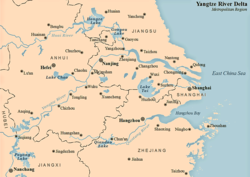
It is the Yangtze River Delta, the commercial powerhouse surrounding Shanghai and neighboring provinces.
speaker_0NARRATOR
Occupying a modest 4% of China's land area, the region at the mouth of China's longest river is home to about 17% of the country's total population and contributes about 25% of its total GDP.
speaker_0NARRATOR
It's one of the most economically dynamic, open and innovative areas in China.
speaker_0NARRATOR
In 2018, during the first China International Import Expo in Shanghai, Xi Jinping's speech envisioned a new chapter for the region.
Xi JinpingSOUNDBITE_SPEAKER
The three cities will support the unification and development of the Yangtze River Triangle and rise as a national strategy.
Xi JinpingSOUNDBITE_SPEAKER
We will support integrated development of the Yangtze River Delta region.
Xi JinpingSOUNDBITE_SPEAKER
We will make it a national strategy and implement our new development philosophy in real earnest.

Wen JiHOST
In Jiangsu's coastal city Qidong, fishing vessels have been ordered to remain in port until the strong wind alert is lifted.
Wen JiHOST
The typhoon has also disrupted rail services across the Yangtze River Delta.
Wen JiHOST
Yemen's Houthi group and the Saudi-led coalition have exchanged heavy attacks.
Wen JiHOST
The Houthis claimed widespread missile and drone strikes across Saudi Arabia, while intense Saudi-led airstrikes wrecked Houthi-held areas in Yemen, causing multiple casualties.
TianluHOST
In Jiangsu's coastal city Qidong, fishing vessels have been ordered to remain in port until the strong wind alert is lifted.
TianluHOST
The typhoon has also disrupted rail services across the Yangtze River Delta.
TianluHOST
Israeli forces have launched military raids in the West Bank city of Hebron just days before an Israeli election.
TianluHOST
The operation began after Israeli Prime Minister Benjamin Netanyahu threatened a major offensive in the occupied territory, which he said will be unlike any carried out since the 1967 Middle East war.
TianluHOST
In Jiangsu's coastal city Qidong, fishing vessels have been ordered to remain in port until the strong wind alert is lifted.
TianluHOST
The typhoon has also disrupted rail services across the Yangtze River Delta.
TianluHOST
A preliminary assessment of the area affected by the earthquake that hit Shuzhan on Thursday shows the risk of large-scale collapses and landslides is relatively low.
TianluHOST
But secondary hazards still warrant close attention along some steep slopes and road sections.

Gary MannersHOST
Earlier work on its hydraulic system, and newer research into unusual mortuary practices such as systematic human bone modification, show a society whose organization extended well beyond its famous jades.
Gary MannersHOST
The archaeological ruins of Liangzhu City, dating back to 3300-2300 BC, are a testament to the ancient urban civilization in the Yangtze River Delta of China.
Gary MannersHOST
A new funerary landscape.
Gary MannersHOST
If future excavation finds hearths, food remains or household rubbish, the buildings may prove residential rather than ceremonial.

Chris StewartHOST
Also, the bureau designated by Hong Taiji to handle border affairs with the Mongols, the Lifanyuan, which was staffed by Manchus and Mongols, but not by Han Jinshi, was elevated to a status parallel to that of the six ministries and thus placed ahead of the censorate in the metropolitan bureaucracy table of organization.
Chris StewartHOST
In related moves designed to highlight the importance of Manchu tradition as opposed to the Jinshi, tax-delinquent landowners in the Yangtze Delta were fined, often after draconian investigations, the number of Jinshi examination degrees awarded was drastically reduced, the eight-legged essay system was abolished, and the forms of bureaucratic elevation were altered to give more power to the regents in assessing career performance.
Chris StewartHOST
Despite the consistency of many of the regents' proposals for strengthening elements of Manchu presence within the Qing polity, the regents themselves seldom acted in concert.
Chris StewartHOST
Their backgrounds and lineage connections were different, and their characters varied greatly.
40 MINS LATER
Chris StewartHOST
His initial informal education in Jinshi language was received from the eunuchs and serving women, but he chose to undergo rigorous training as he began to rule.
Chris StewartHOST
The Sixteen Moral Maxims that were issued in 1670 in the young emperor's name may have been drafted for him by Jinshi advisors, but the meticulous reports of his earnest sessions with a series of classical scholars as they worked together, line by line, through each of the major Confucian classics should not be taken as hyperbole or hypocrisy.
Chris StewartHOST
Rather, they were part of the same policy that led to his convening of the special Bosui Hongzhu examination of 1679, the balancing of provincial and metropolitan appointments between Manchus and Jinshi, and the planning of the Six Southern Tours to those areas of the Yangtze Delta that had been most famous for resistance in the 1640s.
Chris StewartHOST
The imperially sponsored scholarship during the Kangxi reign was of high quality.
Chris StewartHOST
Rather like the Red Flag Fleet pirates we've discussed previously, it was an amalgamated brotherhood of loosely aligned secret societies with a somewhat less strict interpretation of the law than the authorities themselves.
Chris StewartHOST
Likely founded by Fujianese immigrants to Taiwan, and emerging sometime during the early Qing, over the course of the 18th century, the triads franchised themselves out back to Fujian, along then with Guangdong and Guangxi, and by the early 19th century, had spread to the Yangtze Delta provinces Jiangsu, Zhejiang, and Anhui.
Chris StewartHOST
From Mann, quote, End quote.
Chris StewartHOST
It was, first and foremost, a profit-seeking business operation, but it also served as a kind of focal point of allegiance for any number of other disparate bandits or pirate gangs who might want to brandish a much more fearsome name regardless of actual association.
Chris StewartHOST
This same agenda underpinned Kangxi's launch of the special Boshui Hongru, or the Broad Learning and Great Virtue, examination in 1697, aimed at recruiting erudite scholars.
Chris StewartHOST
It also informed his careful balancing of provincial and central governmental posts between Manchus and Han Chinese, and the orchestration of six symbolic southern tours to the Yangtze River Delta, once a hotbed of resistance to Qing rule throughout the 1640s.
Chris StewartHOST
Under Kangxi, imperial scholarship reached a high level of sophistication.
Chris StewartHOST
Although the official history of the Ming dynasty was plagued by delays and political disagreements, other literary projects progressed smoothly.
Chris StewartHOST
Though 36 out of the 188 invited, including such famous names as Tu Yue and Fu Shan, managed to evade the honor or use the opportunity to meet in private with like-minded scholars who resented or even hated the Manchus, and some eminent scholars like Gu Yanwu and Huang Zongxi were able to ensure that they were not asked to participate, all of the 50 who were successful at the examination became officials for the new dynasty.
Chris StewartHOST
The Bosui Hengzhu examination was directed at those in the Yangtze Delta region, which was the center of scholarly endeavors and where much of the initial resistance to the Qing conquest had been concentrated.
Chris StewartHOST
Almost half of the 50 successful candidates, 23 exactly, were from Jiangsu, and an additional 13 were from Zhejiang.
Chris StewartHOST
The Bosui Hengzhu examinations, it should be said, did not solve all of the problems either with the loyalists or with the analytical difficulties of Ming historiography.
11 more episodes mention Yangtze Delta.
Create an account to see the whole feed, search across every transcript, and follow the entities you care about.