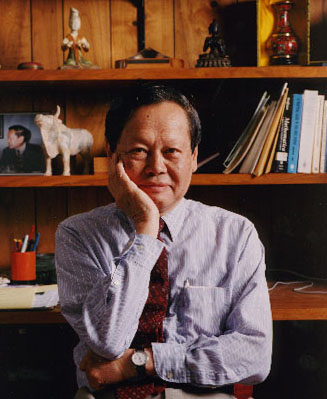
Yang Chen-Ning
Chinese physicist
12
APPEARANCES
1
PODCASTS
Nov 7, 2026
speaker_0MODERATOR
Now,

Chen-Ning YangGUEST
B, there were experiments, especially, there were many non-accurate experiments, which showed right, left are quite symmetrical.
Chen-Ning YangGUEST
And in experiments related to chemistry, related to biology, the physical laws are always exactly symmetrical.
Chen-Ning YangGUEST
And in addition, about the new kind of phenomena that came into physicists' attention in the 20th century, namely radioactivity, there were hundreds, if not thousands, of experiments which showed that right-left are symmetrical.
speaker_1MODERATOR
that night?
speaker_0MODERATOR
So can you mention something about your first interactions with Jim Simons, which I understand were not in mathematics?
Chen-Ning YangGUEST
When I came to Stony Brook, Stony Brook's math department, I was told, was nondescript.
Chen-Ning YangGUEST
Jim, as you know, is a very brilliant mathematician, but also he's a great entrepreneur.
Chen-Ning YangGUEST
He apparently, after his PhD, has gone to do some business in South America somewhere, and then he came back and...
7 MINS LATER
speaker_0MODERATOR
in the wall.
speaker_0MODERATOR
What comments?
Chen-Ning YangGUEST
Unfortunately for him, his greatest contribution to physics was not yet recognized as important at the time that he passed away.
Chen-Ning YangGUEST
He did many things in physics, all of which were good papers, but except for that one, he did not make the, I would say, the really first-rank physics research contribution.
7 MINS LATER
speaker_0MODERATOR
dramatization or a documentary?
speaker_1MODERATOR
Can you comment about why what to most people must have been almost as surprising as parody, non-conservation?
Chen-Ning YangGUEST
The institute has only about 20 professors, and among which the mathematicians form the largest and the most prominent group internationally.
8 MINS LATER
speaker_1MODERATOR
More in the Princeton style.
speaker_1MODERATOR
Can you comment on that situation, on how you think about this all these years later?
speaker_1MODERATOR
true.

speaker_1MODERATOR
Can you comment on that particular period when these, what this meant to you and what it might mean to China?
Chen-Ning YangGUEST
After my first trip in 1971, I realized that there is something that I should do because I think I know both countries.
Chen-Ning YangGUEST
I have attachment to both countries of long periods and I love both countries.
Chen-Ning YangGUEST
And at a time when the two countries are first, not on speaking terms, and second, not understanding each other.
speaker_1MODERATOR
by the statement.
speaker_0MODERATOR
Which do you think are the fields or the areas that are likely to lead the way into the next century? Do you think physics will remain as important as it has? Will biology just continue to grow in importance?
Chen-Ning YangGUEST
First, 20 years ago My feeling about the answer to your question has changed from 20 years ago.
Chen-Ning YangGUEST
My idea was that all of these problems will gradually be solved by new technology.
Chen-Ning YangGUEST
Yes, new technology would create new problems, but by and large, the productivity of the world would, on average, increase.
Chen-Ning YangGUEST
In other words, technology would overcome not only its own shortcomings, but all the accumulated problems.
speaker_0MODERATOR
I know that there are the questions about health care,
speaker_1MODERATOR
What are your hopes and concerns for the future, given this great moment and great changes of the historical nature that have taken place? Well, you
Chen-Ning YangGUEST
First, I have to tell you, one day after my marriage with Fan Fan, a correspondent in Taiwan asked me, how do you feel being married to a person so much younger? I said, one of the things I realize now after the marriage is that because Fan Fan is so much younger than I, She's going to live way beyond the date when I'm gone.
Chen-Ning YangGUEST
I think the 21st century will be a very difficult century, especially because it's clear that China is emerging as a world power.
speaker_1MODERATOR
There's a
speaker_1MODERATOR
Would you describe your education as being Chinese education or a Western education from the scientific point of view?
Chen-Ning YangGUEST
And there was a great debate in China, starting at the beginning of the 20th century, of how much Western culture should be imported.
speaker_1MODERATOR
Would you like to make some comments about the Shaw Prizes and what you see as their role?
Chen-Ning YangGUEST
Renren Shaw came from a family that was sort of a small movie theater operator in Shanghai.
Chen-Ning YangGUEST
And apparently, Reverend Shaw and his brother had some old-style movie projectors.
speaker_1MODERATOR
What was Chairman Mao—well, I hate to say what was he like, but what was it like meeting him? What was it like to go into the office? What was the scene like?
Chen-Ning YangGUEST
I had read a lot about Chairman Mao, of course, before I went, and he's a very good poet.
Chen-Ning YangGUEST
He was a remarkable person because one of the most famous poems of his It's called the Ode to Snow.
9 MINS LATER
speaker_1MODERATOR
one of
speaker_1MODERATOR
So perhaps you could recall a story you told me recently about your first trip to China, how you got the idea that here it was, 1972 perhaps, and how you came to realize that you might be able to take that trip, and then what happened, how you met Zhou Enlai, eventually Chairman Mao.
Chen-Ning YangGUEST
You know that China and America fought this devastating Korean War, and then there were conflicts also in Vietnam.
Chen-Ning YangGUEST
So by late 1969, Chairman Mao and the Premier Zhou Enlai were very worried about the relationship between China and the Soviet Union.