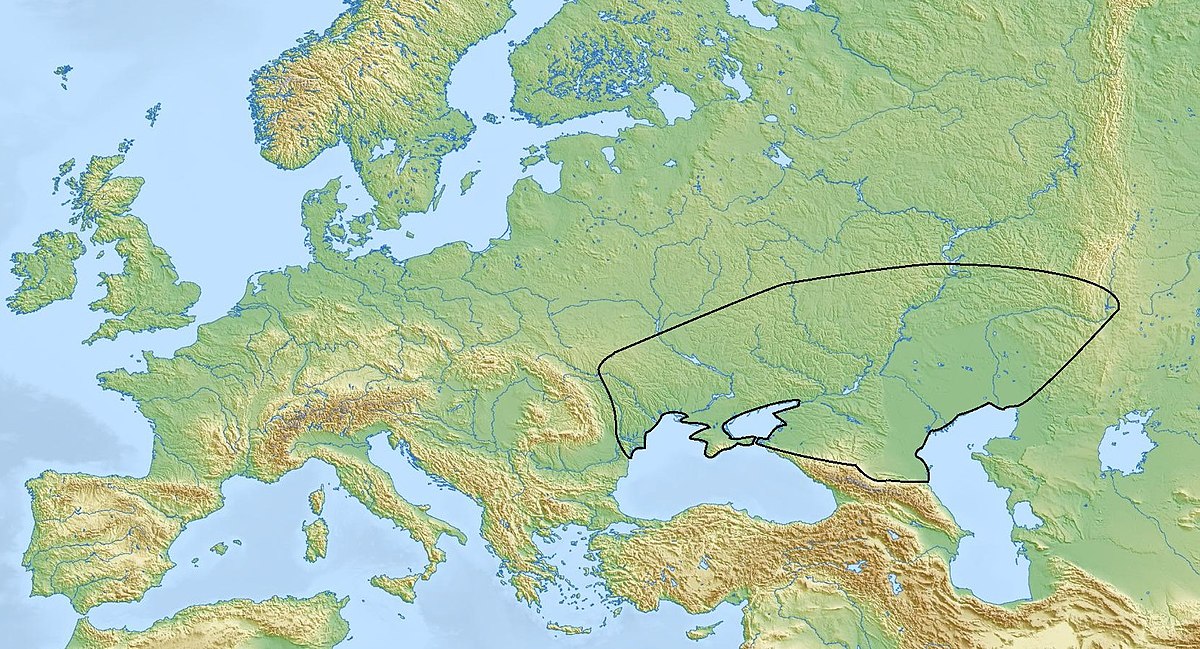
Yamnaya culture
102
MENTIONS
13
EPISODES
12
PODCASTS
Search complete. 102 mentions across 13 episodes found for "Yamnaya culture".
Sep 23, 2026

Timothy SnyderGUEST
But what's interesting is that end of the Ice Age, agricultural revolution, and then you get two different urban revolutions, one in Mesopotamia and, and, and one in Ukraine.
Timothy SnyderGUEST
And of course, the, the first major confrontation between people who settle and people who move takes place right then, um, between the Trypillia, who have lots and lots of towns, including some big ones, and the Yamna, who are coming from the east across those rivers, who are pastoralists.
Timothy SnyderGUEST
And you're absolutely right.
Timothy SnyderGUEST
Like, that, that moment of encounter between people who settle and people who move across the land is very important.
Timothy SnyderGUEST
We are settled literate people, and so our propaganda is generally against the nomads, and we see them as being destructive and alien and backward and so on.
Timothy SnyderGUEST
But historically speaking, the nomads very often brought things.
Timothy SnyderGUEST
So in the case of the, the Yamna, there's a very strong example of this, maybe the strongest in the history of humanity, which is that they, they seem to have brought the, the Proto-Indo-European language, which then becomes the basis of the language that you and I are speaking now, also the basis of Ukrainian, the basis of languages that are spoken around half the world.
Timothy SnyderGUEST
So yes, that, that moment of encounter is also very important, but there are also-- there are moments of encounter which are across the ocean, or sorry, across the Black Sea, like the Greeks meeting the Scythians, which is also very fruitful.

Timothy SnyderGUEST
And, of course, the first major confrontation between people who settle and people who move takes place right then between the Tripilia, who have lots and lots of towns, including some big ones.
Timothy SnyderGUEST
and the Yamna who are coming from the east across those rivers who are pastoralists.
Timothy SnyderGUEST
And you're absolutely right, like that moment of encounter between people who settle and people who move across the land is very important.
Timothy SnyderGUEST
I would note that it is very often creative rather than destructive.
Timothy SnyderGUEST
But historically speaking...
Timothy SnyderGUEST
the nomads very often brought things.
Timothy SnyderGUEST
So in the case of the Yamna, there's a very strong example of this, maybe the strongest in the history of humanity, which is that they seem to have brought the proto-Indo-European language, which then becomes the basis of the language that you and I are speaking now, also the basis of Ukrainian, the basis of languages that are spoken around half the world.
Timothy SnyderGUEST
So yes, that moment of encounter is also very important, but there are moments of encounter which are... across the ocean, or sorry, across the Black Sea, like the Greeks meeting the Scythians, which is also very fruitful.

Rebecca MitchellHOST
There are two major hypotheses.
Rebecca MitchellHOST
There's the step hypothesis, which places the homeland somewhere on the Pontic-Caspian steppe, north of the Black and Caspian Seas, and this is broadly associated with the expansion of steppe pastoralist societies, particularly the archaeological cultures collectively associated with the Yamnaya horizon.
Rebecca MitchellHOST
According to this model, Indo-European languages spread westwards into Europe and eastwards and southwards towards Central and Southern Asia, as populations expanded and interacted with existing communities.
Rebecca MitchellHOST
The main alternative is the Anatolian hypothesis, which places the homeland further south in Anatolia.

ScottHOST
Again, perhaps the most familiar classical example is the Roman seizure of the Sabine women.
ScottHOST
It's possible that the Yamnaya themselves began as the young warband of some clan or tribe, driven off to find a new home.
ScottHOST
If so, they were reasonably successful, considering millions of modern people carry their genes and billions speak some version of their tongue.
ScottHOST
Between 3300 and 3100 BC, two groups of Yamnaya headed off in opposite directions.
ScottHOST
These weren't little forays or fact-finding ventures.
ScottHOST
They were honest-to-deuce-potter major pilgrimages.
ScottHOST
What we do know is that these departures gave birth to the earliest daughters of the Proto-Indo-European language.
ScottHOST
And just a quick note for those in the know, the understanding of the Anatolian branch has recently changed in the face of genetics, so I'll cover the spread of those languages later this season.

Jason PackHOST
I want to now get to these Indo-European speakers.
Jason PackHOST
are the first ones what you call the Yamnaya.
Jason PackHOST
And what was their cheat code? Was it that they had access to bronze and that was the petrol of their day, this geostrategic resource? Or was it that they had a certain technology, metallurgy, that allowed them to dominate and produce goods that others wanted? What was it that they invented?
Laura SpinneyGUEST
Okay.
Laura SpinneyGUEST
So the language that gave rise to all the living Indo-European languages, I'm going to call it Proto-Indo-European, and it's thought now the consensus amongst the historical linguists and the archaeologists and the geneticists is that it arose on the steppe north of the Black Sea or between the Black Sea and the Caspian Sea around about 5,500 years ago, and that it was spoken by these people We define them by their archaeological culture, and that's an important distinction.
Laura SpinneyGUEST
We call them Yamnaya, which is a Russian word, and it means pit grave, literally.
Laura SpinneyGUEST
And they are defined by their burial rite.
Laura SpinneyGUEST
And they had a very distinctive burial rite, at least at the beginning, where they would lay their dead on their back with their knees raised with some grave goods, very often under an urban mound, which in that part of the world is called a kirgan.

Arum NatzorkhangGUEST
Celtic and Italic languages like Latin form this super family called Italo-Celtic, and that's just a branch of Indo-European.
Arum NatzorkhangGUEST
Now, in terms of when the split started, so at that we're going to have to go around 6,000 years back in the future, 6,000 to 8,000 years ago in Ukraine, and we're going to have to analyze a a burial mound culture called the Yamnaya culture.
Arum NatzorkhangGUEST
Now the Yamnayas were very quirky girl boss culture because they were, and we can say this with definitiveness, they were the first peoples to use wheels in vehicles.
Arum NatzorkhangGUEST
Now, granted, there were cultures, you know, both in the old and new world that utilized wheels in some fashion.
Arum NatzorkhangGUEST
You know, we have water wheels in Mesoamerica, for instance.
Aidan MattisHOST
Yes, that
Arum NatzorkhangGUEST
was very much needed.
Arum NatzorkhangGUEST
Now, these people, these Yamnayas, these Indo-Europeans, spoke Proto-Indo-European, which is the common ancestor, as we all know, to the languages that we're oh so familiar with today, such as Latin, Greek, Irish, Old English, Gothic, Afrikaans, Hittite, Old Persian, Sanskrit, Russian, Farsi.

Travis RoyGUEST
And they still could carry those traits.
Travis RoyGUEST
So you have, I think one of the reports was like, it was 60% Asian and like 40% or something like that of the Scythian, which that's, if you look at the, so there is a, when I was looking at all these cultures, there is a group called the, you go back quite a ways to the, it's called the Yamnayas.
Travis RoyGUEST
And that's a culture where all these came from.
Travis RoyGUEST
So the Scythians came from them.

speaker_1ADVERTISER
or medieval Europe, or the Persian
BrantGUEST
Wars, or these are the campaigns of Julius Caesar, or this is when the Yamnaya in the Russian steppes and the other tribes first built the first chariots and domesticated the horses.
BrantGUEST
And they had carnivore diets, and they did all these things.
BrantGUEST
To the best of my knowledge, this is what happened.

Timothy C. WinegardGUEST
So eventually we domesticate these horses 3500 BCE and according to some anthropologists and archaeologists, we likely saved the horse from complete extinction across the planet by, you know, reining them in from domestication or from extinction with this domestication.
Timothy C. WinegardGUEST
So the Yamnaya culture or in what we know as Indo-Europeans were the first and only people to domesticate the horse.
Timothy C. WinegardGUEST
It's a single site origin domestication, we think.
Tyrell Cameron EskelsonHOST
Yeah, I found that really interesting that by domesticating the horse that human beings likely saved it from extinction.
Timothy C. WinegardGUEST
There's new theories that it might have come out of Turkey.
Timothy C. WinegardGUEST
the original, original, like proto-Indo-European, came out of Anatolia and then came north as a dialect into the Caspian and Pontic-Caspian step.
Timothy C. WinegardGUEST
Or it originated itself in the Pontic-Caspian step with the Yamnaya culture or Indo-Europeans.
Timothy C. WinegardGUEST
But at the end of the day, it doesn't really matter because the extended spread of Indo-European or Proto-Indo-European was a direct repercussion of the domestication of the horse.
3 more episodes mention Yamnaya culture.
Create an account to see the whole feed, search across every transcript, and follow the entities you care about.