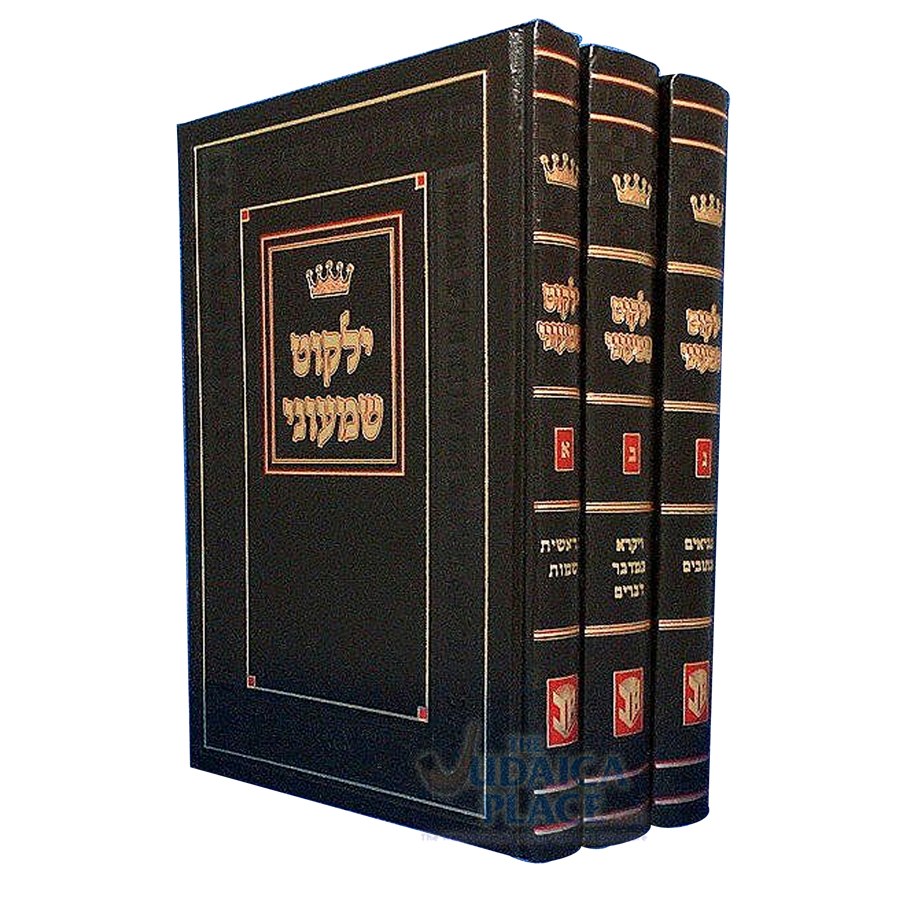
Yalkut Shimoni
BookWikipedia
13
MENTIONS
9
EPISODES
7
PODCASTS
Search complete. 13 mentions across 9 episodes found for "Yalkut Shimoni".
Sep 14, 2026

Harry AmdurerHOST
Some Midrashim here see a positive message in this verse as well, as well as the obvious negative ones.
Harry AmdurerHOST
There's a Medrash in Devorim, Sifrein Devorim, there's a Yalkut Shimoni in the Torah, and there's a Medrash Tanoyim on Devorim.
Harry AmdurerHOST
I won't go through them all with you.
Harry AmdurerHOST
I just want to mention the idea that they all bring out here of a positive message from this verse.

Shlomo YisraeliHOST
And he was the one that says, you have to read it.
Shlomo YisraeliHOST
this way, not this way, it means that your Averot has been weighed, and HaKadosh Baruch Hu is taking away the Malchut from you and giving it to the Parsayim, to the Madayun Paras, and that night, basically, the Babylonian Empire fell overnight, transfer of power to Koresh and Dari Avesh, which according to Yalkut Shimoni, this is just a bit of history that many people don't know, so I'm kind of like opening larger parentheses, going on a tangent, but it's important to know these tangents.
Shlomo YisraeliHOST
According to Yalkut Shimoni, which is not aligned necessarily with Gemarai Maslach and Megillah, the daughter of Belshazzar, was, you know, overnight, when they're killing everyone, and they already had killed her father, she wakes up from all the tumult that was going on, and she runs to the throne of her father, jumping in the lap of who she thought was her father, but really was Daryavesh, who was already sitting there, and he had Rachmanut on her, and this little beautiful girl, who later on became the one that we know as Amalka Vashti, right, and married her to his son.
Shlomo YisraeliHOST
By the way, just another prentice within prentice, in the Persian history that we had, I think they taught it back in the day in History 1 in 10th grade, they actually say this.
Shlomo YisraeliHOST
They say exactly this, that the names they have different of Al-Hashverosh was the son, was not a stable boy, but was the son of Dari Havesh and and that's very much aligned with Yaakov Shimon.

Zvi KahnHOST
And that's why Hashem gave us the mitzvah of tshuva to completely remove not only the sins so we don't get punished for them, but also any negative aspects that the sins that a person commits that they leave an imprint in the person, a negative imprint, that also gets uprooted by the Tshuva completely.
Zvi KahnHOST
Ki d'isa b'yalkut parashas penchas, as it states in the Medrash Yalkut Shimoni on parashas penchas, b'chol ha-korbonos k'siv b'hikravtem.
Zvi KahnHOST
Regarding all of the sacrifices listed over there in Parshas Pinchas that are brought on the different holidays, it says the word, and you will offer a certain sacrifice.
Zvi KahnHOST
But here, regarding Rosh Hashanah, it's written in the Torah, and you will do the offering.

Michael RosensweigHOST
I wasn't able to get onto the printing factor here, which I might need a little bit of assistance for.
Michael RosensweigHOST
But the Elk at Shimoni, I don't know if you can call that up.
Michael RosensweigHOST
Who's in charge of the, you know, whatever this year?
speaker_1UNKNOWN
Yes.
Michael RosensweigHOST
You can do that and the Masmidim at the same time.
speaker_1UNKNOWN
Anyway,
Michael RosensweigHOST
the Yalkut Shimoni in the beginning of Parshas Vayakel has a beautiful comment.
Michael RosensweigHOST
The question is whether or not, how do you navigate the end of the comment? We'll get to that in just a second, but it's just a nice way to start, where he just points out that the phrase, v'yakel, is this idea of getting all of Klal Yisrael together, you know, for, you know, v'rmashem, emotionally more, you know, or Vayakel.
Zvi KahnHOST
If the Jewish people are sinning, then you yourself need to take a step down and need to deal with the situation, which of course Moshe Rabbeinu did, but that shows us that connection and that point makes the point that Zer HaShemshon wants to make, that Moshe's greatness and his personal characteristics came in the merit of his leadership of Chai Yisrael.
Zvi KahnHOST
V'chein hu b'yalkut, and this is also stated in the Yalkut Shimoni, al-Pasuk, on a Pasuk in Habakkuk, The Pesach says he stood and he measured the land.
Zvi KahnHOST
And the Pesach is referring to Hashem.
Zvi KahnHOST
This means that Hashem measured all of the generations.

Eli WeberHOST
But it turns out the continuation of the song is our Haftarah.
Eli WeberHOST
Says the Midrash in the Yalkut Shimoni, «Shonu raboteinu be'sha sh'HaMelech HaMashiach ba omeid al gag Beit HaMikdash», right? The Melech HaMashiach will stand on the roof of the Beit HaMikdash «Vehu mashmi'a lahem le'Yisrael ve'omer», and He says to the Jewish people, «Anavim higia zman g'ulatchem», you humble ones, the time of your redemption has come.
Eli WeberHOST
«Ve'im ein atem ma'aminim», if you don't believe me, «Re'u be'ori she'zareach aleichem», look at the light that's shining upon you.
Eli WeberHOST
«She'namar», our pasuk, «Kumi ori ki vo orech, u'chvod Adonai alayich zarach.
Harry AmdurerHOST
Just a last point here just to finish off so we can start on the next shiur on verse 33.
Harry AmdurerHOST
The Yalkut, one of the very oldest midrash in the Yalkut Shimoni on the Torah in section 946.
Harry AmdurerHOST
It's a big midrash.
Harry AmdurerHOST
This is section 946, part 9.

speaker_0HOST
L'zchos, Refuah Shleimei, Chiel Nichol, Menchai Yesara, and a zchos zivug hagon for Tzvi Yosef ben Aviva Esther.
speaker_0HOST
We mentioned in the Gulaf Alai shiur today a Mayur Dike Yalkut in Hoshea.
speaker_0HOST
The Yalkut says, he brings a mashal, that there was a big stone on the Prachas Drachim, and everyone was tripping over it.
speaker_0HOST
The king said, remove it slowly, take a little bit at a time off the stone, and I'll come in and I'll get rid of it.
speaker_0HOST
Eventually, I'm going to come in and get rid of the stone.
speaker_0HOST
Zakhdi, the Yalkut, it's in Hoshea, Zakhdi Yalkut, that the Rabbonishlam says the Yetzhar is a big stone, and he makes people trip.
speaker_0HOST
Chisel at it a little bit at a time, and then Mashiach Be'ezra Hashem will come and I'll remove it completely.
speaker_0HOST
That's what the Yalkut says.

Baruch FriedGUEST
So why would someone do it? So the Mochavit says, if you're doing it l'kadash as Hashem, it's permitted.
Baruch FriedGUEST
What's the idea of l'kadash as Hashem? So it's coming, there's a story that's brought in the Rishalmi and in the Yalkut, slightly differently, and I think you need both.
Baruch FriedGUEST
It's the story of Repinchas ben Yor, who bought a donkey, and when the students brought the donkey to him, it was discovered an avant-garde, some sort of diamond on the donkey.
Baruch FriedGUEST
And they told him, look, Hashem gave you a way of supporting yourself, supporting the Talmidim.