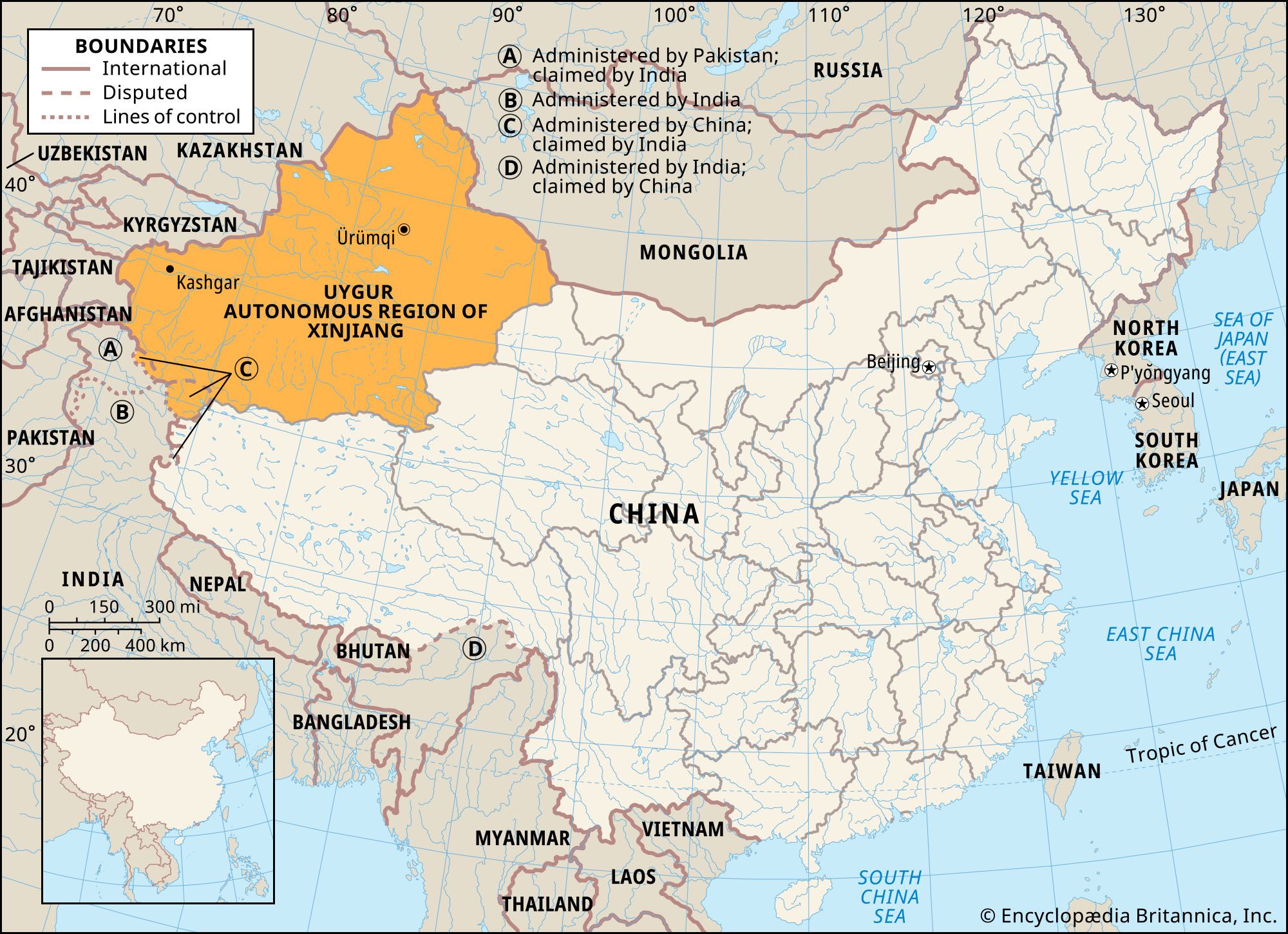
Xinjiang
Chinese autonomous regionWikipedia
752
MENTIONS
286
EPISODES
200
PODCASTS
Search complete. 752 mentions across 286 episodes found for "Xinjiang".
Oct 26, 2026

Cherish MathsonGUEST
There is what is called China-Pakistan Economic Corridor, a 62 billion investment by China in developing roads and highways and railways and ports so that China has an outlet into the Indian Ocean through Pakistan.
Cherish MathsonGUEST
all the way from Xinjiang.
Rod BergerHOST
The history and the relationships are so complex yet so simple if you step back and look at it and you look at the map of the world to understand how location means everything in the way in which we pull different levers for different outcomes.
Rod BergerHOST
My last question for you today, Lieutenant General, is just I'm curious when you reflect back on the boy that grew up in the small village, Are you more proud of your accomplishments because of what it meant to those that you care most about? Or that you as a young boy found yourself basically escaping to some level into the world as a major player and

Keegan BillingsHOST
Kai Shen Kun, a U.S.-based veteran commentator on China's economy and politics with access to sources within the CCP, told us that such authority has spread so far down the system that even the lowest level of city government can now restrict travel.
Keegan BillingsHOST
so some of the screening now spreading across the country was tested years ago in the Xinjiang region.
Keegan BillingsHOST
A 2017 handbook from the northern Xinjiang region instructed authorities to review an applicant's family bank accounts before granting a passport and required travelers to surrender their passports to local police within seven days of returning.
Keegan BillingsHOST
It also ordered relatives of those living abroad to cut ties and stop sending money.
Keegan BillingsHOST
Now that handbook is part of the Xinjiang Police Files, published by the Victims of Communism Memorial Foundation.
Keegan BillingsHOST
Adrian Zenz, a senior fellow in China Studies at the Foundation, told us that the Xinjiang region clearly has been a testing ground for repression, but it goes both ways, with methods brought in from other provinces and refined there.
Keegan BillingsHOST
He said there has been mutual learning.
Keegan BillingsHOST
In the Xinjiang region, the targets were ethnic minorities with ties abroad.

Julian WongNARRATOR
China plows ahead in Uyghur region.
Julian WongNARRATOR
Controversial Xinjiang is key to plan to expand exports, energy production.
Julian WongNARRATOR
Kashgar, China.
Julian WongNARRATOR
Four years ago, the United Nations Human Rights Agency said China's abuses in its far western Xinjiang region were so severe that they potentially amounted to crimes against humanity.
Julian WongNARRATOR
The United States limited imports from the region and blacklisted dozens of Chinese companies over growing evidence that ethnic Uyghurs were being arbitrarily detained and used in forced labor.
Julian WongNARRATOR
Global firms such as BASF and Volkswagen sold their stakes in factories in Xinjiang, while Nike and H&M pledged that they weren't sourcing products from the region.
Julian WongNARRATOR
Yet a visit by the Wall Street Journal showed leader Xi Jinping is plowing ahead in transforming Xinjiang, despite international condemnation.
Julian WongNARRATOR
In Kashgar, a historic Silk Road trading post, shopping malls were jammed, especially with Chinese shoppers and Western brands, including Under Armour and Dairy Queen.

Julian WongNARRATOR
China plows ahead in Uyghur region.
Julian WongNARRATOR
Controversial Xinjiang is key to plan to expand exports, energy production.
Julian WongNARRATOR
Kashgar, China.
Julian WongNARRATOR
Four years ago, the United Nations Human Rights Agency said China's abuses in its far western Xinjiang region were so severe that they potentially amounted to crimes against humanity.
Julian WongNARRATOR
The United States limited imports from the region and blacklisted dozens of Chinese companies over growing evidence that ethnic Uyghurs were being arbitrarily detained and used in forced labor.
Julian WongNARRATOR
Global firms such as BASF and Volkswagen sold their stakes in factories in Xinjiang, while Nike and H&M pledged that they weren't sourcing products from the region.
Julian WongNARRATOR
Yet a visit by the Wall Street Journal showed leader Xi Jinping is plowing ahead in transforming Xinjiang, despite international condemnation.
Julian WongNARRATOR
In Kashgar, a historic Silk Road trading post, shopping malls were jammed, especially with Chinese shoppers and Western brands, including Under Armour and Dairy Queen.

Federico GonzálezGUEST
So I think it's fascinating to be able to try to understand how to navigate that, as you said.
Federico GonzálezGUEST
But even, for example, you have Chinese, but Xinjiang has nothing to do with H&A.
Federico GonzálezGUEST
You talk about the U.S.
Federico GonzálezGUEST
I worked in China.

Babak HaghighatGUEST
There are vast data centers located in different parts of the country.
Babak HaghighatGUEST
And those data centers, let's say in Xinjiang province or Inner Mongolia and so on, it has made sure that they have power, say, through wind energy, solar energy, and so on, so that this kind of infrastructure has been set up.
Babak HaghighatGUEST
And this is a good thing.
Babak HaghighatGUEST
I think this is a... a forward-looking and responsible way of the Chinese planners to set up this.

AlistairNARRATOR
a century or so ago napoleon bonaparte with one of his characteristic flashes of intuition remarked of china there lies a sleeping giant let him sleep for when he wakes he will move the world the china of which he spoke was the dense mass of three hundred million human beings patiently cultivating the valleys and rich alluvial plains of eastern asia reverently worshipping their ancestors and preserving their ancient culture scorning all things foreign or novel too much absorbed in the eternal realities of work and love and children and friends and family too much accustomed to local and individual liberty and too placidly certain of the unconquerable massiveness of their race and civilization to be much agitated by the fears or the ambitions of smaller nations were much concerned by the fact that their emperor and their bureaucracy were of the alien manchu race invasions of the past had been mere pinpricks invaders were slowly but surely assimilated china was the eternal kingdom the celestial empire around which other peoples gravitated like planets in subservient orbits China proper included, besides the thickly peopled lowlands, a back country of hills and mountains, little cultivated, but stored well with unworked mineral treasures.
AlistairNARRATOR
All in all, it was a country half as big as the United States is today, but around China proper lay dependent provinces, Xinjiang, Manchuria, Mongolia, Tibet, which in themselves made up an area as large as the United States, and besides.
AlistairNARRATOR
the neighboring kingdoms of korea anam and tonkan and burma and even the island empire of japan paid tribute and homage or had occasionally done so to the great empire from which all had obtained no small part of their culture
Lady LuckADVERTISER
Hey guys, Lady Luck here.

Cliff HarveyHOST
Maybe it uses conflict minerals.
Cliff HarveyHOST
Maybe it's in some way directly or indirectly complicit in what many of us might consider an ethnocide against the Uyghur people in Xinjiang, for example.
Cliff HarveyHOST
and so that was our first real change in corporate policy to be really focused on procurement and now we obviously talk about that a little bit with our students not in terms of hey this is what we do and you should do this it's more so hey what ethos do you have as a practitioner and what ethos do you have as a business and how does that affect every decision you make and as you said luke We are trying to, we're imperfect people trying to traverse an imperfect world, right? And it's bloody difficult to get it right.
Cliff HarveyHOST
We make our mistakes from time to time.

John BatchelorHOST
He is a Uyghur.
John BatchelorHOST
He was born in East Turkestan, a.k.a. Xinjiang.
John BatchelorHOST
His name is Nuri Turkle.
John BatchelorHOST
The new book is No Escape, The True Story of China's Genocide of the Uyghurs.
John BatchelorHOST
In 1998, a young scholarly man reading and writing in two languages, Mandarin, the Chinese language, and also speaking the Uyghur language.
John BatchelorHOST
And that gives him an advantage, and he's hired...
John BatchelorHOST
in Xinjiang, in the large city, by Zhu Hailan.
John BatchelorHOST
Who is Zhu Hailan and what does Abduwali make of him in those days of late 20th century? Good evening to you.

Carlos MartinezGUEST
in terms of considering China as an enemy, right? So what do people hear about China? They hear what they read or see on news media.
Carlos MartinezGUEST
And that's, well, there's a genocide in Xinjiang.
Carlos MartinezGUEST
There's a repression in Tibet.
Carlos MartinezGUEST
There's suppression in Hong Kong.
276 more episodes mention Xinjiang.
Create an account to see the whole feed, search across every transcript, and follow the entities you care about.