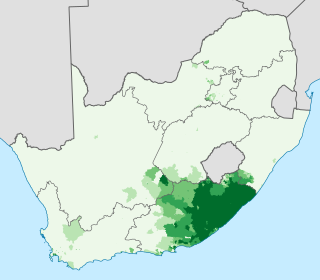
Xhosa
Spoken languageWikipedia
60
MENTIONS
33
EPISODES
31
PODCASTS
Search complete. 60 mentions across 33 episodes found for "Xhosa".
Sep 13, 2026

EsihleAUDIENCE
Batho Pele.
EsihleAUDIENCE
Sorry, I'm Xhosa.
EsihleAUDIENCE
Sorry.
EsihleAUDIENCE
[laughs] Yes.
14 MINS LATER
Mbuyiseni NdloziGUEST
So I, I just wanted to say that because this concert we are going to have, um, he didn't just write "Lizalis'idinga Lakho." He's a composer.
Mbuyiseni NdloziGUEST
We are talking to, to his ideas tonight, but he's a musician, but proper.
Mbuyiseni NdloziGUEST
He seeks to com- to translate the Xhosa Bible i- to, from English to Xhosa, which is a, a huge intellectual labor.
Macfarlane MoleliHOST
Mm.

FinnHOST
How many languages do they have there?
MiraHOST
South Africa officially recognizes 12 official languages, including Zulu, Xhosa, Afrikaans, English, and even South African Sign Language, which was added in 2023.
FinnHOST
12 official languages in one country.
FinnHOST
That is incredible.

Herman PoppleberryHOST
Over five hundred languages across sub-Saharan Africa all forked from a common ancestor, Proto-Bantu, probably spoken in what's now Cameroon or Nigeria about four or five thousand years ago.
Herman PoppleberryHOST
Swahili, Zulu, Zulu, Xhosa, Shona, Kikuyu, all forks.
Herman PoppleberryHOST
Austronesian is even bigger.
Herman PoppleberryHOST
Over twelve hundred languages from Madagascar to Easter Island.

Siyamthanda BanganiGUEST
Upon my audition, I told my agent that I'm not Zulu.
Siyamthanda BanganiGUEST
Can I try this in Xhosa? Because that's the only language that I'll be more comfortable working in.
Siyamthanda BanganiGUEST
And I'm more fluent than Zulu.
Siyamthanda BanganiGUEST
And we went with it.
Siyamthanda BanganiGUEST
And when I got to the callback with Yaku and our showrunner, Mr. Benjamin, I auditioned in Xhosa and they asked me to mix a bit of English in there.
Siyamthanda BanganiGUEST
And later on, I discovered that, oh, this character is based in Joburg, you know, because I thought initially I knew that the show was based and set here in Cape Town.
Siyamthanda BanganiGUEST
So now having it moved to Joburg, I had to learn how to also change the slang and just make it more neutral.

AbdullahAUDIENCE
Now, now, there's o- o- o- this o- o- o- one last thing I want to say to you.
AbdullahAUDIENCE
Please teach your children isiXhosa and Sepedi because their mother is umPedi weyena uNdebele.
AbdullahAUDIENCE
And then that is not here.
AbdullahAUDIENCE
It is a disadvantage for your children not to know one of the, uh, Black African language.
Aubrey MasangoHOST
[laughs]
AbdullahAUDIENCE
No.
AbdullahAUDIENCE
You, you said you know what? You once said, "I, my children, they are missing Siswati, Sepedi, isiXhosa and English." I said, "No, this man is not teaching his children to speak the language."
Aubrey MasangoHOST
Well, I mean, if you had listened to the conversation a little bit more, you would have come to understand that part of what I have committed to do is to have a place in an area where Sepedi and isiNdebele are, isiNdebele are equally spoken so that my children can go there.

Mike SharmanGUEST
And I think that I love asking questions.
Mike SharmanGUEST
So if I see a term trending online and it's in a different language, I'll say, guys, what does this Xhosa word mean? What is the thing? Tell me, educate me.
Mike SharmanGUEST
And I think this is the thing with South Africa.
Mike SharmanGUEST
I think we've all been programmed to be scared to ask a question in fear of offense.

AdamHOST
Tell us about the Nediki.
Eddie GermiquetGUEST
The Xhosa and the Zulu people know it as the Unede.
Eddie GermiquetGUEST
And then the first contact with the white folk were the Boer settlers in the Eastern Cape who were moving further away from the Cape.
Eddie GermiquetGUEST
So they sort of made it more into Dutch and added the diminutive, a nede tjie.

Roger BrookeGUEST
But it comes at a cost because there is a subtle shift that Jung makes, which goes something like this.
Roger BrookeGUEST
The Xhosa student would say, but for Jung, the bee is a symbol of the ancestors in the minds of Xhosa people.
Roger BrookeGUEST
Because we all really, in quotes, know what a bee is, which is that it's a funny little bug that makes honey and can sting.
Roger BrookeGUEST
And objectively, you can read about bees in biology books.
Roger BrookeGUEST
And those relationships with each of those parents as a structural relationship between child and parent tumbles down in the culture through the generations.
Roger BrookeGUEST
And a lot of psychoanalytic psychotherapy in the object relations tradition is about finding a right relationship, a livable relationship with our parents, internal objects or if you like with our ancestors in a way that honors their presence in our lives and wants to have an honorable relationship but also a mutually respectful one in which we can feel supported but also free to be ourselves.
Roger BrookeGUEST
And from that point of view, his Xhosa tradition and the practice of object relations tradition are so similar.
Roger BrookeGUEST
But what I think Jung can offer and phenomenologists can offer is that we need to blow that whole model of mind wide open.

Raymond Reigns TemboGUEST
We're going to scale from here and we're going to like see how everybody else adopts here.
Raymond Reigns TemboGUEST
Maybe we are going to get two or three from Zambia later, but this dude right here has got the biggest audience, has got the biggest reach, and he speaks a language that 80% of Africans speak, which is Xhosa, fun fact, the same language that was put in Black Panther.
Raymond Reigns TemboGUEST
That's the same language that most people in Africa speak.
Raymond Reigns TemboGUEST
So he speaks that, he dances to that, his audience does that, so we're going to use his face.

Mzamo MasitoGUEST
So on both sides.
Mzamo MasitoGUEST
So if you go to the opposite sex and ask, what is a man? A man is defined, like in Xhosa, there's a thing people, they would say like, translated in English, like where they say, which basically means, A man's voice without money has no taste.
Mzamo MasitoGUEST
It's faint.
Mzamo MasitoGUEST
And that's been said for generations.
23 more episodes mention Xhosa.
Create an account to see the whole feed, search across every transcript, and follow the entities you care about.