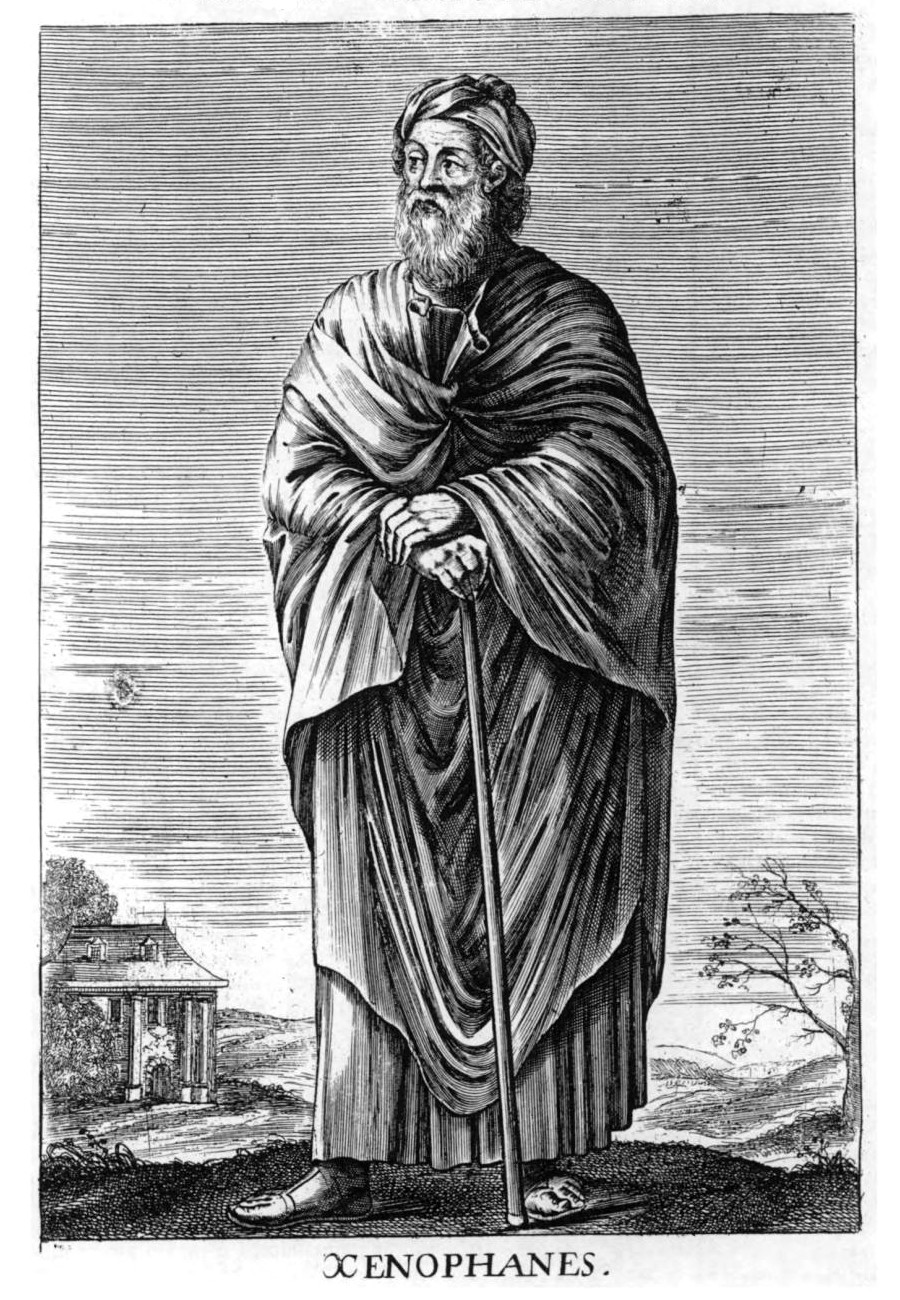
Xenophanes
Philosopher and poetWikipedia
142
MENTIONS
38
EPISODES
36
PODCASTS
Search complete. 142 mentions across 38 episodes found for "Xenophanes".
Sep 16, 2026

Chiquito CrastoNARRATOR
The system of Spinoza is less personal and also less dualistic than that of Descartes.
Chiquito CrastoNARRATOR
In this respect, the difference between them is like that between Xenophanes and Parmenides.
Chiquito CrastoNARRATOR
The teaching of Spinoza might be described generally as the Jewish religion reduced to an abstraction and taking the form of the Eleatic philosophy.
Chiquito CrastoNARRATOR
Like Parmenides, he is overpowered and intoxicated with the idea of being or God.

speaker_6NARRATOR
16.
speaker_6NARRATOR
Much learning does not teach one to have understanding, else it would have taught Hesiod and Pythagoras, and again Xenophanes and Hecateus.
speaker_6NARRATOR
17.
speaker_6NARRATOR
Pythagoras, son of Mnesarchus, practised investigation most of all men, and having chosen out these treatises, he made a wisdom of his own, much learning and bad art.
27 MINS LATER
Jana KramerADVERTISER
That's code Jana at resortpass.com slash Jana.
speaker_6NARRATOR
As Eudemus relates in his account of astronomical works.
speaker_6NARRATOR
and for this reason he is honoured by Xenophanes and Herodotus, and both Heraclitus and Democritus bear witness to him.
speaker_6NARRATOR
Thus time, having a necessary union and connection with heaven, is not simple motion, but, so to speak, motion in an order, having measured limits and periods.

speaker_13NARRATOR
16.
speaker_13NARRATOR
Much learning does not teach one to have understanding, else it would have taught Hesiod and Pythagoras, and again Xenophanes and Hecateus.
speaker_13NARRATOR
17.
speaker_13NARRATOR
Pythagoras, son of Mnesarchus, practised investigation most of all men, and having chosen out these treatises, he made a wisdom of his own, much learning and bad art.
18 MINS LATER
speaker_3ADVERTISER
Visit SpinQuest.com for more details.
speaker_13NARRATOR
as Eudemus relates in his account of astronomical works.
speaker_13NARRATOR
And for this reason he is honoured by Xenophanes and Herodotus, and both Heraclitus and Democritus bear witness to him.
speaker_13NARRATOR
Plutarch, Platonic Questions, 8, 4 Thus time, having a necessary union and connection with heaven, is not simple motion, but, so to speak, motion in an order, having measured limits and periods, of which the sun, being overseer and guardian, to limit, direct, appoint, and proclaim the changes and seasons, which, according to Heraclitus, produce all things, is the helper of the leader and first God, not in small or trivial things, but in the greatest and most important.

speaker_8NARRATOR
Two older influences shaped him, and the tradition names them both.
speaker_8NARRATOR
The first was a wandering poet and thinker named Xenophanes, who had come, like the founders of Elea, out of the Ionian East into the Greek West, and who had spent a long life attacking the ordinary religion of the Greeks.
speaker_8NARRATOR
Xenophanes ridiculed the idea that the gods are born and wear clothes, and steal and lie and quarrel like the people in the old poems.
speaker_8NARRATOR
If horses and oxen had hands and could draw, he said, they would draw their gods as horses and oxen.
speaker_8NARRATOR
Behind that mockery lay a positive vision, and it is the part that matters here.
speaker_8NARRATOR
Xenophanes glimpsed, beyond the crowd of human-like gods, a single god, greatest of all, in no way like a mortal in body or in mind, who stays forever in one place without ever moving, and who sets all things trembling by the pure thought of his mind alone.
speaker_8NARRATOR
In that one unmoving god you can already hear, faint and far off, the first note of what Parmenides would build into an entire philosophy.
speaker_8NARRATOR
The second influence, the tradition says, was a man named Aminias, a follower of Pythagoras, who turned the young Parmenides away from the life of politics and pleasure and toward a life of stillness and contemplation, of sitting quietly and thinking hard.

John Van StanNARRATOR
Especially does he lay stress upon the personal equation, since that is the only permanent item of interest, considering that every, quote, system, end quote, crumbles into nothing with the appearance of a new thinker.
John Van StanNARRATOR
In this way, Nietzsche treats of Thales, Anaximander, Heraclitus, Parmenides, Xenophanes, Anaxagoras.
John Van StanNARRATOR
There are also some sketches of a draft for an intended but never accomplished continuation, in which Empedocles, Democritus, and Plato were to be dealt with.
John Van StanNARRATOR
Probably the most popular of the essays in this book will prove to be the one on truth and falsity.
2 HRS 11 MINS LATER
John Van StanNARRATOR
Aristotle once made a list of such contests on a large scale.
John Van StanNARRATOR
Among them is the most striking instance how even a dead person can still incite a living one to consuming jealousy.
John Van StanNARRATOR
Thus, for example, Aristotle designates the relation between the Colophonian Xenophanes and Homer.
John Van StanNARRATOR
We do not understand this attack on the national hero of poetry in all its strength if we do not imagine, as later on also with Plato, the root of this attack to be the ardent desire to step into the place of the overthrown poet and to inherit his fame.

Helen SayersNARRATOR
They could not, of course, free their minds entirely from received notions, but they began the work of destroying orthodox views and religious faiths.
Helen SayersNARRATOR
Xenophanes may specially be named among these pioneers of thought, though he was not the most important or the ablest, because the toleration of his teaching illustrates the freedom of the atmosphere in which these men lived.
Helen SayersNARRATOR
He went about from city to city, calling in question on moral grounds the popular beliefs about the gods and goddesses, and ridiculing the anthropomorphic conceptions which the Greeks had formed of their divinities.
Helen SayersNARRATOR
If oxen had hands and the capacities of men, they would make gods in the shape of oxen.
Helen SayersNARRATOR
This attack on received theology was an attack on the veracity of the old poets, especially Homer, who was considered the highest authority on mythology.
Helen SayersNARRATOR
Xenophanes criticized him severely for ascribing to the gods acts which, committed by men, would be considered highly disgraceful.
Helen SayersNARRATOR
We do not hear that any attempt was made to restrain him from thus assailing traditional beliefs and branding Homer as immoral.
Helen SayersNARRATOR
We must remember that the Homeric poems were never supposed to be the word of God.

Pamela NagamiNARRATOR
7.
Pamela NagamiNARRATOR
Xenophanes Among those whom Heraclitus mentions as examples of learning without intelligence, Xenophanes is one.
Pamela NagamiNARRATOR
In the order of time this philosopher, an Ionian of Caliphon, preceded the great Ephesian, but for our purposes he may be most conveniently studied in connection with a school developed in express opposition to the theory of a perpetual flux.
Pamela NagamiNARRATOR
i have called xenophanes a philosopher but he was primarily rather a poet of alert and many-sided interests who spent a long life wandering about hellas and making a profession of reciting his own compositions at the banquets of the rich it would appear that the conversation at such social gatherings largely consisted in repeating fabulous stories about the quarrels of titans and centaurs and we know from homer that scandalous ballads about the amours of gods and goddesses were sometimes part of the entertainment xenophanes wished to introduce a higher tone and as a preliminary he attacks the mythology of the old poets with uncompromising vigour Homer and Hesiod, he exclaims, have attributed to the gods everything that is a shame and reproach among men, theft, adultery, and mutual deception.
Pamela NagamiNARRATOR
The Thracians give theirs fair hair and blue eyes.
Pamela NagamiNARRATOR
If oxen or lions had hands and could paint, they too would make gods in their own image.
Pamela NagamiNARRATOR
so much for the aristocratic olympian religion of the poets as to the popular chthonian religion of the mysteries with its suffering and dying gods he is reported to have dismissed it with even briefer and more cutting sarcasm asked by the eleates should they sacrifice to leucothea and mourn for her or not he advised them not to mourn if they believed her to be a goddess not to sacrifice if they believed her to be a woman For himself, Xenophanes, like Anaximander, believed in an infinite source of existence, but unlike his Milesian predecessor, he identified this one and eternal element with the visible earth, which he supposed to stretch downward beneath our feet without end.
Pamela NagamiNARRATOR
This infinite and eternal reality is God and the only God, resembling mortals neither in form nor thought, but perceiving and thinking through its whole extent.

Eric HutchinsonGUEST
I've-- So I, I thought about this 'cause you sent me this question beforehand, and I was think- been thinking like, "Oh, wow, what am I gonna say to this?" Um, and I don't really know.
Eric HutchinsonGUEST
I don't have a great answer to this question, but I've been really fascinated for a long time, um, by, uh, by the pre-Socratic philosopher Xenophanes.
Eric HutchinsonGUEST
Um, so that's who I'm gonna go with.
Eric HutchinsonGUEST
X- Xenophanes is, is kind of the earliest critic of k- of, basically, of the mythological or poetic view of, of the gods that we have.
Eric HutchinsonGUEST
Um, and, uh, so there's this critique, you know, of in kind of Homeric and Hesiodic poetry of, of gods behaving badly, something that we tend to associate especially with Plato, and then the Christians take over the Platonic critique of the gods.
Eric HutchinsonGUEST
But we actually get it before, even before Plato, and he's the first, one of the first ones to do it.
Eric HutchinsonGUEST
I mean, I think things like that, again, it's only, only fragmentary, um, but, uh, there are things in there, you know, long bef- before Socrates and before Plato, uh, really important ideas.
Eric HutchinsonGUEST
And he doesn't get as, nearly as much airtime as Plato and Aristotle and, uh, and all of the other, all the other big-- Socrates, all the other big famous guys.

Pamela NagamiNARRATOR
7.
Pamela NagamiNARRATOR
Xenophanes Among those whom Heraclitus mentions as examples of learning without intelligence, Xenophanes is one.
Pamela NagamiNARRATOR
In the order of time, this philosopher, an Ionian of Caliphon, preceded the great Ephesian, but for our purposes he may be most conveniently studied in connection with a school developed in express opposition to the theory of a perpetual flux.
Pamela NagamiNARRATOR
i have called xenophanes a philosopher but he was primarily rather a poet of alert and many-sided interests who spent a long life wandering about hellas and making a profession of reciting his own compositions at the banquets of the rich it would appear that the conversation at such social gatherings largely consisted in repeating fabulous stories about the quarrels of titans and centaurs and we know from homer that scandalous ballads about the amours of gods and goddesses were sometimes part of the entertainment xenophanes wished to introduce a higher tone and as a preliminary he attacks the mythology of the old poets with uncompromising vigour homer and hesiod he exclaims have attributed to the gods everything that is a shame and reproach among men theft adultery and mutual deception but not to think of the gods as like bad men is merely the first step in true religion we should not think of them as like men at all Mortals think that the gods are generated, that they have senses, a voice, and a body like their own.
Pamela NagamiNARRATOR
so much for the aristocratic olympian religion of the poets as to the popular chthonian religion of the mysteries with its suffering and dying gods he is reported to have dismissed it with even briefer and more cutting sarcasm asked by the eleates should they sacrifice to loicothea and mourn for her or not he advised them not to mourn if they believed her to be a goddess not to sacrifice if they believed her to be a woman for himself xenophanes like alexander believed in an infinite source of existence but unlike his milesian predecessor he identified this one and eternal element with the visible earth which he supposed to stretch downward beneath our feet without end this infinite and eternal reality is god and the only god resembling mortals neither in form nor thought but perceiving and thinking through its whole extent we are told that xenophanes created palaeontology pointing to the impressions of marine animals and plants found imbedded in the quarries of syracuse as evidence that what is now dry land was once water teaching also that it would at some future period be covered with water once more, a theory probably suggested by Anaximander's idea that man was evolved from a fish-like creature.
Pamela NagamiNARRATOR
8.
Pamela NagamiNARRATOR
Parmenides Interesting in himself, Xenophanes interests us still more as the immediate predecessor of Parmenides, the poet-thinker to whom Elea, an otherwise obscure Ionian colony in southern Italy, owes its immortal renown.
Pamela NagamiNARRATOR
grown to manhood as would seem early in the fifth century b c and therefore a contemporary of the great persian war parmenides comes a little later than heraclitus as whose polar opposite and complement he appears in the history of greek philosophy in point of genius there can be no comparison between them heraclitus was so much the greater of the two indeed it is only within the last century that we have been able to appreciate his astonishing genius at something like its true value at the same time parmenides had a more typically greek mind and therefore he counts for more in the history of greek thought Indeed, from Plato on, his ideas dominate its evolution to the end.

Andrew M. HenryHOST
Philosophers have been saying something similar for centuries.
Andrew M. HenryHOST
The Greek philosopher Xenophanes once said that if horses could draw, they'd paint their gods like horses.
Andrew M. HenryHOST
And the sociologist in this study quoted the 17th century philosopher Spinoza.
Andrew M. HenryHOST
A triangle, if it could speak, would likewise say that God is eminently triangular, and a circle that God's nature is eminently circular.
Andrew M. HenryHOST
But Durkheim was among the first to build a systematic naturalistic field of study examining these claims, and his theories are widely held by scholars of religion today, arguing that religious talk turns out to be society talk, or to put a finer point on it, God talk turns out to be society talk.
28 more episodes mention Xenophanes.
Create an account to see the whole feed, search across every transcript, and follow the entities you care about.