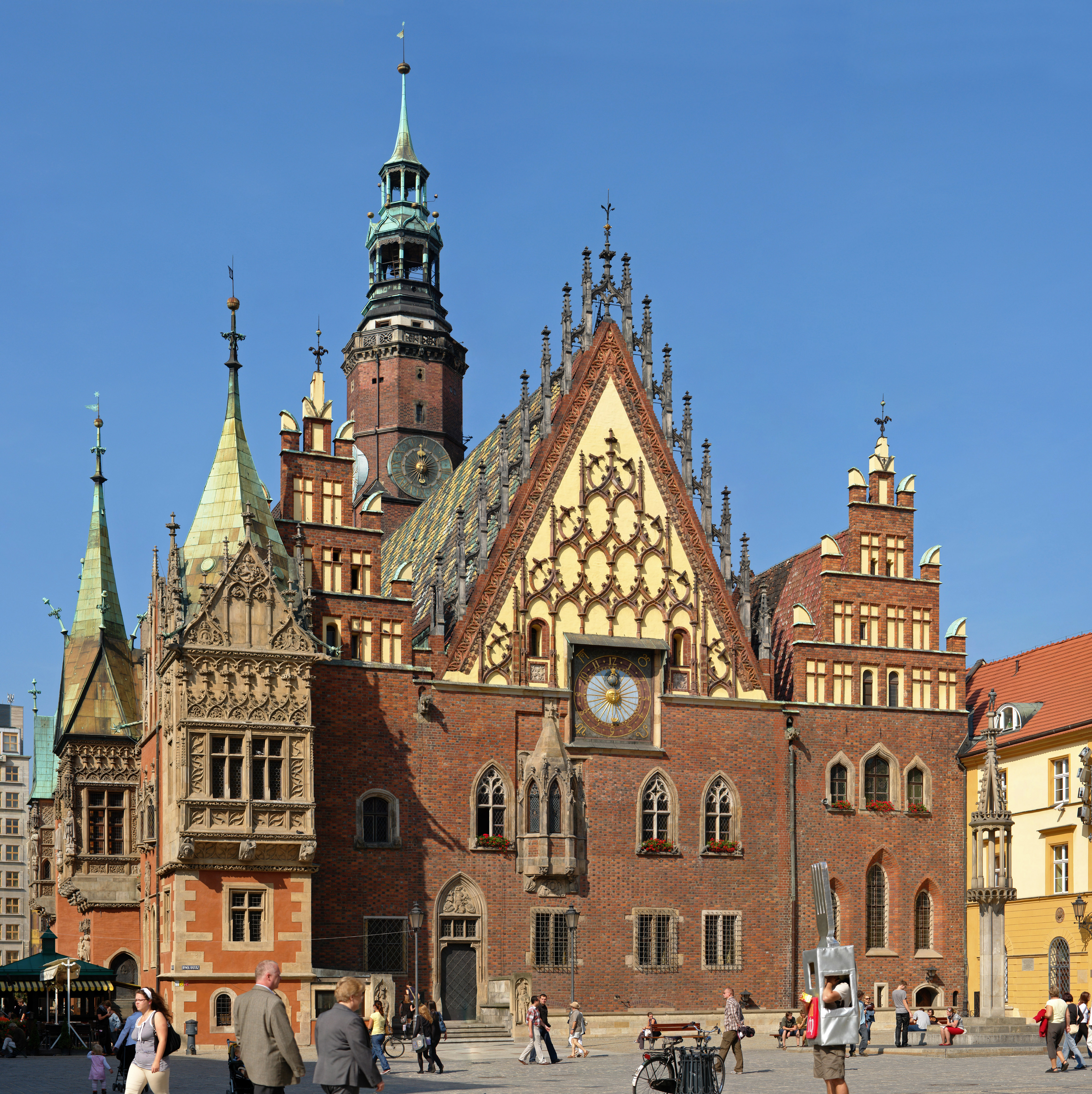
Wrocław
City in PolandWikipedia
80
MENTIONS
54
EPISODES
48
PODCASTS
Search complete. 80 mentions across 54 episodes found for "Wrocław".
Sep 21, 2026

Jacek HubnerGUEST
Poland.
Jacek HubnerGUEST
They have a space in Wrocław, in the city where I was studying.
Jacek HubnerGUEST
And they use songs rather than the lyric voice.
Jacek HubnerGUEST
It's

Pamela NagamiNARRATOR
Then on the 18th of March, it fell upon the Polish armies of Boleslav and Miloslav at Shudu and crushed them, driving off the debris of the two armies in divergent directions.
Pamela NagamiNARRATOR
Kaidu swept on at hurricane speed, took Krakow and then Breslau.
Pamela NagamiNARRATOR
On the 8th of April, he met at Liechnitz the German forces under the Duke Henry of Silesia, together with the orders of the Templars and Hospitallers, and the remains of the Polish troops.
Pamela NagamiNARRATOR
A day's march to the south was the army of King Wenceslas of Bohemia.

Christine van BloklandGUEST
It is Cathedral Island, which is unbelievable.
Christine van BloklandGUEST
So it's a very small island and it is connected to the main part of Wrocław just by a little bridge.
Christine van BloklandGUEST
And you walk over it and especially at Christmas time with all the Christmas lights on and you're kind of going there at dusk.
Christine van BloklandGUEST
It feels like this magical fairy lamp.

Bryn RobertsNARRATOR
The long process of the feudal system to which Europe has been subjected and out of which she has elaborated her liberties is there unknown and the sense of responsibility has yet to be developed out of the municipal nucleus common to the east of the world.
Bryn RobertsNARRATOR
And yet, how near is Breslau to Warsaw? How accessible Konigsberg from St.
Bryn RobertsNARRATOR
Petersburg? The fear of the consequences of this contact is most just on both sides, and it is an interesting point in diplomatic history to observe how unwilling the European states have been to recognize Russia as a substantive European power.
Bryn RobertsNARRATOR
Till the commencement of the French Revolution, her attempts to procure an influence in the domestic affairs of the German Empire were without success, the German states having encountered with determined opposition the pretensions of Russia to the title of guarantee of the Treaty of Westphalia, which she claimed by a forced interpretation of a passage in the Treaty of Teschen.

Andrei ZinkevichHOST
Tomasz, good to see you.
Andrei ZinkevichHOST
Wroclaw, Poland.
Andrei ZinkevichHOST
Zeeshan, India, good to see you.
Andrei ZinkevichHOST
Who else? We have Sonia, we have Maisa.

Pamela NagamiNARRATOR
Then, on the eighteenth of March, it fell upon the Polish armies of Boleslav and Miloslav at Chudu and crushed them, driving off the debris of the two armies in divergent directions.
Pamela NagamiNARRATOR
Kaidu swept on at hurricane speed, took Krakow and then Breslau.
Pamela NagamiNARRATOR
On the eighth of April, he met at Liegnitz the German forces under the Duke Henry of Silesia, together with the orders of the Templars and Hospitallers and the remains of the Polish troops.
Pamela NagamiNARRATOR
A day's march to the south was the army of King Wenceslas of Bohemia.

Larry WilsonNARRATOR
chapter one chapter two of chemical
Larry WilsonNARRATOR
phenomena in life by frederick chapek this librivox recording is in the public domain protoplasm and its chemical properties during its life and in the course of its evolution the form of the body and its organs is subjected to a continuous series of changes but at the same pace the organism of the individual undergoes chemical changes its general composition is changed chemical analysis shows new substances formed which at an earlier age were not yet present whereas some substances have disappeared this is the parallelism of morphological and chemical change in the life of the individual chemical investigation however to a certain extent teaches considerably more than morphology does we shall prove this in our discussion of chemical reactions in living matter chemical changes in living substance continue without interruption as long as active life prevails so the chemist has to face great difficulties when examining living matter from his occupation with inorganic matter he will be accustomed to see that no change takes place in the matter under investigation unless an experiment be made we stand before the question as to what may be made responsible for this continuous change of form and of chemical properties inspection with the naked eye could not have brought any solution to this question nor was chemical analysis able to contribute facts of importance only to the microscopical investigation of the cells do we owe our knowledge of the organs of life and here again animal cells have proved to be much less accessible for searching analysis than the cells of plants it was in eighteen forty that hugo von moll of tubingen drew attention to the important fact that plant cells have the qualifications of life only as long as they contain a slimy layer along the cell wall which layer was at first called the primordial the thorough examination of anatomical facts led mohl and schleiden to the conviction that all the organs of the cell originate in this slimy matter consequently the mucous layer was called protoplasm in the following decades it was fully established that the presence of life is extremely closely connected with the presence of active protoplasm the physiologists brucke and kuhne may be called the originators of the view now universally adopted that protoplasm is the living substance in animals and plants the general and fundamental properties of protoplasm in both are the same but it was the merit of the well-known botanist Ferdinand Cohn of Breslau that he was the first to declare, in 1850, the identity of the protoplasm in plant cells and of the so-called sarcode in animal cells.
Larry WilsonNARRATOR
The chemistry of life may henceforth be called the chemistry of protoplasm.
Larry WilsonNARRATOR
This is our territory when we study chemical phenomena in life.

speaker_0NARRATOR
Rather, it allows us to position ourselves within the one holy Catholic and apostolic tradition as a key partner with others who celebrate God's perfecting call upon the Church and our lives.
speaker_0NARRATOR
The Legacy of Dietrich Bonhoeffer by Sam Barber In 1906, as the Ford Motor Company prepared to transition to the assembly line, and as wireless communication dawned at the hands of Guglielmo Marconi, the Wright brothers proved that powered flight was possible, and Karl and Paula Bonhoeffer welcomed their sixth son in Breslau, Germany, a son they named Dietrich.
speaker_0NARRATOR
Dietrich's father, a renowned psychiatrist and neurologist, was not particularly religious, but his mother had been reared in the home of noted Protestant theologian Karl Alfred von Haas, and she persuaded her husband that the Bonhoeffer children should be raised in her deep Christian faith with a love for scripture, learning, music, and service.
speaker_0NARRATOR
Early on, Dietrich distinguished himself as a gifted pianist and developed a delightful charm to accompany his razor-sharp intellect.

speaker_10NARRATOR
chapter one chapter two of
speaker_5NARRATOR
chemical phenomena in life by frederick chapek this librivox recording is in the public domain protoplasm and its chemical properties during its life and in the course of its evolution the form of the body and its organs is subjected to a continuous series of changes but at the same pace the organism of the individual undergoes chemical changes its general composition is changed chemical analysis shows new substances formed which at an earlier age were not yet present whereas some substances have disappeared this is the parallelism of morphological and chemical change in the life of the individual chemical investigation however to a certain extent teaches considerably more than morphology does we shall prove this in our discussion of chemical reactions in living matter chemical changes in living substance continue without interruption as long as active life prevails so the chemist has to face great difficulties when examining living matter from his occupation with inorganic matter he will be accustomed to see that no change takes place in the matter under investigation unless an experiment be made we stand before the question as to what may be made responsible for this continuous change of form and of chemical properties inspection with the naked eye could not have brought any solution to this question nor was chemical analysis able to contribute facts of importance only to the microscopical investigation of the cells do we owe our knowledge of the organs of life and here again animal cells have proved to be much less accessible for searching analysis than the cells of plants it was in eighteen forty that hugo von moll of tubingen drew attention to the important fact that plant cells have the qualifications of life only as long as they contain a slimy layer along the cell wall which layer was at first called the primordial the thorough examination of anatomical facts led mohl and schleiden to the conviction that all the organs of the cell originate in this slimy matter consequently the mucous layer was called protoplasm in the following decades it was fully established that the presence of life is extremely closely connected with the presence of active protoplasm the physiologists brucke and kuhne may be called the originators of the view now universally adopted that protoplasm is the living substance in animals and plants the general and fundamental properties of protoplasm in both are the same But it was the merit of the well-known botanist Ferdinand Cohn of Breslau that he was the first to declare, in 1850, the identity of the protoplasm in plant cells and of the so-called sarcode in animal cells.
speaker_5NARRATOR
The chemistry of life may henceforth be called the chemistry of protoplasm.
speaker_5NARRATOR
This is our territory when we study chemical phenomena in life.

Jason DoyleGUEST
Sometimes you gotta try to find the, the fastest way around, but also the safest.
KarlHOST
I know there's no real way to say easier with speedway, 'cause obviously it's massively technical, but if you have a big open track like a, a Sparta Ros- Wrocław or a tight track like a Cardiff, which is, which is tougher to ride?
Jason DoyleGUEST
Uh, Wrocław obviously because it's, uh, anyone can go fast there, but it's, it's amazing, like, these big Polish tracks.
Jason DoyleGUEST
They're, they're definitely prepared so well and, and, uh, it's, uh, it...
Jason DoyleGUEST
When you're out in front, it's, it's amazing, but when you're behind, you're, you just...
44 more episodes mention Wrocław.
Create an account to see the whole feed, search across every transcript, and follow the entities you care about.