Wolff-Parkinson-White syndrome
DisorderWikipedia
10
MENTIONS
5
EPISODES
5
PODCASTS
Search complete. 10 mentions across 5 episodes found for "Wolff-Parkinson-White syndrome".
Sep 27, 2026

Chris BrownHOST
Now, I also have a heart condition.
Chris BrownHOST
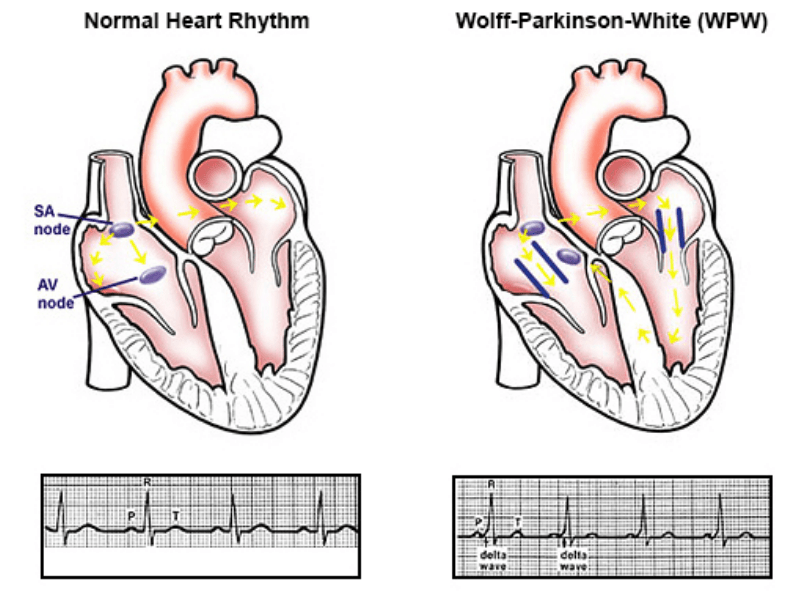
It's called Wolfe-Parkinson-White, or WPW, okay? It's, uh, basically an extra electrical pathway, and, uh, it, it kinda simulates what, uh, atrial fibrillation or AFib, uh, in, in, in the fact that, like, it gets your heart going on a loop.
Chris BrownHOST
And, uh, you know, my heart can go from anywhere from A normal, uh, rhythm to all of a sudden just [mimicking drums] going crazy like I ran a marathon and just out of nowhere.
Chris BrownHOST
And then all of a sudden it's like kaboom, and, uh, it goes back to normal.

DivineHOST
Digoxin specific antibody fragments, right? And remember, digoxin can also slow conduction down the AV node, right? It's an AV nodal blocking agent, so it can actually cause, uh, brady, bradycardia.
DivineHOST
Just something you want to keep at the back of your mind for, for exams, right? So if, for example, a person has like AFib and they have WPW or they have like heart block, uh, giving them digoxin may not be the smartest idea in the world, right? Because in those circumstances, giving AV nodal blocking agents just gonna worsen your, your condition.
DivineHOST
All right.
DivineHOST
Now, what if they give you a question about, um, a person, right? You're, you're told that this person is, um, um, you know, has missed like the last two...

Patrick McCarthyGUEST
I mean, number one, you get the living history.
Patrick McCarthyGUEST
One of the chapters is about the history of arrhythmia surgery, WPW, AV node reentry, VTAC.
Patrick McCarthyGUEST
And then most of the book is about atrial fib.
Patrick McCarthyGUEST
There's 600 illustrations.

speaker_6HOST
Oh, I know where you're going with this.
speaker_5HOST
What if that AV node gatekeeper is completely compromised? What if the patient has Wolff-Parkinson-White syndrome?
speaker_6HOST
BWPW.
speaker_5HOST
Because WPW means a patient is born with an extra physical electrical highway, called the bundle of Kent.
speaker_5HOST
It connects the atria and the ventricles, completely bypassing the AV node's natural speed limit.
speaker_6HOST
It's a physical shortcut.
speaker_5HOST
Right.
speaker_5HOST
And on a normal day, their ECG shows a short PR interval and a slurred upstroke on the QRS, that's the delta wave, because the signal is taking that shortcut and pre-exciting the ventricles.

JoshHOST
And this is a really big one not to miss, as continuing with a standard treatment, thinking this is AF with RVR, could prove fatal.
JoshHOST
Hopefully, most of the people listening to this know what Wolff-Parkinson-White is.
JoshHOST
If not, a quick recap.
JoshHOST
Wolff-Parkinson-White is an accessory conduction pathway between the atria and the ventricles called the bundle of Kent.
JoshHOST
This allows impulses to be conducted through something other than the AV node on their way down to the ventricles.
JoshHOST
This means that when we have AF with the atria fibrillating, as Simon said, around their intrinsic rate of 300 beats per minute, impulses can be conducted through the ventricles, bypassing this decremental conduction of the AV node that I talked about earlier.
JoshHOST
So if we have ventricular rates over 200, we need to start looking for that characteristic delta wave on the ECG, which is showing us that the second conduction pathway is there.
JoshHOST
Now, why is this important? Well, treatment with AV nodal blocking drugs such as adenosine, calcium channel blockers, and beta blockers may increase the conduction via the accessory pathway with a resultant increase in ventricular rate and a possible degeneration into VT or VF.