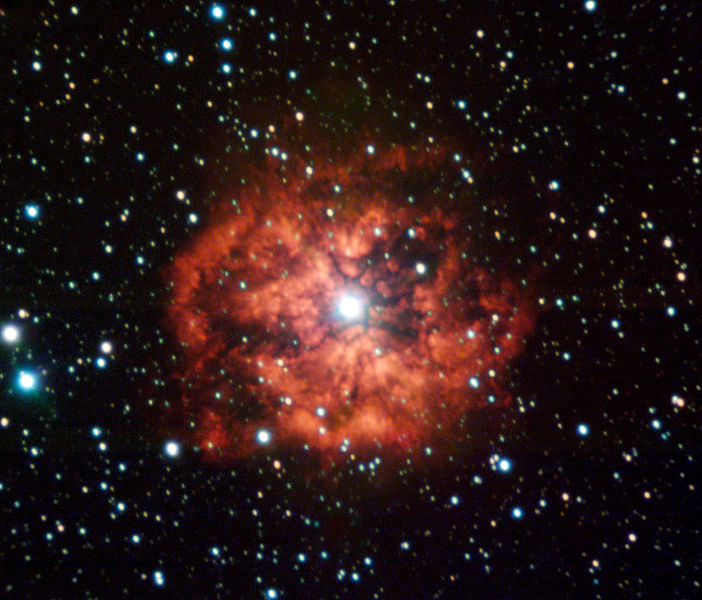
Wolf–Rayet star
7
MENTIONS
4
EPISODES
4
PODCASTS
Search complete. 7 mentions across 4 episodes found for "Wolf–Rayet star".
Oct 8, 2026

Joseph W. PhippsHOST
This amazing data led to the controversial claims that Cygnus X-3 was the first identified cosmic particle accelerator in the galaxy.
Joseph W. PhippsHOST
Cygnus X-3 is a binary system composed of a dying Wolf-Rayet star that feeds a close proximity neutron star, producing streams of superheated plasma.
Joseph W. PhippsHOST
And, and that kinda makes me wonder why, why it's called a, a Wolf-Rayet star, and we have all this ancient talk about, you know, the dog star Sirius and, uh, Anubis.
Joseph W. PhippsHOST
This ejecta is shot out at relativistic speeds very close to the speed of light.
Joseph W. PhippsHOST
These unimaginable beams, like cosmic searchlights, are held together by magnetic sheaths that produce powerful particle acceleration in a variety of frequency ranges, including X-rays, infrared, radio waves, and gamma rays.

speaker_3HOST
We see huge O type stars, which are even more massive and hotter than B types.
speaker_3HOST
We see incredibly luminous Wolf-Rayet stars.
speaker_5HOST
Which are what exactly?
speaker_3HOST
They're massive stars in a very specific, intense, windy phase of their evolution.
speaker_5HOST
So-
speaker_3HOST
The heavier O types are missing.
speaker_3HOST
The Wolf-Rayet stars are missing.
speaker_3HOST
Why would only the B type stars migrate inward?

AveryHOST
What this team has done is get back in.
AveryHOST
They used ESO's Very Large Telescope in Chile for spectroscopy, they used ALMA, and they compared what they saw against models built for Wolf-Rayet stars.
AveryHOST
the hot, stripped, fiercely windy stars that show strong carbon and helium signatures.
AveryHOST
And that is what Sakurai's object now looks like.
AveryHOST
The emergence of a WC star in Sakurai's object.
AveryHOST
Astronomers write it in square brackets, which is the notation for the low-mass version.
AveryHOST
It has the spectrum of a Wolf-Rayet star without being a massive star at all.
AnnaHOST
So the curtain is thinning.

DianaHOST
One of the most massive and unusual young star clusters known in the Milky Way, packed with some of the rarest stars in existence.
DianaHOST
Supergiants, hypergiants, and Wolf-Rayet stars, all crowded together in one relatively small region of space.
DianaHOST
It is essentially a catastrophe waiting to happen.
DianaHOST
several catastrophes actually.