Winter War
WarWikipedia
60
MENTIONS
27
EPISODES
24
PODCASTS
Search complete. 60 mentions across 27 episodes found for "Winter War".
Oct 2, 2026

Victor Davis HansonGUEST
So they didn't have the manpower.
Victor Davis HansonGUEST
They were kind of like Finland in the 39-40 Winter War.
Victor Davis HansonGUEST
They were heroic and they stopped the Soviet Union for five months and they obtained their autonomy.
Victor Davis HansonGUEST
But when it was all said and done, Stalin ground them down, even though he lost 600,000 casualties.

ChadHOST
Yeah, okay
Funk BaggusGUEST
... that, the opening with all the landscapes, the colors were just blowing out of the TV.
Funk BaggusGUEST
I was like, wow.
Funk BaggusGUEST
Uh-
24 MINS LATER
KevinHOST
I didn't think about that.
ChadHOST
Maybe it's because the minefield scene after the horse walks by, I thought it was just gonna be a chase movie, like a Predator style like, you know, he comes in and fucks them up as the predator.
ChadHOST
But it's like the mine field blowing up the horse, and then him like gathering the gold while they watch him and decide not to shoot him.
KevinHOST
Hmm.

Oscar JonssonGUEST
So, there's a wonderful book from 1975 called The Soviet View of War and Peace, and they kind of outline it in the sense that, you know, there's no such thing as a true peace in the Soviet mind until the whole world has transformed into socialist.
Oscar JonssonGUEST
And because capitalism is inherently aggressive, things such as the Winter War is not only righteous war, it's a defensive war.
Oscar JonssonGUEST
Even though, you know, Soviet Union, you know, obviously started it and same, you know, the Cuba crisis and everything, Cuban Missile Crisis.
Oscar JonssonGUEST
It is not just righteous, it's defensive, because there cannot be peaceful coexistence with the capitalists.

speaker_8NARRATOR
While World War II was defined by mobile warfare, trenches were still used in static situations.
speaker_8NARRATOR
The Finnish Army used the Mannerheim Line to resist the Soviet Union during the Winter War, relying on a system of flexible fieldworks that allowed troops to move between positions.
speaker_8NARRATOR
At Sevastopol, Soviet forces held out in trenches for months, and at the Battle of Stalingrad, both sides dug into the ruins of the city.
speaker_8NARRATOR
the Battle of Kursk saw the construction of massive Soviet defenses that successfully stopped German armor.

JustinHOST
We're talking a very small man, so, you know, when you think of a great soldier, you don't think of somebody like Audie Murphy, who was this tiny little skinny guy that the wind could blow him away kind of thing, you know.
JustinHOST
Up next, we have Ghost Division, about Rommel and his 7th Panzer Division, which is tanks, during the invasion of France, and how they kind of seem to come and go, kind of like a ghost, you know, as Rommel would have, you know, become very famous, especially during the African campaign, you know, You know in things like that Patton himself was actually a very In very inspired by Rommel and how he did things so it's kind of cool to get something like that And then of course the last song that we're gonna go off this list And probably my favorite of the World War two songs Maybe by Sabaton is white death which about is about finished sniper Seymour high during the Winter War of 1939 to 1940 in Finland against the USSR, and is the deadliest sniper in history with like 505 kills with a sniper, you know, which is just crazy.
JustinHOST
And to really think about it, it was all open sights, you know, just so that he didn't have a glare from his his scope you know and he gets the nick you know he gets the nickname white death by the russians because he basically he just blends in with the snow you know the song really kind of tells you about it like you know putting snow in his mouth to hide your breath and stuff like that so it's a really it's a really cool Really cool song.
JustinHOST
You know, there's not much known about the gentleman as he never wrote anything about it.

Brian PierceHOST
But sales had indeed been arranged, but Brewster was already struggling.
Brian PierceHOST
The U.S. Navy ultimately intervened during the Winter War to release aircraft originally intended for the U.S. inventory so that they could be rushed to Finland.
Brian PierceHOST
It wasn't all generosity.
Brian PierceHOST
During the delays with Brewster to the Navy, Grumman had been developing and tweaking their design, and the U.S. Navy placed its first official production orders for the F4F3, what would ultimately be called the Wildcat, in August 1939 for 54 aircraft.
Brian PierceHOST
The Finns were fighting a completely separate war of survival against their predatory neighbor, the Soviet Union.
Brian PierceHOST
Actually, they fought two.
Brian PierceHOST
In what they called the Winter War during 1939 to 1940, Finland fought a purely defensive war alone against a Soviet invasion after rejecting Stalin's territorial demands.
Brian PierceHOST
During this conflict, Western democracies, including the U.S. and Britain, sympathized with Finland and allowed the sale of weapons like the Brewster fighter, but they did not intervene militarily.

Adam DuniganGUEST
And that's in the absence of the US.
Adam DuniganGUEST
And I always like to think back to the Winter War right before the start of World War II with Finland.
Adam DuniganGUEST
Those Nordics, man, they gave the Russians hell one time.
Adam DuniganGUEST
And I think the Russians would blush at trying to test those waters again.

Tom KarakoGUEST
Finland has enormous amount of artillery.
Tom KarakoGUEST
The Russians still remember the, the Winter War.
Tom KarakoGUEST
So I think in the long scheme of things, we're coming up on the anniversary of their admission in the spring.
Tom KarakoGUEST
In the, the long term, this is a big deal and a big progress point.

speaker_2NARRATOR
Many of the concrete barriers and steel nets that now line alpine slopes above villages date from the decades of building that followed that winter.
speaker_2NARRATOR
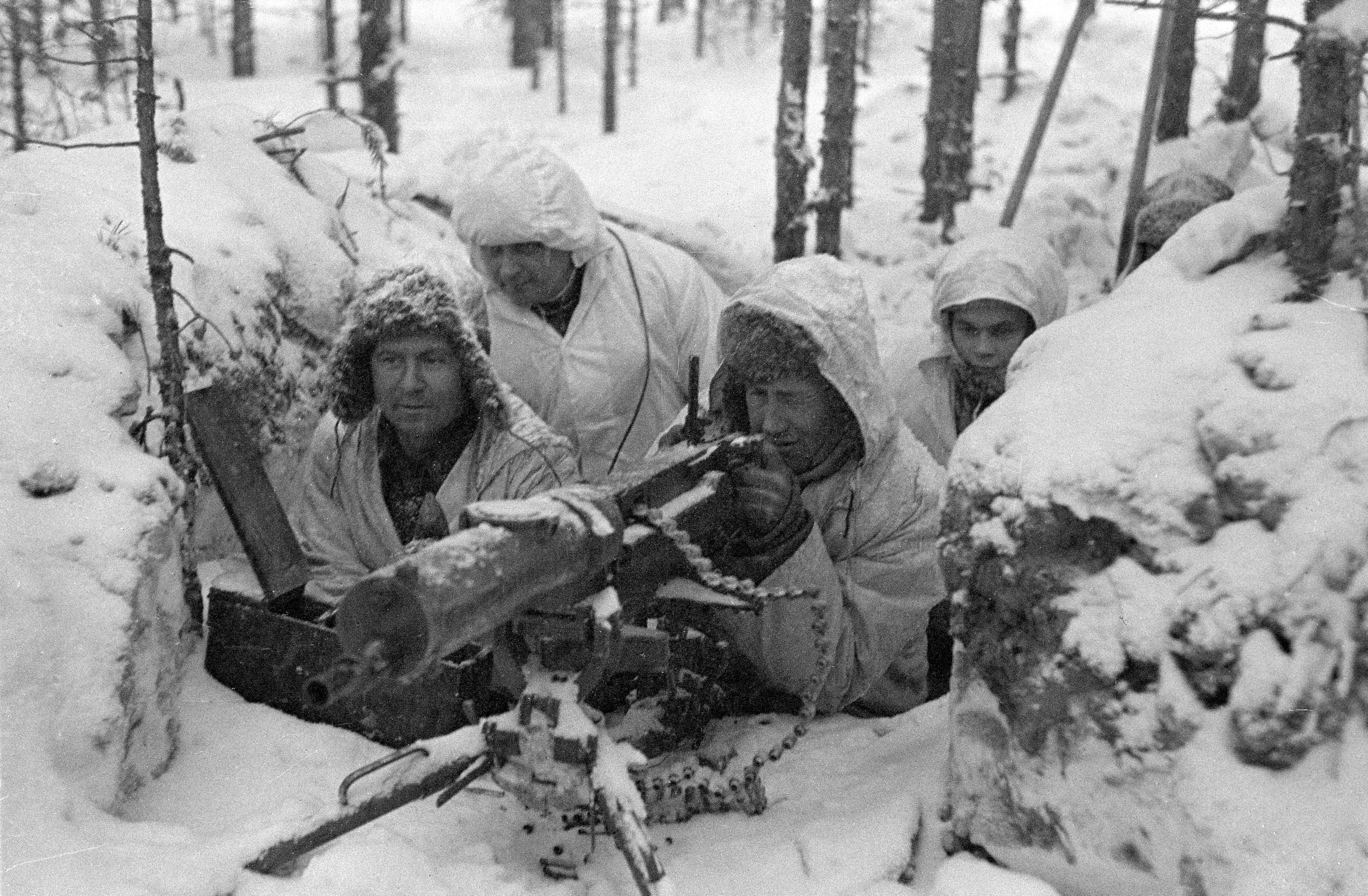
The Winter War between Finland and the Soviet Union in 1939 and 1940 was fought in extremely heavy snow, and Finnish ski troops used their familiarity with snowy terrain to great tactical advantage.
speaker_2NARRATOR
Finnish soldiers dressed in white camouflage and moved silently on skis through deep forests, striking quickly and then disappearing.
speaker_2NARRATOR
The phrase White Death was used to describe Finnish sniper Simo Häyhä, who was credited with over five hundred kills during the Winter War, often operating in deep snow, where he packed the snow in front of his position so that the muzzle blast would not lift a telltale puff into the air.
speaker_2NARRATOR
Napoleon’s retreat from Moscow in 1812 was devastating in part because of the early onset of heavy snow and extreme cold.
speaker_2NARRATOR
Tens of thousands of soldiers died from exposure, starvation, and the difficulty of moving through deep snow with inadequate winter equipment.
17 more episodes mention Winter War.
Create an account to see the whole feed, search across every transcript, and follow the entities you care about.