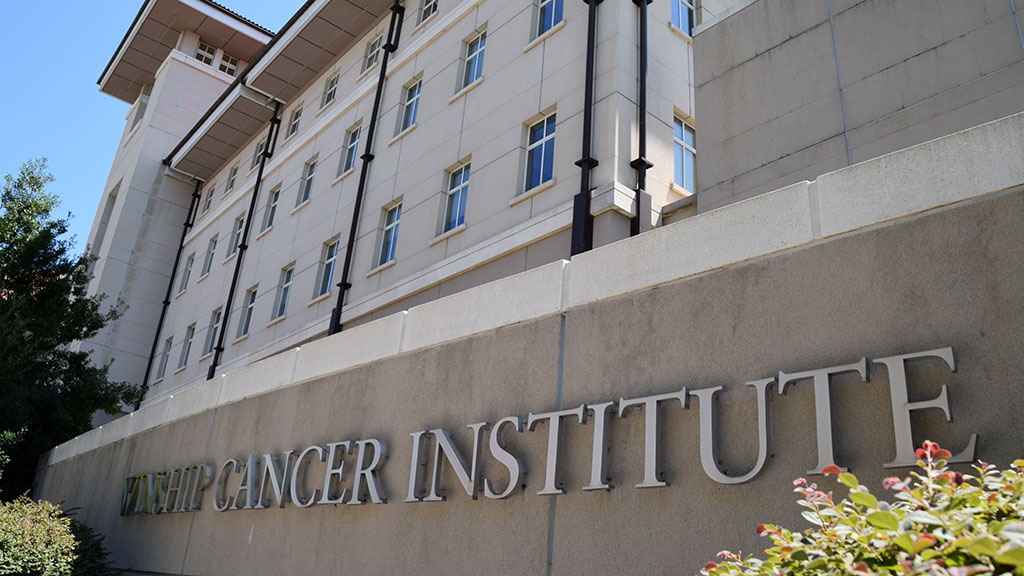
Winship Cancer Institute
Medical institution in Atlanta, GeorgiaWikipedia
12
MENTIONS
8
EPISODES
7
PODCASTS
Search complete. 12 mentions across 8 episodes found for "Winship Cancer Institute".
Sep 24, 2026

Jessica ThomasHOST
And researchers have known for some time that at least some neuroendocrine tumors can express GLP-1 receptors.
Jessica ThomasHOST
Dr. Pohine-Ear, an associate professor at Emory University and Winship Cancer Institute, is an expert in neuroendocrine tumor biology and has conducted extensive research on GLP-1 receptors in human neuroendocrine tumors.
Po-Hien EarGUEST
Why they are often in the news now is because the new GLP-1 drugs, these are fantastic molecules that are very effective at helping people to control their diabetes and their obesity and overall has improved the lives of many, many people.
Po-Hien EarGUEST
So that's why it's really a very hot topic at the moment.
28 MINS LATER
Jessica ThomasHOST
We'll link the full expert consensus statement on the NETRF webpage for this episode, along with a transcript.
Jessica ThomasHOST
For anyone who would like to learn more, or use it as a resource when talking with their care team.
Jessica ThomasHOST
We spoke with one of its lead authors, Dr. Udavir Grewal, a GI and neuroendocrine medical oncologist at Winship Cancer Institute of Emory University.
Udhayvir Singh GrewalGUEST
A lot of our patients have increasingly turned to us for advice, whether these agents are safe, what could they do to determine the risk associated with these agents.

Neil LoveHOST
We have a great faculty today, Dr. Aditya Bardia from the UCLA Health Johnson Comprehensive Cancer Center in Los Angeles.
Neil LoveHOST
Dr. Kevin Kalinske from the Winship Cancer Institute of Emory University in Atlanta, and Dr. Joyce O'Shaughnessy from Texas Oncology and the Sarah Cannon Research Institute in Dallas.
Neil LoveHOST
As always, we will be discussing the use of unapproved agents and regimens, so check out the package inserts for more information.
Neil LoveHOST
We basically have divided this up into three sections, and for each one, The faculty is going to give a short presentation summarizing some of the key papers.

Neil LoveHOST
We have a great faculty today, Dr. Aditya Bardia from the UCLA Health Johnson Comprehensive Cancer Center in Los Angeles.
Neil LoveHOST
Dr. Kevin Kalinske from the Winship Cancer Institute of Emory University in Atlanta, and Dr. Joyce O'Shaughnessy from Texas Oncology and the Sarah Cannon Research Institute in Dallas.
Neil LoveHOST
As always, we will be discussing the use of unapproved agents and regimens, so check out the package inserts for more information.
Neil LoveHOST
We basically have divided this up into three sections, and for each one, The faculty is going to give a short presentation summarizing some of the key papers.
Jessica ThomasHOST
And researchers have known for some time that at least some neuroendocrine tumors can express GLP-1 receptors.
Jessica ThomasHOST
Dr. Pohine-Ear, an associate professor at Emory University and Winship Cancer Institute, is an expert in neuroendocrine tumor biology and has conducted extensive research on GLP-1 receptors in human neuroendocrine tumors.
Po-Hien EarGUEST
Why they are often in the news now is because the new GLP-1 drugs, these are fantastic molecules that are very effective at helping people to control their diabetes and their obesity and overall has improved the lives of many, many people.
Po-Hien EarGUEST
So that's why it's really a very hot topic at the moment.
28 MINS LATER
Jessica ThomasHOST
We'll link the full expert consensus statement on the NETRF webpage for this episode, along with a transcript.
Jessica ThomasHOST
For anyone who would like to learn more, or use it as a resource when talking with their care team.
Jessica ThomasHOST
We spoke with one of its lead authors, Dr. Udavir Grewal, a GI and neuroendocrine medical oncologist at Winship Cancer Institute of Emory University.
Udhayvir Singh GrewalGUEST
A lot of our patients have increasingly turned to us for advice, whether these agents are safe, what could they do to determine the risk associated with these agents.

Summer JohnsonHOST
Cancer centers share their creative solutions to challenges in patient care and operations, and ACCC members engage directly with these award winners at the ACCC National Oncology Conference to bring those successful strategies back to apply at their own cancer centers.
Summer JohnsonHOST
Today, a preview of an ACCC Innovator Award-winning program by Winship Cancer Institute at Emory University.
Summer JohnsonHOST
Dr. Teresa Gillespie is a professor in the School of Medicine at Emory University and Associate Director for Community Outreach and Engagement at Winship Cancer Institute.
Summer JohnsonHOST
Thanks, Teresa, for joining us.
Summer JohnsonHOST
What challenge was your team looking to solve?
Theresa W. GillespieGUEST
So a big problem is that the Winship Cancer Institute is in the city of Atlanta, which is in a very... urban metro area.
Theresa W. GillespieGUEST
And then all around the rest of the state are 120 rural counties.
Theresa W. GillespieGUEST
So our challenge was how to best reach these rural populations that were at a distance.

Patricia JakelHOST
Please join me and Stephanie as we discuss oncology nurse navigation with Emily Beard.
Patricia JakelHOST
Emily currently serves as an oncology survivorship navigator at the Winship Cancer Institute at Emory University.
Emily BeardGUEST
Honestly, you know, I thought I was going into nursing to become a midwife.
Emily BeardGUEST
That was kind of what I had thought, you know, when I was a nursing student that I would end up doing.

Steve JacksonHOST
This is Project Oncology on ReachMD.
Steve JacksonHOST
On this episode, we'll hear from Dr. Jonathan Cohen, a board-certified hematologist and medical oncologist at Emory Winship Cancer Institute in Atlanta.
Steve JacksonHOST
He'll be highlighting the biggest unanswered questions surrounding chemotherapy-free approaches for mantle cell lymphoma, which he spoke about at the 2026 Society of Hematologic Oncology Annual Meeting.
Steve JacksonHOST
Here's Dr. Cohen now.

Keith CantorGUEST
Well, the extra goes to the hair because they're the second fastest growing cells and it kills it.
Keith CantorGUEST
As a matter of fact, I just had a conversation with Emory Hospital and Winship Cancer Institute,
Jeanine Cook-GarardHOST
which
Keith CantorGUEST
is part of Emory.