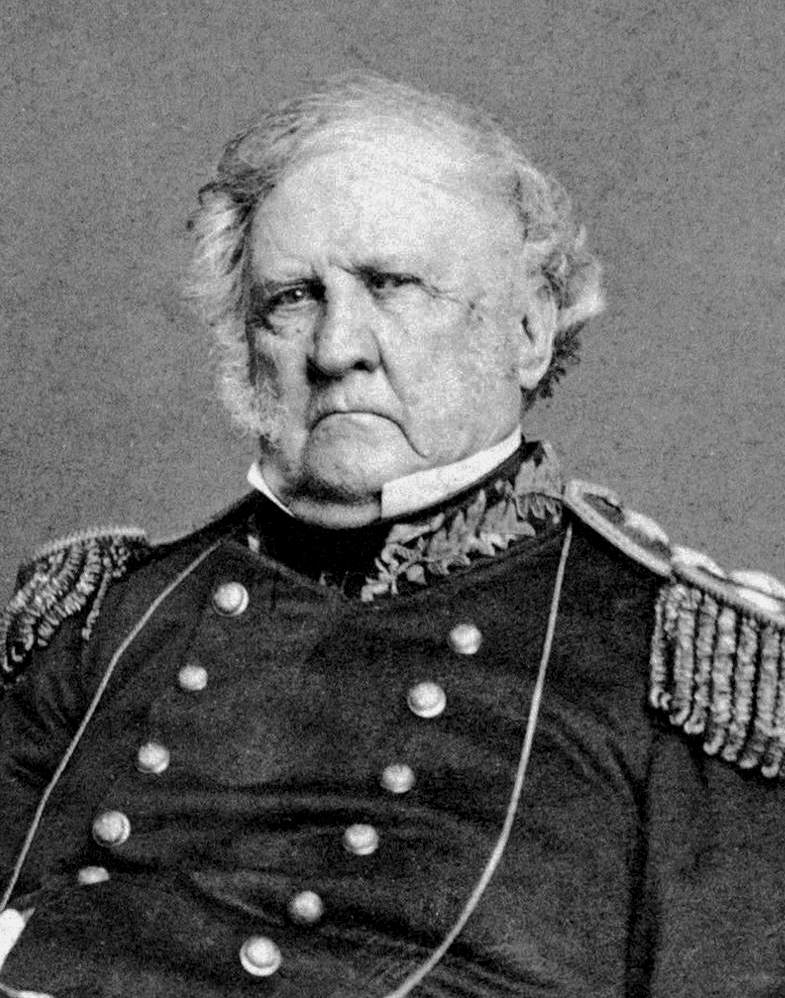
Winfield Scott
Former Commanding General of the United States ArmyWikipedia
96
MENTIONS
39
EPISODES
35
PODCASTS
Search complete. 96 mentions across 39 episodes found for "Winfield Scott".
Sep 21, 2026

SamHOST
So it proved American soldiers could fight well when they were properly led, even if the timing was absurd.
SophieHOST
right then the mexican-american war which atkinson treats as this pivotal moment because it's the first time the country tastes territorial ambition and military success at the same time winfield scott marches from vera cruz all the way to mexico city and it's a genuine masterpiece of operational art
SamHOST
And Scott's insight is that war isn't just courage.
SamHOST
It's supply lines and reconnaissance and understanding what the enemy intends to do, which sounds obvious until you remember how many commanders ignored it.

SarahHOST
The actions of the treaty party threw the nation into a civil war that raged for decades and which resulted in the assassinations of Elias Boudinot, John Ridge, and John Ridge's father, Major Ridge, or The Ridge.
SarahHOST
Some Cherokee began to leave in 1835 willingly under the treaty terms, but others resisted until 1838, when the United States Army, under General Winfield Scott, forced the removal of the remaining Cherokee, who were force-marched to the Indian Territory.
SarahHOST
The story of that forced migration is long and important, but one that we don't have the ability to give justice to here.
SarahHOST
But in the end...

Katie GiboneyNARRATOR
Both parties, Whigs and Democrats, endorsed the fugitive slave law and approved the great compromise.
Katie GiboneyNARRATOR
The Democrats, with Franklin Pierce as their leader, swept the country against the war hero, General Winfield Scott, on whom the Whigs had staked their hopes.
Katie GiboneyNARRATOR
Even Webster, broken with grief at his failure to receive the nomination, advised his friends to vote for Pierce and turned away from politics to meditate upon approaching death.
Katie GiboneyNARRATOR
The verdict of the voters would seem to indicate that for the time everybody, save a handful of disgruntled agitators, looked upon Clay's settlement as the last word.

Marc FennellHOST
They are both understandably shocked that a dispute over a pig has grown into a standoff that now involves as many as three warships, more than 80 guns, and over 2,000 men.
Mike VouriGUEST
The last thing they wanted was to go to war with each other, so they sent out the commanding general of the United States Army, Winfield Scott.
Marc FennellHOST
So Winfield Scott was known as The Great Pacifier.
Marc FennellHOST
Uh, he'd recently just resolved two diplomatic nightmares on the Canadian border without, it has to be said, a single shot being fired.
Marc FennellHOST
So yeah, he's the guy they need.

John GreenHOST
Another critic was concerned about the increase in executive power that Polk seemed to show, saying, That critic was none other than noted peacenik Abraham Lincoln, who would go on to do more to expand executive power than any president in the 19th century except maybe Andrew Jackson.
John GreenHOST
Right, so Santa Ana's army was defeated in February 1847, but Mexico refused to give up, so Winfield Scott, who had the unfortunate nickname Old Fuss and Feathers, captured Mexico City itself in September.
John GreenHOST
A final peace treaty, the Treaty of Guadalupe Hidalgo, was signed in 1848, under which Mexico confirmed the annexation of Texas and further ceded California, as well as several other places that would later become states, but we couldn't fit on the map.
John GreenHOST
In return, the U.S. paid Mexico $15 million and agreed to a no-backseas deal in Reed, Texas, thereby freeing Mexico from the shackles of Amarillo.

Juan NaulaNARRATOR
Van Buren's political rise was accompanied by a series of family tragedies.
Juan NaulaNARRATOR
In 1814, his wife, Hannah, gave birth to his fourth son, whom he named after General Winfield Scott, a hero of the War of 1812 against the British, who had worked with Van Buren in defending New York from the British.
Juan NaulaNARRATOR
However, Winfield Scott Van Buren died a few weeks after his birth.
Juan NaulaNARRATOR
Van Buren's father, Abraham, passed away in 1817, his mother, Maria, the following year, and in 1819, Van Buren's wife, Hannah, died of tuberculosis just before her 36th birthday.
Juan NaulaNARRATOR
He never remarried, and instead became a devoted father to his four surviving sons, Abraham, John, Martin, and Smith, all of whom would go on to support their father's political career at state and national levels.
26 MINS LATER
Juan NaulaNARRATOR
Like most of the Democratic Party, Van Buren supported the policy as the only means of preventing bloodshed between whites and Native Americans in the South.
Juan NaulaNARRATOR
While most of the removals were carried out under the Jackson administration, it was up to Van Buren to oversee the removal of the Cherokees.
Juan NaulaNARRATOR
By 1838, 2,000 Cherokees had gone west voluntarily, and in May, Van Buren ordered General Winfield Scott and an army of 7,000 men to carry out the relocation of 14,000 Cherokees.

DianeHOST
A part of the Trail of Tears came through Chattanooga.
DianeHOST
In May 1838, soldiers under the command of General Winfield Scott began rounding up Cherokee Indians in the Chattanooga area who'd refused to move to Indian Territory in the future Oklahoma.
DianeHOST
About 15,000 Cherokee were placed in stockades in Tennessee and Alabama under this removal.
DianeHOST
Roughly 3,000 were sent by boat down the Tennessee River, and the rest were marched overland in the fall and winter of 1838 to 1839.

Sarah Beth TerryHOST
The one we stand to take our hats off and salute flags at sporting events was written on this date back in 1814.
Sarah Beth TerryHOST
In 1847, US forces under General Winfield Scott captured Mexico City in the Mexican-American War.
Sarah Beth TerryHOST
In 1901 on this date, President William McKinley died from complications of gunshot wounds, making Theodore Roosevelt the youngest president ever.
Sarah Beth TerryHOST
He was 42 years old.

ShelleyHOST
Today in history.
ShelleyHOST
In 1847, during the Mexican-American War, US forces under General Winfield Scott took control of the Mexican city.
ShelleyHOST
In 1861, the first naval engagement since the start of the Civil War took place as the USS Colorado attacked and sank the Confederate private schooner Judah off the coast of Pensacola, Florida.
ShelleyHOST
In 1901, President William McKinley died in Buffalo, New York of gunshot wounds inflicted by an assassin eight days earlier.

Bob TaylorHOST
Ca- uh, Lincoln came out of the Whig Party, so.
Becky TaylorHOST
Well, and then they avoided hard questions, like slavery, and they fell apart, you know, when they couldn't answer the questions, and they nominated an old, out-of-touch candidate, which was Winfield Scott, AKA Joe Biden.
Bob TaylorHOST
[laughs]
Becky TaylorHOST
That's what the, that's what the Whig Party actually did.
29 more episodes mention Winfield Scott.
Create an account to see the whole feed, search across every transcript, and follow the entities you care about.