William Westmoreland
GeneralWikipedia
43
MENTIONS
14
EPISODES
13
PODCASTS
Search complete. 43 mentions across 14 episodes found for "William Westmoreland".
Nov 4, 2026

Dave LeeHOST
That's why almost every expert and the president himself says it won't happen.
Dave LeeHOST
But generals have reasoned their way to this edge before, and it's worth knowing how close they got.
Dave LeeHOST
August 6, 1945, Hiroshima.
Dave LeeHOST
Three days later, Nagasaki.

Eliot CohenGUEST
But again, a very common pattern, and it shows up even in the way people look.
Eliot CohenGUEST
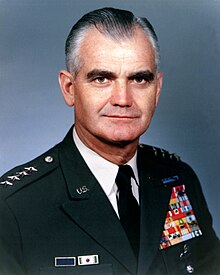
You compare William Westmoreland looks like your idea of a soldier, ram around straight, you know, impeccable uniform, jutting jaw and stuff.
Eliot CohenGUEST
Creighton Abrams looked like you had, you know, tossed him in a dryer and put him on spin dry for a while and let him stagger out.
Eliot CohenGUEST
And Creighton Abrams was a much better commander than Westmoreland was.

speaker_0NARRATOR
Inside the village, the soldiers found women, children, and elderly people.
speaker_0NARRATOR
not vietcong soldiers at first they didn't panic or run following the gi's instructions but then according to one soldier's testimony those soldiers started killing them it was a brutal scene people were killed with gunshots bayonets and more one man was pushed into a well and a grenade was thrown in after him dozens of people were lined up in front of ditches and shot with one soldier testifying that he went through several magazines of his m16 people were grouped together and then shot at with grenade launchers there was no discrimination between gender or age women as young as teenagers and as old as grandmothers were killed and in some cases sexually assaulted children even infants were not spared even after their mothers threw themselves over them to try and protect them from the shooting this went on intermittently for three hours until at 11am a ceasefire was ordered and soldiers from Company C proceeded to eat lunch that sounds particularly cold-blooded to you you're not the only one general william c westmoreland wrote the same in his memoir years after the incident don't feel too bad for him just yet though during the ordeal a helicopter crew was flying over the village to provide close air support in case it was needed the pilot warrant officer hugh thompson jr watched more or less everything as it unfolded from the air he radioed hq several times but nothing was done about it he and his crew landed once to ask the soldiers if the civilians needed help they got no good answers with one soldier telling a shocked thompson that he was helping them out of their misery thompson took off again and after some time decided he'd seen enough he landed his helicopter to help a group of civilians who were trapped in a bunker he then told his american crew to fire on the american soldiers if they shot at the people inside thompson managed to talk the civilians mostly women and children over to his helicopter he then flew them out of the village in two groups staying behind with the second group to protect them from his own colleagues after that evacuation thompson landed his helicopter a third time to rescue a four-year-old girl who had crawled out of a ditch bloodied but apparently unharmed upon returning to base he told his superiors that american infantry and me lie were no better than the nazis it's mass murder out there they're rounding them up and herding them into ditches and then just shooting them in response the ceasefire at 11am was ordered with Thompson's intervention the massacre was over and the final count of anywhere from 347 to 504 civilians had been to put it plainly murdered on the American side there was a single casualty a soldier who had shot himself in the foot to avoid taking part in the massacre but now would come the next shameful chapter in this story the aftermath At first, not much was made of the operation in My Lai.
speaker_0NARRATOR
The combat report stated that 22 civilians and 128 Viet Cong combatants had been killed, and the operation was dubbed a success.
speaker_0NARRATOR
Several higher-ups, including General Westmoreland, congratulated the unit on a job well done, but there were rumors.

ThomasGUEST
Okay, so, and there's another delicious irony about Khe Sanh.
ThomasGUEST
It was Westmoreland's decision, and Westmoreland, I think, was an abject mediocrity.
ThomasGUEST
A dear friend of our family was General Neil Creighton, who was a fascinating guy.
ThomasGUEST
He was the curator of, he was responsible for the McCormick Trust, and obviously I'm a huge Robert R. McCormick fan, you know.
ThomasGUEST
When I was a kid, we'd go visit him and his wife at Cantini, and...
ThomasGUEST
he, uh, he served most of his career with, uh, armored calorie black horse, the German border, but he spent a couple of years in Vietnam as a company commander.
ThomasGUEST
And, you know, he commanded tanks in Vietnam and he was always, you know, he said to me one time, he's like, you know, it's, it's like, you know, it's horseshit that people act like, you know, there wasn't armor in Vietnam, but there was, but, you know, in any event, he, uh, One of his quips was that Westmoreland had about three stars too many.
ThomasGUEST
And Westmoreland, in almost every other circumstance, had a completely wrongheaded view of the strategic and tactical situation.

David PetraeusGUEST
So- And then, of course, everybody below the strategic leader is developing big ideas at his or her level, but they're doing it within the confines of what the strategic leader has decided.
David PetraeusGUEST
For example, if General Westmoreland decides we're going to pursue a war of attrition with North Vietnam, which he did, and search and destroy operations and so forth.
David PetraeusGUEST
That's what the division commanders and the brigade commanders and battalion commanders are going to do.
David PetraeusGUEST
They have a certain degree of latitude in the conduct of operations and so forth.

Matt HayesHOST
The tide of the battle turned finally with the arrival of several hundred South Vietnamese reinforcements, and numerous Allied airstrikes.
Matt HayesHOST
With the camp secured, General William Westmoreland, senior U.S. military commander in Saigon, decided to seize the advantage and sent in the 1st Cav Division, air mobile, to find, fix, and defeat the enemy forces that had threatened Plymouth.
Matt HayesHOST
This decision would result in November in the Battle of the Ia Drang Valley, the war's bloodiest battle to date.
Matt HayesHOST
The Vietnamese communists never won a major battle in the entire war.

Geoff WawroGUEST
This has already happened.
Geoff WawroGUEST
So West Berlin's plan is, OK, as bad as that is, it offers us an opportunity because we have superior technology.
Geoff WawroGUEST
We have superior firepower and mobility.
Geoff WawroGUEST
So I can use this new vertical envelopment concept provided by this air mobile posture.
John BatchelorHOST
And I want to emphasize here again and again, Jeff, it's in your book, this is a massacre with heavy weaponry, and the North Vietnamese keep coming.
John BatchelorHOST
Is that a consideration to Westmoreland, the fever and passion of the NVA troops?
Geoff WawroGUEST
Well, I mean, they understood, West Berlin and the Americans understood the passion that these North Vietnamese troops had for what they were doing.
Geoff WawroGUEST
But what was, as the historian, what was most interesting to me about the battle was that the North Vietnamese were not throwing themselves away.

Charlie RoseHOST
Stay with us.
Charlie RoseHOST
Douglas MacArthur William Westmoreland Maxwell Taylor Their portraits hang in the office of the superintendent, the president of the university.
Charlie RoseHOST
All were graduates of West Point and served as superintendent.
Charlie RoseHOST
In recent years, it is the last position an individual holds in the Army.

Jocko WillinkHOST
[laughs]
Bing WestGUEST
And she knew there was something going on that was different when, in 1945, both of them were in the Battle for Okinawa as platoon commanders, and she was scared to death.
Bing WestGUEST
And I had a favorite blanket that I used to suck all the time, and she said, "You have to do something for Uncle Tommy and Uncle Wally." And she said, with that, I opened up the window, threw the blanket out, and said, "That's for the dirty yellow baskets."
Jocko WillinkHOST
[laughs]
Bing WestGUEST
And we transport, transposed, we went over to Okinawa, the usual stuff, you know, hung off Vietnam, not a lot was going on.
Bing WestGUEST
Got out, I was going to graduate school at Princeton, and my regimental commander said, "You know, we need...
Bing WestGUEST
We're getting into this fight now," in '66, and he had fought in World War II, the others had fought in Korea, the regimental commanders, and they said, "We have no way of telling the new lieutenants and platoon sergeants what they're getting into." So I said, "Well, I'm perfectly willing to come back," so I came back and they immediately put me into different units, and I'd spend two or three weeks with a unit in combat, come back, write that one up, and go out, do...
Bing WestGUEST
They'd send me to some place else.
4 more episodes mention William Westmoreland.
Create an account to see the whole feed, search across every transcript, and follow the entities you care about.