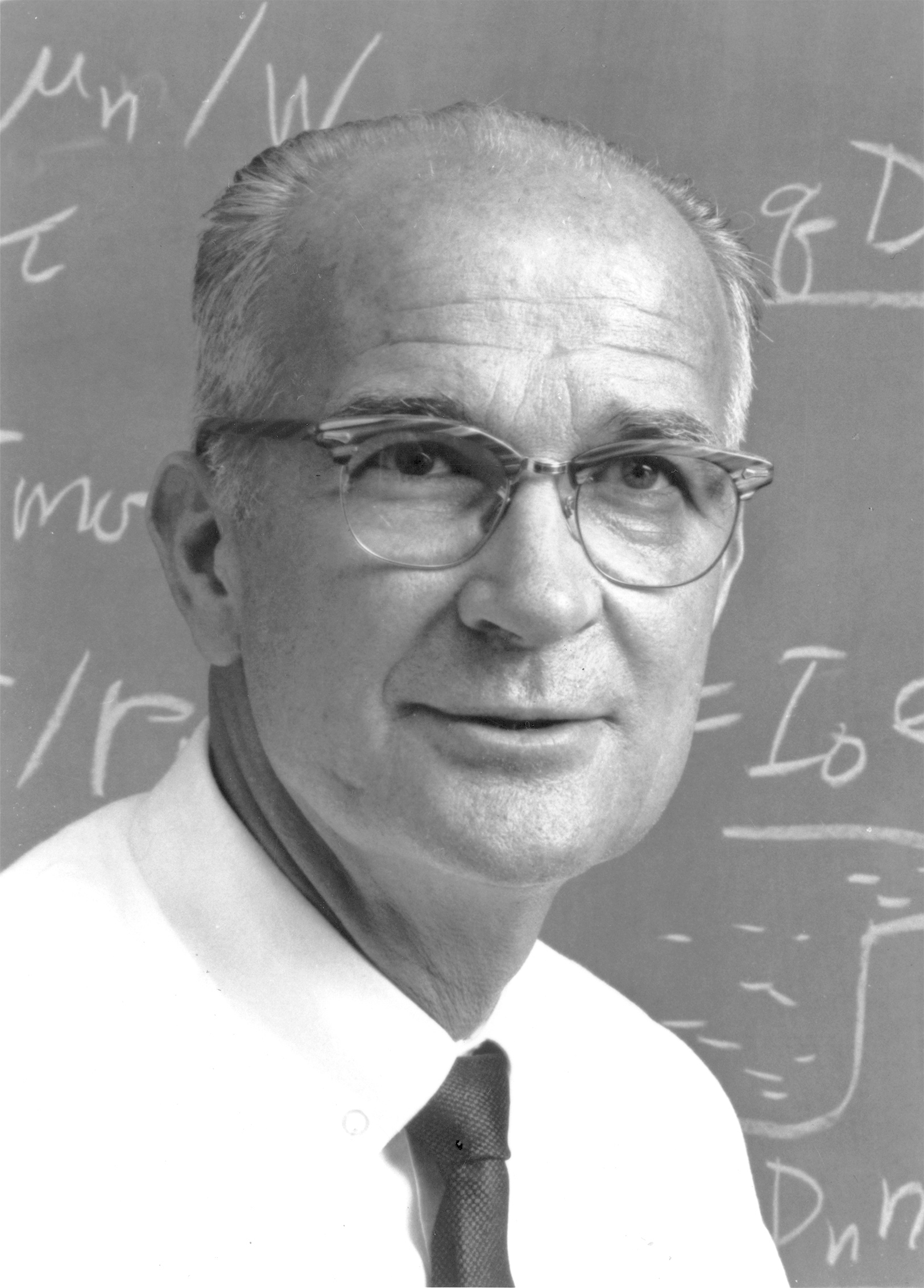
William Shockley
American physicistWikipedia
23
MENTIONS
15
EPISODES
15
PODCASTS
Search complete. 23 mentions across 15 episodes found for "William Shockley".
Sep 21, 2026

John A. RogersGUEST
... that's the point.
John A. RogersGUEST
I think for me, a role model is John Bardeen, who was a theoretical physicist, uh, focused on semiconductor charge transport, and working with, uh, Brattain and, and Shockley, they invented the transistor, won the Nobel Prize, changed the world.
John A. RogersGUEST
You know, if, if you can aspire to that level of science and technology, I think that's a model that we like to, like to think about.
John A. RogersGUEST
So put another way, we'd like to generate knowledge for the ages, but technology for today.

JoeHOST
Their air attack plan called for waves of 300 to 400 kamikaze aircraft every hour until all aircraft and pilots were expended, a rate that would have resulted in more attacks in three hours than the entire three-month Okinawa campaign.
JoeHOST
William Shockley's study for the Secretary of War Henry Stimson estimated conquering Japan would cost 1.7 to 4 million American casualties and 5 to 10 million Japanese fatalities with large-scale civilian participation in defense.
JoeHOST
These potential casualty estimates made it an acceptable fact that America would lose a very large number of men.
JoeHOST
This prompted President Harry Truman to finally authorize the use of the atomic bomb to force Japan's surrender.

Cory DoctorowHOST
There's hardly any technology, any built infrastructure, that is free from sin.
Cory DoctorowHOST
Every microchip you use is filled with billions of linear descendants of William Shockley's silicon transistors.
Cory DoctorowHOST
Shockley was a monster, a virulent racist and eugenicist who spent his Nobel Prize bounty in efforts to pay black women to have their tubes tied as part of a disgusting racist project.
Cory DoctorowHOST
Going further back, Europe's roads owe their existence to Rome's imperial conquest, a bloody campaign that included mass enslavement and the indiscriminate slaughter of civilians.
10 MINS LATER
Cory DoctorowHOST
Optimizing open models is a matter for collaborative open effort, not closed labs fueled by investors' centabillions.
Cory DoctorowHOST
AI has technopolitics, but those politics are neither inevitable nor immutable.
Cory DoctorowHOST
Sam Altman's lurking presence in a language model is no more politically disqualifying than William Shockley's residue in your microchips.
Cory DoctorowHOST
AI today might be a defective tomato harvester, immiserating workers and driving out good tomatoes with bad.

Bob MurphyHOST
Major historical inventions.
Bob MurphyHOST
The transistor, 1947, invented by Jan Bardeen, William Shockley, and Walter Brayton, launching the solid-state electronics revolution.
Bob MurphyHOST
Information theory, formulated by Claude Shannon, setting the mathematical basis for the digital age.
Bob MurphyHOST
The laser, fundamental principles were first published and patented by Bell Labs researchers.

Andrew FeldmanGUEST
Uh, my parents were faculty, and there's a, a little neighborhood, uh, where all your, all your neighbors are, are other professors.
Andrew FeldmanGUEST
Um, my neighbor was, uh, William Shockley, the inventor-
Jack AltmanHOST
That's crazy.
Jack AltmanHOST
Yeah

Mike KasparHOST
Yeah, and I will – just from my own personal perspective on watching the film, you can't unsee this.
Mike KasparHOST
Once you know and once you begin to understand William Shockley and eugenics and European racism and superiority and colonialism and – All of this stuff is laid bare and it's not – you're not pulling from tangential relationships.
Mike KasparHOST
This is where it is.
Mike KasparHOST
This is where it came from.

Valerie VeatchGUEST
But the origins of that term were an attempt to raise philanthropic funding for certain kinds of mathematical research.
Valerie VeatchGUEST
And John McCarthy is the character who kind of coins this term as a sort of flashy, sexy term that he can raise money underneath.
Valerie VeatchGUEST
And always the project in his mind was to create human-level intelligence.
Valerie VeatchGUEST
And it's super laughable that computers can produce human-type intelligence.
Valerie VeatchGUEST
Why it's so weird.
Valerie VeatchGUEST
I mean, one layer that I don't touch on in the film, but we can all agree with is this kind of idea that we see becoming repopularized, which is the kind of new frontier attitude of American expansionism.
Valerie VeatchGUEST
And so when you start there with that, you know, area, then we have that first layer of capture and erasure, right? And then we have the character William Shockley in our film, who I won't spoil it by giving any more information than that.
Valerie VeatchGUEST
But, you know, he's somebody who grew up in the Bay Area and after his service in the war, he came back and created a... technology company that then a lot of spawned a lot of other technology companies um creating the semiconductor and microchips and there's we don't talk about it in the film at all but there's also a legacy of land poisoning and environmental degradation that's a direct result of this enterprise being the industry in silicon valley

Michael GibsonGUEST
But it's pretty unusual.
Michael GibsonGUEST
Maybe William Shockley, I guess, Shockley Semiconductors, I don't know.
MattHOST
But I think
Michael GibsonGUEST
we're going to start to see

JayHOST
So Fairchild was created by eight individuals who left this company called Shockley Semiconductors.
JayHOST
William Shockley helped create the integrated circuits.
JayHOST
He creates a company in Silicon Valley, one of the first semiconductor companies, one of the first technology companies, and they're from the East Coast.
JayHOST
And usually all technology companies would be on the East Coast at this point.

Judge GlockGUEST
And like a lot of industries in America, they snowball in these local areas.
Judge GlockGUEST
I often ask people, why is Silicon Valley Silicon Valley? Well, it's Silicon Valley because a guy named William Shockley went back there to take care of his ailing mother and started Shockley Semen Conductors.
Judge GlockGUEST
A little kind of grain can become... over time, the base of a giant flourishing industry.
Judge GlockGUEST
And that's kind of what happened in Loudoun.
5 more episodes mention William Shockley.
Create an account to see the whole feed, search across every transcript, and follow the entities you care about.