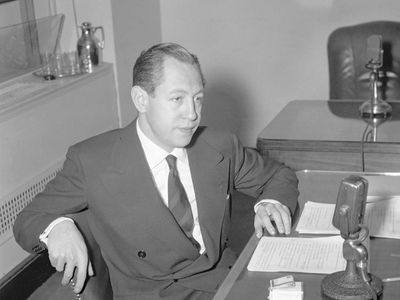
William S. Paley
American businessman and former CEO of CBSWikipedia
15
MENTIONS
13
EPISODES
13
PODCASTS
Search complete. 15 mentions across 13 episodes found for "William S. Paley".
Nov 1, 2026

Matt the CatHOST
Duke was really impressed with the group and got them a record deal in New York.
Matt the CatHOST
In 1930, William Paley, the head of CBS, hired the brothers, making them the first African Americans to have a national radio show.
Matt the CatHOST
They would even occasionally sing with Rudy Valli on his radio show, The Fleischman's Yeast Hour.
Matt the CatHOST
On September 25, 1931, they had their first recording session for Brunswick Records.

Mary LivingstonePANELIST
Hello? New York calling? Yes, he's here.
Mary LivingstonePANELIST
Jack, it's Mr. William Paley, the head of CBS.
Mary LivingstonePANELIST
Oh.
Jack BennyHOST
Oh, I wonder what he wants.

Joe GaragiolaSOUNDBITE_SPEAKER
Mr.
Joe GaragiolaSOUNDBITE_SPEAKER
Bill Paley, CBS is here.
Joe GaragiolaSOUNDBITE_SPEAKER
We look around, a whole list.
Joe GaragiolaSOUNDBITE_SPEAKER
Mary Ann Moore is here.

David DonovanSOUNDBITE_SPEAKER
And, you know, I won't go on, but, you know, the people that you're in the Hall of Fame with are the legends of broadcasting.
David DonovanSOUNDBITE_SPEAKER
Ernie Anastas, Craig Carlton, Tom Murphy, who ran ABC, Bill Paley, who ran CBS, Regis Philbin, Walter Cronkite, Al Roker, Boomer Esiason, Funk Flex, Mike Francesa, Mr. G over at PIX, Marvin Scott, Angie Martinez, Mike Wallace.
David DonovanSOUNDBITE_SPEAKER
I mean, the names go on and on.
David DonovanSOUNDBITE_SPEAKER
Barbara

Eric LandGUEST
Well, I think the tough part for journalists is that their corporate leaders have to have a backbone and stand behind them when they're asking tough questions or when they're being threatened.
Eric LandGUEST
In the days of Arthur Ox Sulzberger, who owned the New York Times, and Bill Paley, and the leaders of NBC, Elton Ruhl, who ran ABC, Robert Sinoff ran NBC, they never would have allowed themselves to be intimidated by lawsuits or threats or license challenges.
Eric LandGUEST
They told their news people to go do news.
Eric LandGUEST
And I learned that from my first news director, Al Shadalkati in Cincinnati, who Cronkite felt was the greatest local newsman of his time, who refused to allow anyone from the outside into his newsroom because he feared that there would be some form of influence, whether from advertisers or outside influence.

RochesterPANELIST
Yeah.
RochesterPANELIST
Miss Livingston, who is William Paley?
Mary LivingstonePANELIST
Uh, William Paley is the head of the Columbia Broadcasting System.
Mary LivingstonePANELIST
Why?
RochesterPANELIST
He has now replaced Hale LeRoy in Mr. Benny's dreams.
Jack BennyHOST
I'm Jack Benny.
Mary LivingstonePANELIST
I don't care who you are, wipe your feet.
Jack BennyHOST
[laughs] Well, look, when Mr. William Paley comes in, tell him I want to see him right away, will you?

Kathleen BradyGUEST
They felt that this was going to be sufficient proof for the executives.
Kathleen BradyGUEST
And what happened is William Paley and the others told the writers, all right, put him in the show, but just have him on camera if it has something to do with music or whatever, but just have him there then.
Kathleen BradyGUEST
And so, of course, the writers who loved Bob and Marilyn, who loved Desi, made his being a band leader and Lucy wanting to get into show business a major theme, if not the theme, of the whole I Love Lucy show.
Kathleen BradyGUEST
So that's how Desi got on camera as much as he did and won the hearts of America.

Tom GulleyHOST
It irritated the suits to no end that Sundays at 8:00 was The Ed Sullivan Show, with its huge rating, and then everybody switched to Bonanza.
Tom GulleyHOST
William Paley would rant about this every time we would meet." By this time, all three networks began broadcasting most of their primetime shows in color, but Perry Mason was still filmed in black and white, and looked outdated compared to current shows.
Tom GulleyHOST
Um, you know.
Tom GulleyHOST
They, they filmed one episode in color, just to appease William S. Paley, but Patrick went on about Paley.

Bob SchillerGUEST
You can't do that.
Bob SchillerGUEST
No such thing." So he called, uh, William Paley, his friend, and he says, "Bill," he says, "I want to go on an hour and 15 minutes." And he says, "That's ridiculous." So he says, "Let me take care of it." So Desi picks up the phone, and he calls Mr.
Bob SchillerGUEST
U.S. Steel, uh, which followed the u- w- was to follow the Lucy-Desi Comedy Hour, and he says, "Mr.
Bob SchillerGUEST
U.S." He always dealt with the president of whatever, uh, company w- he was talking to.

Anthony ScaramucciHOST
And again, I don't know if you've ever read the book, but David Halberstam wrote a book years ago called The Powers That Be.
Anthony ScaramucciHOST
And one of the things that Bill Paley said, which I think gave some luster to CBS News, he expected to lose money.
Anthony ScaramucciHOST
in the news organization side of his business.
Anthony ScaramucciHOST
That's a great point.
3 more episodes mention William S. Paley.
Create an account to see the whole feed, search across every transcript, and follow the entities you care about.