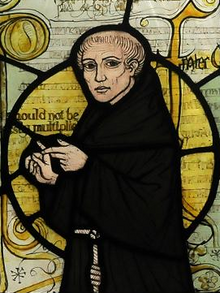
William of Ockham
English friarWikipedia
61
MENTIONS
34
EPISODES
32
PODCASTS
Search complete. 61 mentions across 34 episodes found for "William of Ockham".
Oct 28, 2026

Roger CunninghamGUEST
That's not actually accurate.
Roger CunninghamGUEST
Um, To bring a hypothesis into the plurality set is what William of Ockham spoke about.
Roger CunninghamGUEST
We have surpassed that point to where the ECDO argument is now necessary.
Roger CunninghamGUEST
It just has to be expressed with discipline so that it contrasts with its axial obliquity tilt in the fourth icon in this panel here.

Dan MillerHOST
And so we experience that as an act within history, but in fact, it's one eternal decree outside of history, right? So to us, it feels as if God is undertaking acts in history or responding to us and so forth, but it's actually the unfolding of a set of events that have been predetermined from before the creation of the universe, right? So we could say that experientially, we experience these things as temporal, but metaphysically speaking, they're actually not, right? So that's sort of the classical view.
Dan MillerHOST
The next position that's worth thinking about comes from a medieval theologian, William of Ockham.
Dan MillerHOST
you know anything about medieval theology then you know that occam's name looms large and it looms large because i think occam is famous in the christian theological tradition for advancing a number of sort of really complicated fascinating and contentious positions on a lot of different topics he's what's known as a nominalist um In popular sort of parlance, when people talk about so-called Occam's razor, it's named after him.
Dan MillerHOST
It's a little bit of a misnomer, but you can get to the idea through his thought if you want to.
Dan MillerHOST
And so on this basis, the argument is that no matter what God has known eternally, it is nevertheless because of our free decisions.
Dan MillerHOST
So even if God foreknows something from all eternity, that perfect knowledge is still a result of our free actions.
Dan MillerHOST
So Ockham kind of wants to have it all.
Dan MillerHOST
God has perfect, timeless knowledge.

Aaron RennGUEST
And some people go back a long way.
Aaron RennGUEST
Some people say it was William of Ockham and nominalisms where it all went wrong.
Aaron RennGUEST
Charles Taylor, this Canadian philosopher, wrote a book called A Secular Age that told essentially a 500-year story of secularization.
Aaron RennGUEST
I mean I would say, look, the trends were moving sort of away from Christianity in the West for a long time.

Aaron RennGUEST
And some people go back a long way.
Aaron RennGUEST
Some people say it was William of Ockham and nominalisms where it all went wrong.
Aaron RennGUEST
Charles Taylor, this Canadian philosopher, wrote a book called A Secular Age that told essentially a 500-year story of secularization.
Aaron RennGUEST
I mean I would say, look, the trends were moving sort of away from Christianity in the West for a long time.

Joe FolleyGUEST
if not millennia, certainly over a millennium, an awful lot of incredibly sophisticated thoughts on all subjects took place within a theological context.
Joe FolleyGUEST
The classic example of this is William of Ockham, of Ockham's raise of fame, who not only made innovations there, which is methodological principles, but also in early medieval logic and various other epistemic questions, which we today might not consider to be theology, but he was writing theology and was a theologian.
Joe FolleyGUEST
So in some ways, I think that my interest in theology partly comes about because effectively, if you want to engage with some of the most interesting ideas from the past, you're going to end up engaging with theology.
Joe FolleyGUEST
There's just kind of no way around it.

Ike BakerGUEST
if you really want to understand Plato, you need to go to the traditions before Plato and work your way forward in time.
Ike BakerGUEST
And, you know, we have scholasticism of Thomas Aquinas, even William of Ockham and all that stuff that, that kind of, it really gives, puts an artificial box, a hermeneutical box around Platonism.
Ike BakerGUEST
That's digestible in terms of Aristotle.
Ike BakerGUEST
And the thing is, is because Plato, Plato fucked with Christian theology.

Nathan SkeensGUEST
He didn't represent every scholastic, and he had his critics.
Nathan SkeensGUEST
Ockham was a good critic of Aquinas, among others.
Nathan SkeensGUEST
So, I mean, there were various individuals who would say they disagree with Aquinas, but Aquinas was kind of the big dog theologically at this time, and he had a huge influence on how the church thinks and operates.
Nathan SkeensGUEST
Certainly the Roman Catholic Church today still is heavily indebted to Aquinas, to Thomas Aquinas.
Aaron RennGUEST
And some people go back a long way.
Aaron RennGUEST
Some people say it was William of Ockham and nominalisms where it all went wrong.
Aaron RennGUEST
Charles Taylor, this Canadian philosopher, wrote a book called A Secular Age that told essentially a 500-year story of secularization.
Aaron RennGUEST
I mean I would say, look, the trends were moving sort of away from Christianity in the West for a long time.

speaker_0HOST
And then that... little irrational human person made of flesh and blood who is intellectually a worm compared to this machine, yet has this personhood that's kind of indefinable that somehow rebels against it.
speaker_0HOST
And I guess the totalitarian control of the machine, right? But Less common is the discussion of how the hairs of nominalists and empiricists of William of Ockham and David Hume have contributed to the demise of personal dignity.
speaker_0HOST
This storyline is relatively new to me at least, and it has been subject to my readings of late.
speaker_0HOST
So yeah, I mentioned this recently with Parkes-Gore too.
Justin SledgeSOUNDBITE_SPEAKER
So in many ways, the early adopters in Western philosophy were largely Platonists.
Justin SledgeSOUNDBITE_SPEAKER
What ultimately ends up happening is that Boethius ultimately takes control of this situation and led by people like Abelard and eventually the inheritance of Averroes and mostly Ockham.
Justin SledgeSOUNDBITE_SPEAKER
William of Ockham, famous for his razor, which is ironically one of the most systematically misquoted ideas ever.
Justin SledgeSOUNDBITE_SPEAKER
Ockham never said that the simplest answer is most correct because that's patently wrong.
Justin SledgeSOUNDBITE_SPEAKER
He simply said that you should not multiply entities beyond necessity in order to explain how a phenomena happens.
Justin SledgeSOUNDBITE_SPEAKER
But what we ultimately end up have are two rival positions in the West.
24 more episodes mention William of Ockham.
Create an account to see the whole feed, search across every transcript, and follow the entities you care about.