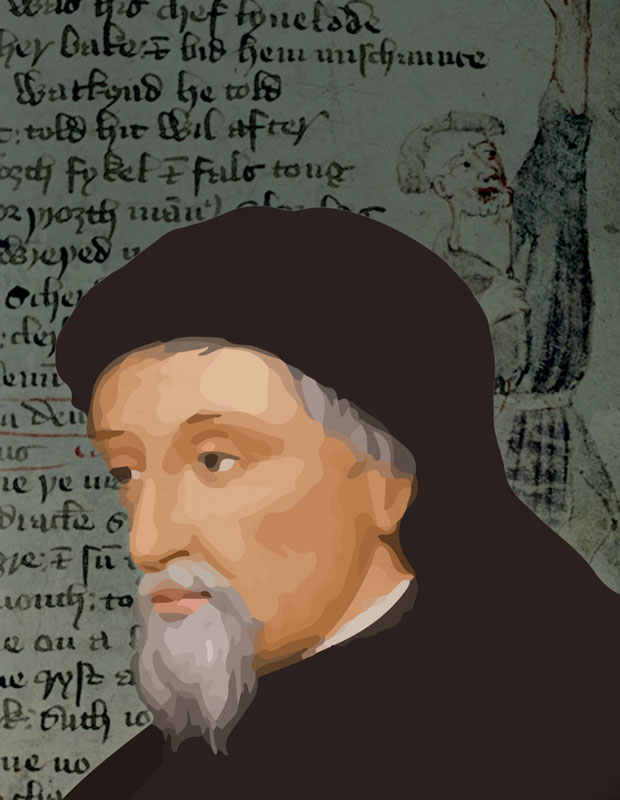
William Langland
AuthorWikipedia
12
MENTIONS
9
EPISODES
9
PODCASTS
Search complete. 12 mentions across 9 episodes found for "William Langland".
Oct 14, 2026

Lawrence WarnerGUEST
She was an essayist.
Lawrence WarnerGUEST
One of, one thing that she and I enjoyed figuring out was that I read her, um, nonfiction book about her ancestry, um, her maternal ancestry, uh, in Essex, um, and on page-- At, at the time, I should say, I was reading her books and skimming through sometimes appropriately to find any place where she might mention Piers Plowman or Langland, because Langland's the author of Piers Plowman, because it was a lot and she didn't remember it all.
Lawrence WarnerGUEST
She couldn't tell me where to look really.
Lawrence WarnerGUEST
And I spotted Warner, you know, so-and-so Warner on page 93, and looking into it, I realized this was my ancestor as well.
Lawrence WarnerGUEST
Again, not quite related, but, but Ewan Duff is a great photographer who did the covers of two of her early novels.
Lawrence WarnerGUEST
He took these photographs.
Lawrence WarnerGUEST
I was able to publish them with his permission and Maureen's and King's College London's in, um, the Yearbook of Langland Studies.
Lawrence WarnerGUEST
There were Black folks on the stage.

Hannah SkodaPANELIST
But it also, John Ball again in, in his sermon sort of calling everybody to revolt, cites the figure of Piers Plowman, who's a sort of made into a kind of quasi-mythical figure to kind of rally everybody together.
Hannah SkodaPANELIST
Piers Plowman's actually the subject of a poem by William Langland, who was horrified that his character should be used in this way.
Hannah SkodaPANELIST
But nevertheless, you've got the idea of a sort of rallying figure there.
Hannah SkodaPANELIST
You have a kind of iconography of revolt as well, so they have a banner, uh, or many banners.

Rick StevesHOST
I love it
Graham RobbGUEST
... for example, Piers Plowman Piers Plowman is one of the great medieval works of literature, uh, by William Langland, who lived in Worcestershire.
Rick StevesHOST
Yeah.
Graham RobbGUEST
And he...

Sam RotenbergHOST
The origin of this phrase apparently is all the way back in the 14th century.
Sam RotenbergHOST
Poet William Langland in England is credited with that.
Sam RotenbergHOST
But the sentiment is much, much older, over a thousand years before that.
Sam RotenbergHOST
The rabbis of the Mishnah said, he who is slow to anger and quick to forgive is a pious person.

Justin HensonHOST
This go around, we have Andrew Garfield playing Plowman, which isn't a known name for Robin Hood.
Justin HensonHOST
But I guess we can kinda connect it to a nod to Piers Plowman's a poem written by William Langland around 1377, which contains the oldest known literary reference to Robin Hood.
Justin HensonHOST
In this poem, a lazy priest acknowledges that he does not know his Latin church prayers very well, but knows the rhymes of Robin Hood.
Justin HensonHOST
So the name is merely, I think, just a nod, but utilizes it as almost an attempt at separation, but also an acknowledgement of to follow blind laziness that we can see towards the last 45 minutes or so of The Uprising.

Anthony DelaneyHOST
We're in the 14th century now, and we're starting to get some literary allusions here.
Matt LewisGUEST
Yeah, so the first kind of written reference that we have to anything to do with Robin Hood, definitely as Robin Hood the outlaw, comes in Piers Plowman, so William Langland's famous poem that he writes about this plowman out in the field kind of-
Anthony DelaneyHOST
Mm
Matt LewisGUEST
... daydreaming his life away and all of the visions that he has.
Matt LewisGUEST
He knows stories of Robin Hood.
Matt LewisGUEST
So by the time we're in 1377 with Piers Plowman, Robin Hood is established as a folk story, a tale that people are telling to each other.
Matt LewisGUEST
They're not written down yet, but William Langland here is writing down the fact that people are telling stories-
Maddy PellingHOST
Mm

HeatherHOST
He's going to be very important in part three, so remember his name.
HeatherHOST
And then right around this time, a writer called William Langland was working on a long poem called Pierce Plowman about an honest plowman searching for truth in a corrupt world.
HeatherHOST
And it was hugely popular.
HeatherHOST
In 1381, a letter that was attributed to John Ball told the people of Essex to stand together in God's name and bid Pierce Plowman go to his work.

Sally HelmHOST
Mm
Paul GreengrassGUEST
... by William Langland, which was just literally just a few years before the Peasants' Revolt, and that's basically a poem that features the dreams and reveries and hopes and fears and rages of a simple farmer.
Paul GreengrassGUEST
So it felt to me like Plowman was a great name for him, and it was nodding to the famous poem.
Sally HelmHOST
Wow, that's amazing that the speaker of that poem sort of brought to life the dreams of these farmers for you, and that that's what you were drawing from.

Kayla JonesHOST
So I've had a little research sesh because I had an inkling based on all the research that I did for the Robin Hood video last year.
Kayla JonesHOST
But Piers Plowman is a character in William Langland's 14th century Middle English poem.
Kayla JonesHOST
It's a famous allegorical narrative written around 1377 that was a protest of the harsh conditions of the poor in medieval society.
Kayla JonesHOST
It was an egregorical narrative written around 1377 that was a protest of the harsh conditions that the poor were under in medieval society.