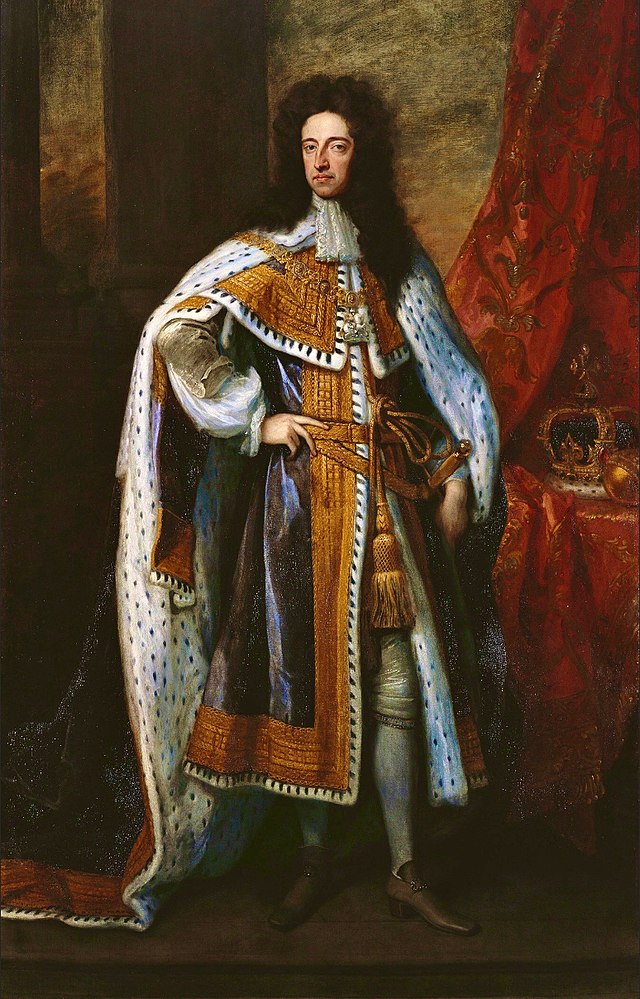
William III
Former King of EnglandWikipedia
384
MENTIONS
100
EPISODES
94
PODCASTS
Search complete. 384 mentions across 100 episodes found for "William III".
Oct 26, 2026

Christine RuckerNARRATOR
And when in 1673 the effect of the Dover Treaty began to be seen, and it became apparent that the king himself was the worst man in the government, Marvell's, quote, wrath at the degradation of his country and the seeming hopelessness of the struggle, end quote, made him sometimes appear to be what he was not in principle under the Commonwealth, a fierce republican and a bitter opponent of the established church.
Christine RuckerNARRATOR
Whether from the old prejudice against Holland or from a sense of the difficulty in merely deposing James II, if he were permitted to ascend the throne, in favor of a foreign prince, he was unable to foresee a future liberator in William of Orange, and what hope he professed to have in the Stuart line was for a little while fixed on the Duke of Monmouth.
Christine RuckerNARRATOR
This hope, however, was very slight.
Christine RuckerNARRATOR
His principal aim seems to have been to bring about a condition of public feeling which should lead to the re-establishment of the Commonwealth, not immediately, but on the death of Charles II.

Bertie BrosnanGUEST
They're like, oh, no, but King Henry II was French.
Bertie BrosnanGUEST
It's like, so was William of Orange.
Bertie BrosnanGUEST
He was Dutch, wasn't he? That's right.
Bertie BrosnanGUEST
Was he King of England or was that England? Anyway, as
Bertie BrosnanGUEST
If you're... wearing the banner of england and your king is king henry ii and you're living in england
Stephen KellyHOST
you're pretty
Bertie BrosnanGUEST
you're pretty much english to me like you know what i mean oh you're speaking french well william of orange was speaking dutch and he was king of england so uh king james the first of england he was scottish he was king james the sixth of scotland so like
Stephen KellyHOST
you know it's about cause it's about your alliance as well yes you know what i mean And your tribe.

Kevin DavidsonNARRATOR
It is understood that he made this change to distinguish his branch of the family from that of the Roman Catholic branch.
Kevin DavidsonNARRATOR
In the year 1796, a son was born to this Gavin Arthur, and he was named William Arthur, in honor of William of Orange.
Kevin DavidsonNARRATOR
This boy was educated at what was then known as the Blue School in Belfast.
Kevin DavidsonNARRATOR
He simply acquired a common school education.

RobHOST
but the vibe was in the air.
RobHOST
So King Billy always ends, is at the end of the Orangeman parade riding a white horse.
RobHOST
Right.
RobHOST
Okay.
RobHOST
So Prince William of Orange became King Billy.
RobHOST
Yeah.
RobHOST
So, um, the, the Stainer Orange Council or whatever decided that, well, okay, we, so we need to get a white horse for King Billy to be riding.
RobHOST
And the only person who had a white horse in the area was a local parishioner of the Catholic parish.

AlistairNARRATOR
But by this time a serious conspiracy had been set on foot to secure independence under Russian protection, several Finnish-Swedish officers having entered into correspondence with the Empress Catherine.
AlistairNARRATOR
This was of course treason, but the miseries of the country, under a series of incapable Holstein-Gortop kings, had rendered the leading Finlanders desperate, and history will probably judge the action of Sprengtporten and his fellow conspirators as lightly as it judges that of the English Whigs who, a century before, had entered into correspondence with William of Orange while still owing allegiance to a Stuart king.
AlistairNARRATOR
Mr. Freeman assumes, and no doubt correctly, that the Swedish nobility, who were at that time smarting under the recent loss of their privileges, thought more of the erection of an aristocratic state under Russian protection in which they should be supreme than of securing the popular liberties in Finland.
AlistairNARRATOR
It must be admitted, however, that Sprengtporten, whatever his original motives may have been, stood out sturdily and successfully at the critical moment for the constitutional liberty of his country.

Kevin Perez-AllenHOST
Louis marches on the Republic itself in 1672, so Richard sends Montague's ships to sail beside the Dutch fleet and keeps the Dunkirk garrison in place.
Kevin Perez-AllenHOST
On July 4th, with French troops inside the country, the Dutch leaders named William of Orange, a prince of only 21 years of age, their stadtholder.
Kevin Perez-AllenHOST
The office makes him the head of the Dutch government and commander of its army, the same post his family held a generation ago.
Kevin Perez-AllenHOST
Richard signs a treaty with him that winter to keep that alliance going.
8 MINS LATER
Kevin Perez-AllenHOST
The real Richard died on July 12th, 1712 at 85 under the name John Clark in a lodging at Chesant in Hertfordshire.
Kevin Perez-AllenHOST
In the alternate timeline, King Richard IV dies on the same day, at the same age, but after 53 years and 10 months ruling England.
Kevin Perez-AllenHOST
In 1689, England got a king chosen by its parliament, a Dutch stadtholder named William of Orange, whose family Cromwell had barred from office in Holland 35 years prior.
Kevin Perez-AllenHOST
The last man in the family to carry the Cromwell name, an Oliver born in 1742, built a mansion at Chesson Park and died in 1821, leaving one daughter.

Pamela NagamiNARRATOR
The first reaching from the reign of Edward III to that of Henry VI.
Pamela NagamiNARRATOR
The other reaching from the reign of James I to that of William III.
Pamela NagamiNARRATOR
This chronology speaks for itself.
Pamela NagamiNARRATOR
When the predominance either of king or parliament was secured, it was felt to be better that political opponents should be dealt with by mere dismissal from office, and that criminal offences, excepting during the reign of terror which marked the latter times of Henry VIII, should be tried before professional judges.

AlistairNARRATOR
But by this time a serious conspiracy had been set on foot to secure independence under Russian protection, several Finnish-Swedish officers having entered into correspondence with the Empress Catherine.
AlistairNARRATOR
This was of course treason, but the miseries of the country under a series of incapable Holstein-Gortop kings had rendered the leading Finlanders desperate, and history will probably judge the action of Sprengtporten and his fellow conspirators as lightly as it judges that of the English Whigs who, a century before, had entered into correspondence with William of Orange while still owing allegiance to a Stuart king.
AlistairNARRATOR
Mr Freeman assumes, and no doubt correctly, that the Swedish nobility, who were at that time smarting under the recent loss of their privileges, thought more of the erection of an aristocratic state under Russian protection in which they should be supreme than of securing the popular liberties in Finland.
AlistairNARRATOR
It must be admitted, however, that Sprengtporten, whatever his original motives may have been, stood out sturdily and successfully at the critical moment for the constitutional liberty of his country.

Pamela NagamiNARRATOR
In an impeachment the House of Commons, acting as the grand jury of the whole country, presented offenders against the Commonwealth to be judged by the House of Lords sitting as judge and jury combined.
Pamela NagamiNARRATOR
In English history impeachments are found in two distinct periods, the first reaching from the reign of Edward III to that of Henry VI, the other reaching from the reign of James I to that of William III.
Pamela NagamiNARRATOR
This chronology speaks for itself.
Pamela NagamiNARRATOR
When the predominance either of king or parliament was secured, it was felt to be better that political opponents should be dealt with by mere dismissal from office, and that criminal offences, excepting during the reign of terror which marked the latter times of Henry VIII, should be tried before professional judges.

UrbanHOST
Essentially, these are, as we're going to look at in the next couple slides, These are the Jacobites, which is a claimant to the throne of England, the Stuart.
UrbanHOST
claimants after the glorious revolution and King James II flees and they place King William of Orange and his wife Anne on the throne of England, the Dutch bankers do.
UrbanHOST
And so, Philip, that is where that line comes in.
UrbanHOST
Who bankrolls this takeover of England, not just with the glorious revolution, but first you have Oliver Cromwell.
90 more episodes mention William III.
Create an account to see the whole feed, search across every transcript, and follow the entities you care about.