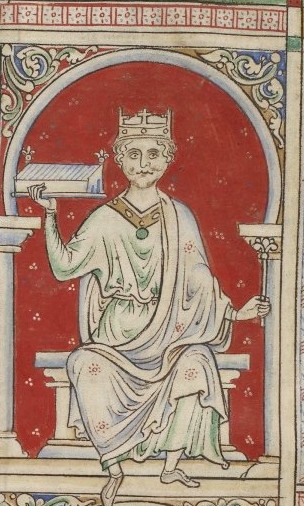
William II of England
Former King of EnglandWikipedia
106
MENTIONS
23
EPISODES
20
PODCASTS
Search complete. 106 mentions across 23 episodes found for "William II of England".
Oct 28, 2026

speaker_0HOST
King Stephen reigned from 1135 to 1154 claiming the crown before the anointed heir Empress Matilda had a chance to act.
speaker_0HOST
Although his predecessor, Henry I, had started the construction of Carlisle Castle in stone to replace the wooden fort that Henry's brother William Rufus had established some 25 to 30 years earlier, Carlisle was taken by King David of Scotland in 1135 after Stephen's hurried ascent to the throne.
speaker_0HOST
The struggle between Stephen and Matilda for the English crown kicked off a period of civil war known as the Anarchy.
speaker_0HOST
Henry I had married David's sister, and it was this friendship that had kept the peace in the Western Marches.
6 MINS LATER
speaker_0HOST
It was like seeing a man in a long sequined coat.
speaker_0HOST
All the children that were born whilst my family lived there all saw the same boy wearing a white gown with a roof round his neck like a choir boy.
speaker_0HOST
Even my sister's friend once asked who the boy was sitting next to my brother on his bed.
speaker_0HOST
But there was no boy.

JimmyHOST
He was the fourth son of William the Conqueror, the one who wasn't supposed to get anything.
JimmyHOST
He'd taken the English throne in August 1100 within days of his brother William Rufus being assassinated on a hunting trip.
JimmyHOST
Six years later, he'd beaten his other brother, Robert Kurt Hose, at Tinchabray and taken Normandy off him too.
JimmyHOST
Robert spent the rest of his life, nearly 28 years, as Henry's prisoner, forced to watch his brother's ascendancy.
JimmyHOST
But for King Henry, it turned out that holding Normandy was much harder than taking it.
JimmyHOST
Louis VI of France backed Robert's son, William Clito, as the rightful duke, and from 1116 onward, the border was permanently on fire.
9 MINS LATER
JimmyHOST
It reached Count Theobald of Blois and the other lords, and they made a decision that says a great deal about what it was like to work for Henry.
JimmyHOST
They didn't tell him.

Rebecca LarsonHOST
We're doing our Norman King series.
Rebecca LarsonHOST
We started with William the Conqueror and then we went to William Rufus.
Rebecca LarsonHOST
And now we have come to the I want to call him like the troublemaker.
Rebecca LarsonHOST
maybe murderer henry the first
Rebecca LarsonHOST
i'll find a way to laugh don't worry
Matt LewisGUEST
yeah yeah the darker it gets the more you laugh
Rebecca LarsonHOST
So last week we ended the episode essentially at William Rufus being killed in New Forest, most likely by his brother, but we don't have any proof.
Rebecca LarsonHOST
Just seems coincidental.

Dan SnowHOST
But I've come here to see a very different sort of landmark, established by our country's next great builders in stone.
Dan SnowHOST
Twenty years after the massacre of the harrying, William II, son of the conqueror, granted this site to the Benedictines and started St Mary's Abbey.
Dan SnowHOST
So is it unusual to have such a big monastery so close to the middle of town?
Janet BurtonGUEST
No it isn't really.
Janet BurtonGUEST
The king looked on monks as spiritual soldiers.
Janet BurtonGUEST
But Abbot Stephen himself, the founder abbot, wrote a short narrative of the foundation of St Mary's.
Janet BurtonGUEST
And he makes the specific point that William II was quite aware that York had been a troublesome place.
Janet BurtonGUEST
So when this stone abbey started to rise up here in the late 11th century, within sight of the stone minster, you think of the stone castles that William I had built, these were all real symbols of royal authority.

Kara ShallenbergNARRATOR
With this fair, unwilling Saxon bride and her long plait of yellow hair goes a very pretty, pathetic story, which I may tell you at some future time, if you take kindly to this.
Kara ShallenbergNARRATOR
A Cascodin was seneschal to William Rufus and sat at the rich, half-barbaric banquets in the first great hall.
Kara ShallenbergNARRATOR
Still another was one of the doughty barons who wrested from John the great charter, England's declaration of independence.
Kara ShallenbergNARRATOR
Another was high in the councils of Henry V. I have omitted one whom I should not fail to mention, Adjudica Cascodin, who was a member of the Dunce Parliament of Henry IV, so called because there were no lawyers in it.

David TuckerHOST
And now the fire was threatening something infinitely older.
David TuckerHOST
Westminster Hall, that magnificent medieval hall, built in the reign of William Rufus, son of William the Conqueror.
David TuckerHOST
Think about that.
David TuckerHOST
A building that had stood there since 1097, more than seven centuries old on the night of the fire.

Marc MorrisGUEST
Well, I mean, he, again, there's a little bit of backstory there because people have been looking at Ireland since the beginning of the 12th century, if not earlier.
Marc MorrisGUEST
I mean, William Rufus at the end of the 11th century, the Conqueror's, um, first successor as King of England, he is said to have stood on the ba- the coast of Pembrokeshire and fantasized about building a bridge of boats across the Irish Sea to conquer Ireland.
Marc MorrisGUEST
By the time you get to the middle of the 12th century, Henry II, right at the start of his reign, is applying to the Pope for permission to conquer Ireland, and is, is all set to go until he's distracted by other business in his sprawling kind of, you know, cross-Channel empire.
Marc MorrisGUEST
So the idea of, of, you know, Ireland is the next stage in the, in the, uh, next part of the frontier that we're gonna colonize, that's there very strongly.

Richard AndertonGUEST
And this is Sir Walter Tyrell.
Richard AndertonGUEST
And we're going right back to 1100. where William Rufus is supposed to have been shot during a hunting accident in the New Forest.
Richard AndertonGUEST
And the man accused of loosing the fatal arrow was Sir Walter Tyrrell.
Richard AndertonGUEST
And I always wondered, were these two related? And so I started digging and basically, yes, they are.
Adam PenningtonHOST
And I had never made the connection.
Adam PenningtonHOST
And I find, I don't know why, but you said about you're always interested in... people that are on the fringes.
Adam PenningtonHOST
I am intensely fascinated by King William II, King William Rufus.
Adam PenningtonHOST
Oh, excellent.

speaker_0HOST
It was not the ending that the conqueror's reputation suggested he deserved, though one might argue it was characteristically uncompromising in its own way.
speaker_0HOST
England passed to his second son, William Rufus, red-faced, energetic, crude in manner, effective as a soldier, and profoundly unpopular with the church he consistently plundered for funds.
speaker_0HOST
He was killed in the New Forest in 1100 AD by an arrow during a hunting expedition, in circumstances that have never been entirely explained, and that a noticeable number of contemporaries did not seem particularly interested in investigating thoroughly.
speaker_0HOST
His younger brother Henry moved to secure the treasury and the throne with a speed that suggested he had been giving the subject some prior thought.

Uncle IanHOST
Robert ended up becoming Duke of Normandy.
Uncle IanHOST
The next King of England in 1087 was William Rufus.
Uncle IanHOST
So we know him as William II, and he ruled until the year 1100.
Uncle IanHOST
In 1100, Robert was still alive, um, but he was also still rebelling and eventually was imprisoned by William's youngest son, who'd become the third King of Norman England, and we know him as Henry I.
13 more episodes mention William II of England.
Create an account to see the whole feed, search across every transcript, and follow the entities you care about.