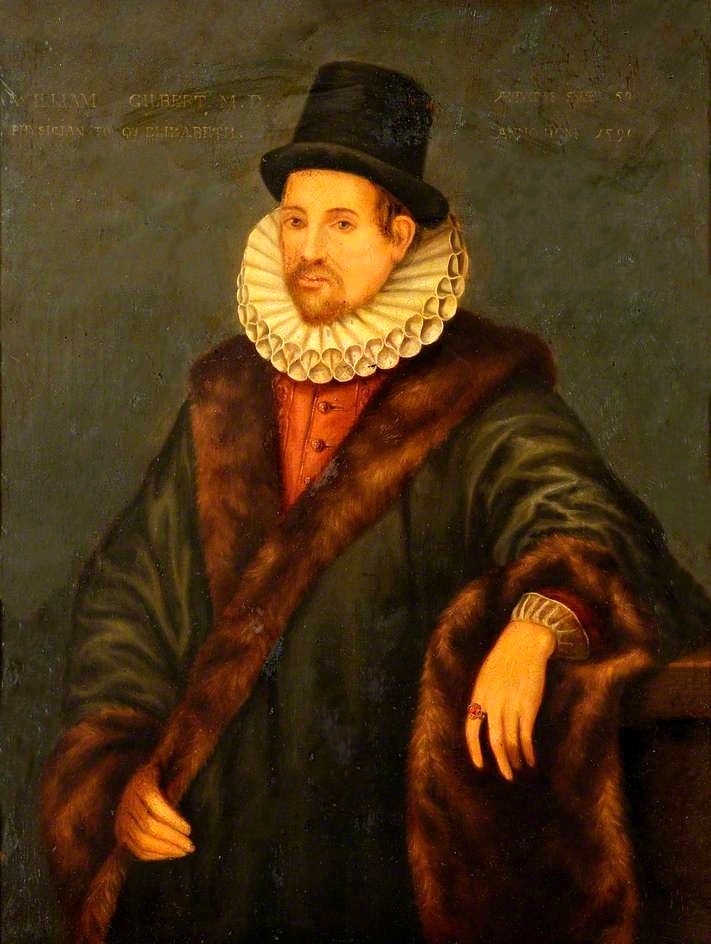
William Gilbert
English physician and physicistWikipedia
9
MENTIONS
9
EPISODES
9
PODCASTS
Search complete. 9 mentions across 9 episodes found for "William Gilbert".
Oct 9, 2026

speaker_0HOST
We can get into electrodynamics from classic electrodynamics.
speaker_0HOST
In 1600, William Gilbert proposed in his De Magnete that electricity and magnetism, while both capable of causing attraction and repulsion of objects, were distinct effects.
speaker_0HOST
Mariners had noticed that lightning strikes had the ability to disturb a compass needle.
speaker_0HOST
The link between lightning and electricity was not confirmed until Benjamin Franklin's proposed experiments in 1752 were conducted on May 10th by Thomas Francois d'Alabarde of France using a 40-foot-tall iron rod instead of a kite, and he successfully extracted electrical sparks from a cloud.

Joseph W. PhippsHOST
And why not explore this fringe idea? I mean, all gigantic breakthroughs in science and society were once considered fringe.
Joseph W. PhippsHOST
Am I wrong? Leonardo da Vinci, William Gilbert, uh, Nicolaus Copernicus, um, hell, Nikola Tesla.
Joseph W. PhippsHOST
It seems that the biggest influences in scientific thinking and modern technology came from spiritual people, people on the fringe.
Joseph W. PhippsHOST
Even today with the highly venerated Rupert Sheldrake.

Benjamin BosterHOST
In 1282, the properties of magnets and the dry compasses were discussed by Al-Sharaf Umar II, a Yemeni physicist, astronomer, and geographer.
Benjamin BosterHOST
In 1600, William Gilbert published his On the Magnet and Magnetic Bodies and On the Great Magnet, the Earth.
Benjamin BosterHOST
In his work, he describes many of his experiments with his model Earth called the terrella.
Benjamin BosterHOST
From his experiments, he concluded that the Earth was itself magnetic and that this was the reason compasses pointed north, whereas previously some believed that it was the pole star Polaris or a large magnetic island on the North Pole that attracted the compass.

Colin WeldonGUEST
Exactly, which is fascinating.
Colin WeldonGUEST
And then a guy called William Gilbert in 1600 coined the Latin phrase electricus.
Colin WeldonGUEST
So every single time you hear the word electricity, it comes specifically from amber because of its static electrochemical properties, which is pretty amazing, I think.
Matthew WeldonHOST
And amber, you know, it went...

Joe SchwarczHOST
At the same time, the materials that were attracted to the amber repelled each other.
Joe SchwarczHOST
The phenomenon remained no more than a curiosity until Elizabethan times, when the English physician William Gilbert discovered that substances other than amber also had such properties and coined the term electric to describe their behavior, and the attractive force the Greeks had observed so long ago came to be known as electricity.
Joe SchwarczHOST
The experiments now became fast and furious.
Joe SchwarczHOST
When two amber rods were rubbed, or electrified as it was said, with fur, they, uh, repelled each other.

speaker_0NARRATOR
No fue hasta los años 1600 cuando las personas comenzaron a estudiar seriamente estos efectos.
speaker_0NARRATOR
Un médico inglés llamado William Gilbert empezó a elaborar teorías sobre la electricidad y publicó sus ideas en un libro llamado De Magnete.
speaker_0NARRATOR
La acumulación gradual de observaciones y experimentos durante los años 1700 transformó la electricidad de algo puramente místico en un tema digno de una investigación seria.
speaker_0NARRATOR
El ámbar y la fricción se convirtieron en puertas de entrada hacia la comprensión de una fuerza fundamental de la naturaleza.

speaker_2NARRATOR
It wasn't until the 1600s that people began to seriously study these effects.
speaker_2NARRATOR
An English physician named William Gilbert started theorizing about electricity and published his ideas in a book called De Magnete.
speaker_2NARRATOR
The gradual accumulation of observations and experiments through the 1700s transformed electricity from something purely mystical into a subject worthy of serious investigation.
speaker_2NARRATOR
Amber and friction became doorways into understanding a fundamental force of nature.

Ashleigh BodellHOST
And eventually, people began to understand the bigger reason a compass works.
Ashleigh BodellHOST
In the late 1500s, a English, an English physician and scientist named William Gilbert became deeply interested in magnetism.
Ashleigh BodellHOST
He studied lodestones, experimented with magnetic materials, and eventually proposed something that completely changed the way people understood the compass.
Ashleigh BodellHOST
He argued that the Earth itself behaves like a giant magnet, and that sounds obvious to us now because we grow up learning about the Earth's magnetic field.