William Caxton
Merchant and diplomatWikipedia
131
MENTIONS
78
EPISODES
9
PODCASTS
Search complete. 131 mentions across 78 episodes found for "William Caxton".
Oct 22, 2026

Beth ThomasNARRATOR
a Frenchman working in Venice.
Beth ThomasNARRATOR
Caxton never employed it, and it was not introduced into England until 1509.
Beth ThomasNARRATOR
In that year, Richard Pinson, a London printer and a naturalized Englishman, though Norman by birth, used some Roman type in portions of the Sermo-Fratris Hieronymi de Ferrara and in fifteen eighteen he produced horatio riccardi passeate which was entirely printed in these characters Had the idea of the title page, in the modern sense of the term, a very obvious idea, as it seems to us, occurred to the first printers, we should not have to sharpen our wits on the 101 doubtful points with which the subject of early bibliography bristles.
Beth ThomasNARRATOR
Today, the title page not only introduces the book itself, but declares the name of the writer, and the publisher and the time and place of publication but during the first sixty years of printing title pages were rare and the old methods followed by the scribes in writing their manuscript books still obtained the subject matter began with incipit or here beginneth etc according to the language in which the work was written and such information as the printer considered it desirable to impart was contained in the colophon or note affixed to the end of the book more often than not these colophons are irritatingly reticent and withhold the very thing we want to know At other times they are informing, and in some cases amusing.
13 MINS LATER
Beth ThomasNARRATOR
this device continued to be used after the death of aldus minutius in fifteen fifteen by his descendants who carried on the work of the press until fifteen ninety seven france was somewhat late in availing herself of the advantages offered by the new art although peter schoeffer had had a bookseller's shop in paris in fourteen seventy guillaume fiche rector of the sorbonne invited three german printers ulrich gring michael freiburger and martin kranz to come and set up a printing-press at the sorbonne the first work they produced there was the epistale of gasparinus For this and a few other volumes they used a very beautiful Roman type, but after the closing of the Sorbonne Press in 1472, they established other presses elsewhere in Paris and adopted a Gothic character similar to that of the contemporary French manuscripts, and therefore more likely to be popular with French readers.
Beth ThomasNARRATOR
the first work printed in the french language however is believed to have been executed chiefly at any rate by an englishman probably at bruges five years later that is about fourteen seventy six The book was Les Recueils des Histoires des Troyes.
Beth ThomasNARRATOR
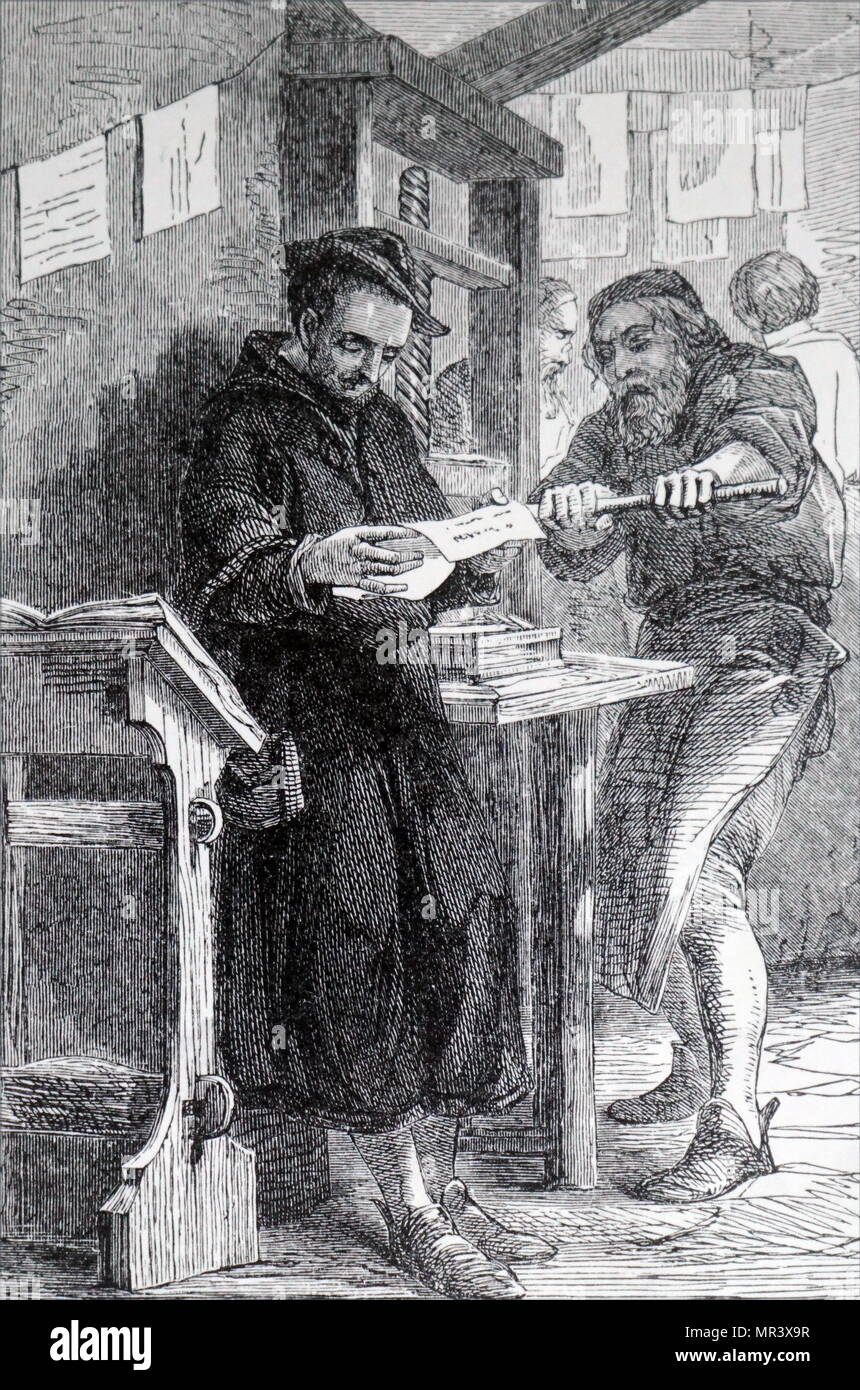
The Englishman was William Caxton.
Beth ThomasNARRATOR
Caxton also printed at the same place, and about the year 1475, the first book in the English language, a translation of Les Recueils.

Tom HollandHOST
And so I think it's, it's unsurprising that when the first printing press is introduced, um, in England in 1476, so again, again, that's against the backdrop of the Wars of the Roses, the merchant responsible for it very rapidly is looking around for something to publish about King Arthur.
Tom HollandHOST
And this publisher is a guy called William Caxton, and he is a top entrepreneur.
Tom HollandHOST
I mean, publishing is just one of the many irons that he has in the fire, and he has a very keen sense of what the public wants.
Tom HollandHOST
And so he comes across this manuscript called The Morte d'Arthur, um, a posthumous manuscript left by a, a knight called Thomas Malory, who's, who's since died.
Tom HollandHOST
And he reads it and he says, "Oh, this is brilliant.
Tom HollandHOST
We've gotta, we've gotta publish this." And so because Malory is already dead, Caxton can essentially do what he like with it.
Tom HollandHOST
He can trim it, edit it, mark it as he, as he wants, and he does a tremendous job.
Tom HollandHOST
Um, and the result is a massive bestseller.

AC WilsonHOST
Speaking of foundational English literature, we have Geoffrey Chaucer's The Canterbury Tales.
AC WilsonHOST
A first edition printed by William Caxton in 1477, sold for seven point five million dollars in 1998 to the billionaire philanthropist Sir Paul Getty.
speaker_4HOST
William Caxton was the man who actually introduced the printing press to England, so this edition of The Canterbury Tales is one of the earliest major books printed on English soil.
speaker_4HOST
Only 12 copies of this specific 1477 run survive.
AC WilsonHOST
The source material notes the story as 17,000 lines of poetry about pilgrims having a storytelling contest.

Anna NaumoskaNARRATOR
By good luck, the great printer who made it one of his first works has left an account of the circumstances that led to its production.
Anna NaumoskaNARRATOR
In the reign of Edward IV, William Caxton set up his printing press, the first in England, in the precincts of Westminster Abbey.
Anna NaumoskaNARRATOR
There he was visited, as he himself relates, by many noble and diverse gentlemen, demanding why he had not printed the noble history of the Saint Grail and of the most renowned Christian king, Arthur.
Anna NaumoskaNARRATOR
To please them, and because he himself loved chivalry, Caxton printed Sir Thomas Malory's story, in which all that is best in the many Arthurian romances is woven into one grand narrative.
Anna NaumoskaNARRATOR
Since then, in our own days, the story of Arthur and his knights has been told in beautiful verse by Lord Tennyson.
Anna NaumoskaNARRATOR
But for the originals of some of his poems, it would be useless to look in Malory.

Kirsten DiproseHOST
I'm still very, very sad about Michael Mosley's death, says June in Frankston South.
Kirsten DiproseHOST
I remember reading when Diana died that either Harry or William asked why all these people were crying as they didn't even know her, says Narelle.
Kirsten DiproseHOST
Another text says, hi, Kirsten, are these increasing parasocial relationships linked to increased loneliness? Loneliness is an increasing issue in our society because the identity is a constant, whereas those in the person's life may not be constant.
Kirsten DiproseHOST
That's one from Dorothy.
Kate BurridgeGUEST
But also...
Kate BurridgeGUEST
The early printers were also quite excited by European spelling conventions.
Kate BurridgeGUEST
So even, you know, William Caxton, for example, who, you know, introduced Dutch spellings like the G-H in ghost and ghastly.
Kate BurridgeGUEST
Now, that's hardly helpful for English, that G-H. shouldn't be there, and that would be an easy reform, actually.
68 more episodes mention William Caxton.
Create an account to see the whole feed, search across every transcript, and follow the entities you care about.