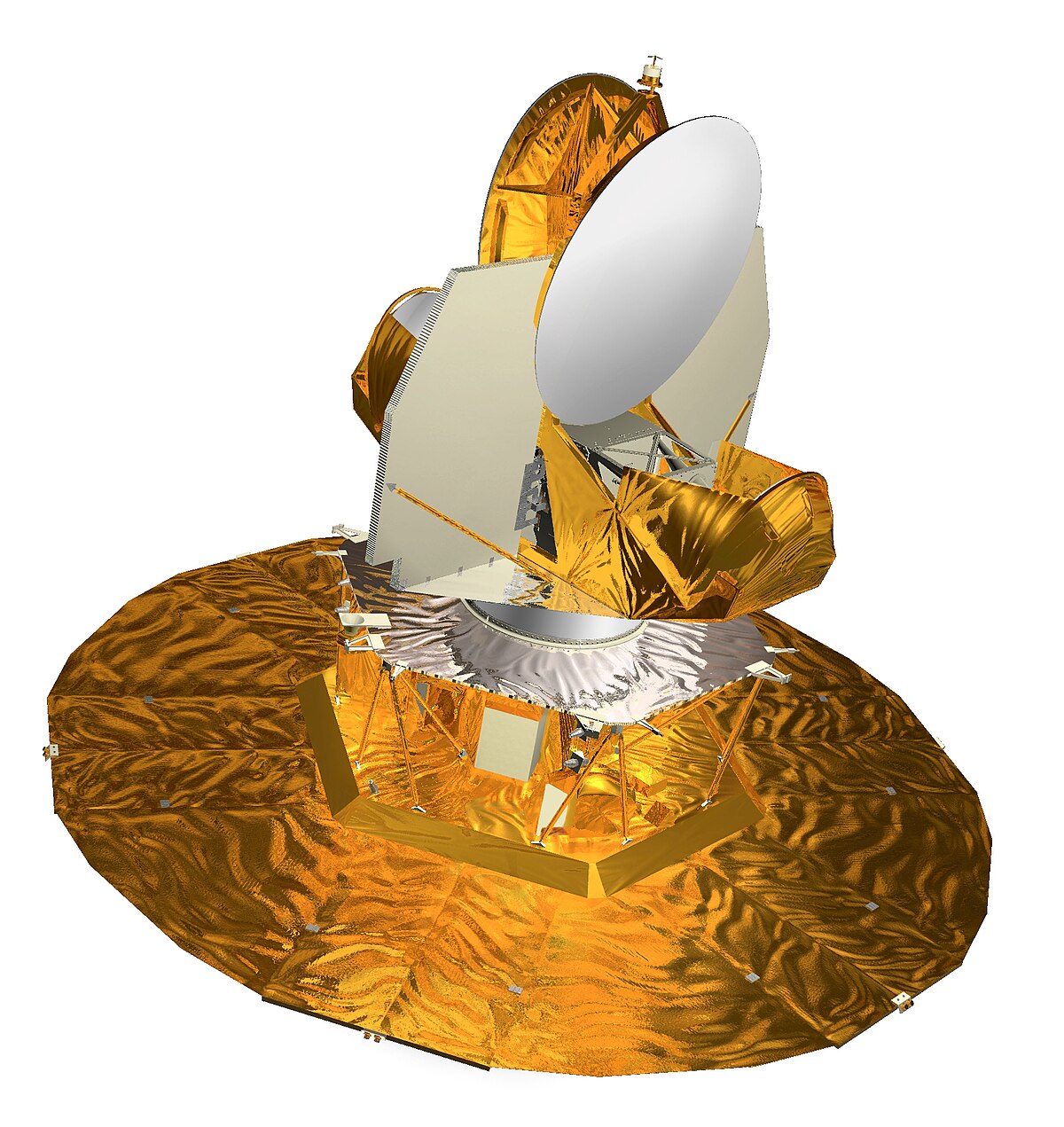
Wilkinson Microwave Anisotropy Probe
SpacecraftWikipedia
17
MENTIONS
7
EPISODES
7
PODCASTS
Search complete. 17 mentions across 7 episodes found for "Wilkinson Microwave Anisotropy Probe".
Oct 9, 2026

speaker_0HOST
That discover earned a Nobel Prize and confirmed the Big Bang over its rivals.
speaker_0HOST
Today, satellites such as NASA's WMAP and the European Space Agency's Planck mission have mapped the CMB in exquisite detail.
speaker_2HOST
To be honest, I have my doubts about whether or not there is a pattern inside the cosmic background radiation.
speaker_2HOST
It may just be random, or we may not have fast enough compute engines right now.

David KippingHOST
By running this cosmological model forward in time, one can predict what the current rate of expansion should be.
David KippingHOST
Over time we've got better at making that measurement, with early results from the WMAP satellite giving a result of about 72 plus or minus 5, but now more precisely pinned down to 67.4 plus or minus 0.5 using the Planck mission.
David KippingHOST
I'll ignore the units here because it's really not that important for the current discussion and largely This
speaker_0ADVERTISER
episode is brought to you by Google Chrome.

speaker_4HOST
What changed then?
speaker_5HOST
That's when the Wilkinson Microwave Anisotropy Probe, or WMAP, began providing these highly resolved maps of the temperature fluctuations in that light, and those fluctuations, those tiny differences in heat, are actually the quantum seeds of future galaxy clusters.
speaker_4HOST
Oh, wow.
speaker_4HOST
But we aren't looking at the small clusters for this, right? To find global topology, we need to look at the massive anomalies in the CMB data.
speaker_5HOST
Right.
speaker_5HOST
WMAP and later the Planck satellite gave us these incredible high-definition maps of the temperature variations.
speaker_4HOST
Yeah.
speaker_5HOST
And researchers immediately started breaking those maps down using spherical harmonics.

speaker_8HOST
You might expect to see a distinct hot or cold ring, or unusual temperature features, or characteristic polarization patterns that break the expected statistical isotropy of the universe.
speaker_7HOST
Has any of the data from our satellites like Planck or WMAP shown evidence of these collisions? Have they found the bruises?
speaker_8HOST
There have been tantalizing anomalies over the years, like the famous cold spot in the CMB that generated a lot of theoretical excitement.
speaker_8HOST
But to date, rigorous statistical analysis has not yielded any convincing, widely accepted evidence of a bubble collision.

Charles BailynHOST
It was a pretty blurry image.
Charles BailynHOST
So, then there was another satellite, still operating actually, called WMAP.
Charles BailynHOST
WMAP is the Wilkinson Microwave Anisotropy probe.
Charles BailynHOST
So, anisotropy, it means irregularity.
Charles BailynHOST
Wilkinson, Dave Wilkinson, was one of the pioneers of this kind of radio astronomy, and he was the leader of this project until he died shortly before launch, and so then they named it after him.
Charles BailynHOST
And then, in 2003, WMAP announced its results, and they got a much more precise map.
Charles BailynHOST
microwave background, so precise that they could measure the size of these irregularities.
Charles BailynHOST
Not just how irregular they were, but how big they were.

speaker_2HOST
We would see it imprinted on the cosmic microwave background radiation, the CMB.
speaker_3HOST
Because we have incredibly precise satellites now, like WMAP and Planck.
speaker_2HOST
Oh, their precision is unbelievable.
speaker_2HOST
They have mapped the CMB down to microscopic temperature variations.
9 MINS LATER
speaker_2HOST
It is an instantaneous screeching feedback loop.
speaker_3HOST
But wait, wait.
speaker_3HOST
If we have a violent screeching feedback loop of energy, why doesn't that leave a massive scar on the cosmic microwave background? I mean, if the plasma is going crazy, shouldn't WMAP and Planck have seen a massive signature of turbulence, even if it wasn't uniform heat? Doesn't a violently nonlinear reaction just change the type of CMB anomaly we should be looking for?
speaker_2HOST
That is the pivotal question right there, and the answer lies in the concept of self-regulation through resonance destruction.

Manoush ZomorodiHOST
[laughs] So how did you come up with this idea of translating all your measurements of these sound waves into music, something that is, we can listen to?
Mark WhittleGUEST
So starting with the COBE mission, it's a NASA satellite, in 1990, and then the WMAP satellite in 2003, the sensitivity of the microwave telescopes began to reveal these very slight patches on the microwave background.
Mark WhittleGUEST
And what scientists do with the image of the microwave background, this full sky, this sphere of glowing with patchiness on it, is they do a, a wave analysis of it, and it produces a spectrum.
Mark WhittleGUEST
Um, and not only were these waves basically acoustic waves, but also there was a fundamental of harmonics, and that is exactly the signature of something like a musical instrument or a human voice.