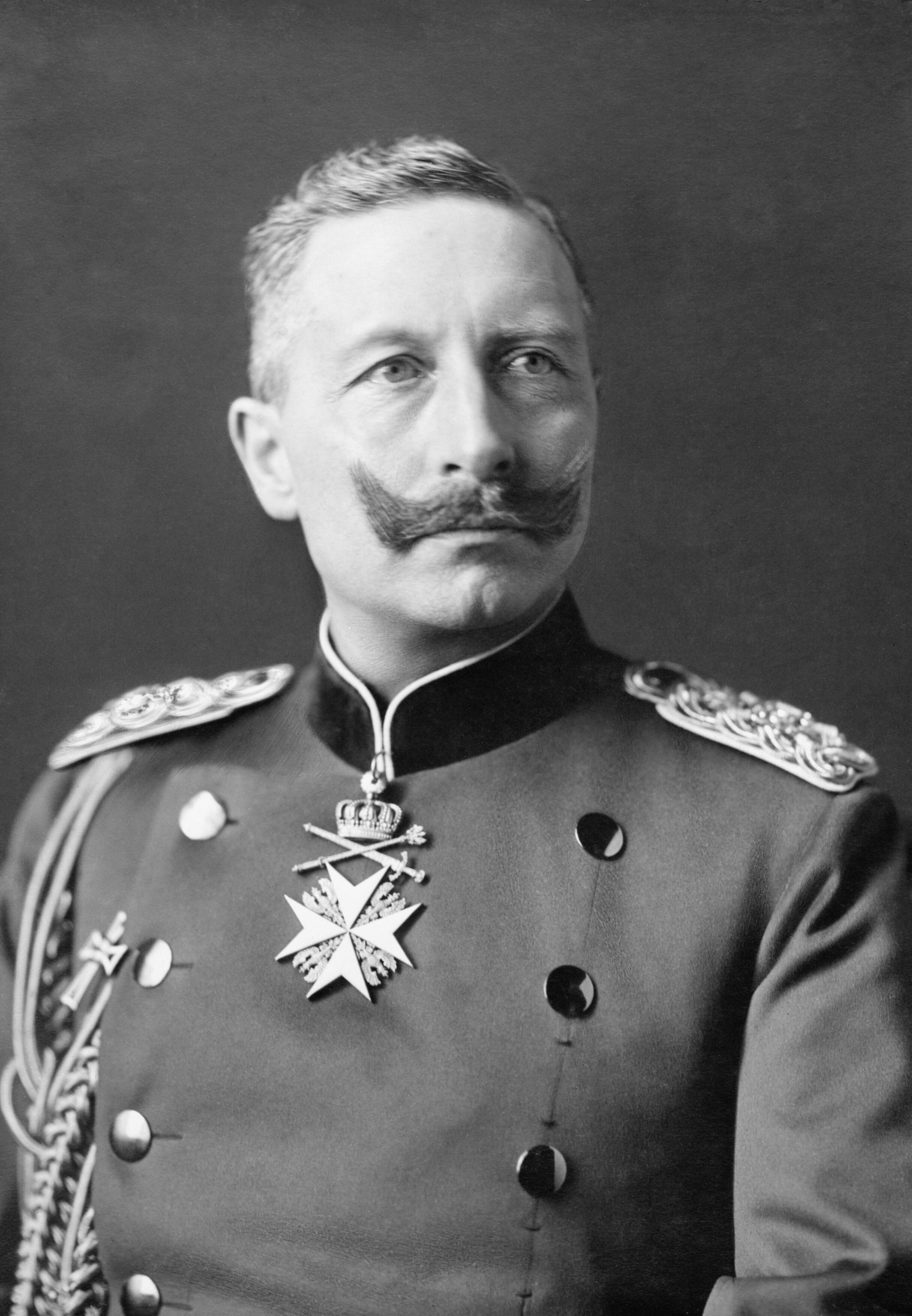
Wilhelm II
Former German EmperorWikipedia
142
MENTIONS
77
EPISODES
69
PODCASTS
Search complete. 142 mentions across 77 episodes found for "Wilhelm II".
Nov 4, 2026

Dave WarnekeHOST
This period of history, like after World War I, before World War II, in Germany is commonly called the Weimar Republic, during which it was a constitutional republic for the first time in history.
Dave WarnekeHOST
Kaiser Wilhelm had been forced to abdicate at the end of the First World War, which converted Germany into an unstable democratic state.
Jess PerkinsHOST
Sounds like a kind of...
Jess PerkinsHOST
Guess? What does it sound like? Sounds like a real whiny kid.

Odd Arne WestadGUEST
So it's important to bear that in mind because it has such significance for our own time.
Odd Arne WestadGUEST
I mean, Kaiser Wilhelm II was the oldest favorite grandson of Queen Victoria.
Odd Arne WestadGUEST
She literally died in his arms.
Odd Arne WestadGUEST
This is a man who had very strong connections.

Isaac WeishauptHOST
So David Pre-Rowell wrote a book called Seize the Daylight.
Isaac WeishauptHOST
And it actually goes back to the Roman Empire, but the way we understand it today, you got to look at people like Benjamin Franklin, Sir Arthur Conan Doyle, Winston Churchill, Kaiser Wilhelm from Germany, and President Roosevelt.
Isaac WeishauptHOST
All these people were... making things happen with it, okay? And...
Isaac WeishauptHOST
With the

Jim WebbGUEST
But also, it's very important to remember that this is the tagline that they sell every single war on.
Jim WebbGUEST
You can go back to World War I when, I believe it was Kaiser Wilhelm said that, you will be home before the trees turn brown.
Jim WebbGUEST
That's a paraphrase there.
Jim WebbGUEST
Right, right,

Christopher DillonHOST
So we saw in the past episode that in November 1918, left-wing revolutionaries rode a popular tide of war weariness and anger at German elites to topple the monarchies that headed the various German states.
Christopher DillonHOST
So the King of Kings, Kaiser Wilhelm II, was the last to fall.
Christopher DillonHOST
And he did so with characteristic lack of grace.
Christopher DillonHOST
So Wilhelm blamed treachery by Jews and socialists within for his demise.

Jeff GullyGUEST
The Treaty of Versailles also gave Hitler so much of his rhetoric and power about the downtrodden and the wrongs done to the German people to create that rise.
Jeff GullyGUEST
So about that, Versailles goes to a negotiated environment, which Kaiser Wilhelm wanted.
Jeff GullyGUEST
You change the whole dynamic.
Jeff GullyGUEST
So what motivates Germany to become the power they become? Absolutely, yeah.

Jim WebbHOST
And quite frankly, this is something that's promised every single time.
Jim WebbHOST
I mean, you can go back to I guess it was Kaiser Wilhelm in 1914 saying you will be home before the leaves have fallen from the trees.
Jim WebbHOST
MacArthur in the Korean War, you'll be home by Christmas.
Jim WebbHOST
More recently, the Iraq war.

Thomas777GUEST
You know, so this idea that, you know, what was this supposedly like German militarism built on? You know, like war gaming, you know, like fantasies, like it doesn't bear out.
Thomas777GUEST
Kaiser Wilhelm was not a good executive.
Thomas777GUEST
And I think there was something brutish about him quite literally in terms of his habits and his aversion to diplomacy of the sort that was called for.
Thomas777GUEST
And that was easy to lampoon.
52 MINS LATER
Thomas777GUEST
I'm doing well, thank you.
Thomas777GUEST
Today, what I wanna talk about, I wanna talk about misconceptions, not just about the st- strategic landscape as it existed in the decades prior to the Great War, but specifically the, the transfer of power from, uh, Chancellor Bismarck, um, you know, to various successors, all of whom, really until Hollweg, were very much subjugated to the will of the emperor, of the kaiser, okay? And this was not a good thing.
Thomas777GUEST
You know, we, we talked about briefly the man of Kaiser Wilhelm, he, he was, he was very much a brutish person, you know, and this was, this was lampooned to full effect by, you know, Allied media and things.
Thomas777GUEST
Um, but it's an oversimplification to just, to just talk about, oh, the, the man Wilhelm, you know, he, he sabotaged what was an im- an imperfect, but, you know, workable, uh, paradigm of, uh, of conflict resolution on the continent, okay? That's not the case at all.

Daniel ClarkHOST
It could fire a 106 kilogram shell over 130 kilometers.
Daniel ClarkHOST
I'm talking about the Kaiser Wilhelm gun.
Daniel ClarkHOST
The Kaiser Wilhelm gun, or Paris gun, was constructed under great secrecy.
Daniel ClarkHOST
Only three were built, but all would be used to shell Paris during 1918, the first time Paris had been hit by artillery since the Franco-Prussian War.
Daniel ClarkHOST
The Germans targeted Paris through four rounds of shelling.

speaker_0NARRATOR
In fact, it is known that Field Marshal Konrad von Utzendorf, Chief of the Imperial Austro-Hungarian Staff, would factor the difficulties caused to the British by the Austro-Crisis into his planning when Austria-Hungary decided its response to Serbia when their Archduke Ferdinand was assassinated.
speaker_0NARRATOR
and what set tongues wagging was that in august nineteen thirteen kaiser wilhelm of imperial germany had actually met sir edward carson in hamburg whilst carson was recuperating from an illness and the kaiser's talk ranged widely he asked about the gardens of mount stuart in county down agreeing that they were beautiful before drawing a comparison between the management of gardens and the management of states observing to carson that britain did too little to consolidate her empire we have our own ideas carson answered referring to home rule we give them self-government the kaiser was reported as confiding to carson his lifelong wish to visit ireland but that his grandmother queen victoria would never allow him Perhaps she thought, he said, that I wanted to take the little place.
speaker_0NARRATOR
When talk moved on to Ulster affairs and the Ulster crisis, which the Kaiser had, it was reported, followed closely.
speaker_0NARRATOR
Carson replied dryly, I think, sir, that you're well out of it, and moved the conversation on to other matters.
speaker_0NARRATOR
They both laughed, but, as ATQ Stewart observes, when the German ruler pressed on indomitably asking about Ulster, Carson adroitly changed the subject.
speaker_0NARRATOR
But another account from the British ambassador, Sir Frank Lascelles, reported that Kaiser Wilhelm and Sir Edward Carson had gotten on very well at that luncheon.
speaker_0NARRATOR
Carson, he said, clearly on good form, had even regaled them all with some of his best tales.
speaker_0NARRATOR
At one point they came to a serious talk about the situation in Ireland and the Kaiser asked, you mean you won't be ruled by the priests? and Carson, quote-unquote, assented.
67 more episodes mention Wilhelm II.
Create an account to see the whole feed, search across every transcript, and follow the entities you care about.