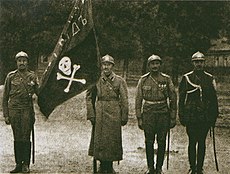
White Army
Military formationWikipedia
97
MENTIONS
24
EPISODES
16
PODCASTS
Search complete. 97 mentions across 24 episodes found for "White Army".
Oct 9, 2026

Yael SteinerHOST
Which by the way, uh, they're now fighting a civil war, so the, the party has become the government, but not everybody is in the party, and not everybody wants the party to be the government.
Yael SteinerHOST
So they're fighting the White Army, they're fighting Ukrainians.
Yael SteinerHOST
It's basically we've taken out the tsar, but now we need to take out everyone who doesn't agree with us, because again, permanent revolution.
Yael SteinerHOST
So Trotsky becomes the head of the Red Army, and he is fierce and-
Pete QuiñonesHOST
If you've never looked up Operation Trust, look that up.
Pete QuiñonesHOST
While the White Army was getting slaughtered by the Jew-led Bolsheviks, there was this whole propaganda campaign to say that the White Army was winning.
Pete QuiñonesHOST
So don't worry.
Pete QuiñonesHOST
That's what it is.

Karl DahlGUEST
Essentially, there, there was, there were local elections where the, it was framed as a mandate in the press for the establishment of a republic and the tossing out of, uh, the old system.
Karl DahlGUEST
And so it just kind of happened, and, and it, and there's, there's sort of a parallel when you look at what happened in Russia, where people just lost confidence in the old system, and so, um, they waited too long before the White Army, like, asserted itself again.
Karl DahlGUEST
The, the advances of the, of the Reds were, were massive because a lot of people kind of bought the propaganda that they were going against the failure of the old system instead of it actually having a very clear goal, right? Um, when you look at the memoirs of the people in the Republic, the people in most of the political parties, they didn't believe in a republic.
Karl DahlGUEST
The, the conservatives certainly did not.

Kristaps AndrejsonsHOST
He went into the really deep end of reenactment.
Kristaps AndrejsonsHOST
He also started publishing articles in the historical almanac Belaya Gvardiya, White Guard, and in the small-circulation Moscow journal Voyennaya Byil, Military Past, past in the sense of, well, very archaic version of it, where he eventually took a seat on the editorial board.
Kristaps AndrejsonsHOST
He was writing for, and partly to, a readership of a few hundred people who agreed with him about the war that had ended in 1920.
Kristaps AndrejsonsHOST
The height of this point came in May 1996, when the Drozdov Association, a historical and memorial organization originally founded by white émigrés in Paris, named for a volunteer army general who died in 1919, formally enrolled the 25-year-old Girkin and gave him a rank.
27 MINS LATER
Kristaps AndrejsonsHOST
The clean army had degenerated into an armed street gang flying an imperial banner.
Kristaps AndrejsonsHOST
And here, in the basement stench of besieged Sloviansk, the foundational paradox of Igor Strelkov is resolved permanently, preserved in the official administrative paperwork that survived this war.
Kristaps AndrejsonsHOST
For a quarter of a century, Igor Girkin had constructed his entire identity around a burning religious devotion to the White Guard.
Kristaps AndrejsonsHOST
He despised the Bolsheviks.

Pete QuiñonesHOST
If you've never looked up Operation Trust, look that up.
Pete QuiñonesHOST
While the White Army was getting slaughtered by the Jew-led Bolsheviks, there was this whole propaganda campaign to say
Pete QuiñonesHOST
that the White Army was winning.
Pete QuiñonesHOST
So don't worry.
Pete QuiñonesHOST
That's what it is.
Karl DahlGUEST
Essentially, there, there was, there were local elections where the, it was framed as a mandate in the press for the establishment of a republic and the tossing out of, uh, the old system.
Karl DahlGUEST
And so it just kind of happened, and, and it, and there's, there's sort of a parallel when you look at what happened in Russia, where people just lost confidence in the old system, and so, um, uh, they waited too long before the White Army, like asserted itself again.
Karl DahlGUEST
The, the advances of the, of the Reds were, were massive because a lot of people kind of bought the propaganda that they were going against the failure of the old system instead of it actually having a very clear goal, right? Um, when you look at the memoirs of the people in the Republic, the people in most of the political parties, they didn't believe in a republic.
Karl DahlGUEST
The, the conservatives certainly did not.

speaker_3NARRATOR
This move was supported by a faction of the Socialist Revolutionary Party that also opposed Russia's role in the war.
speaker_3NARRATOR
Immediately following the Bolshevik victory, liberal and monarchist forces organized the White Army to oppose the new regime, leading to the start of the Russian Civil War in early 1900-18.
speaker_3NARRATOR
The provisional government had consistently avoided holding elections, which contributed to the rising mood of revolution.
speaker_3NARRATOR
However, the events of October forced political parties to organize quickly for a vote to the state Duma on 25 November 1917.
speaker_3NARRATOR
The Bolsheviks initially held power in Petrograd and Moscow, gradually expanding their control across the vast empire.
speaker_3NARRATOR
They eventually reached the Siberian coast at Vladivostok four years after the war began.
speaker_3NARRATOR
The final remnants of the White Army surrendered in 1900 Dryansvansik, in the far northern districts of the country.
speaker_3NARRATOR
Near the end of the conflict, the Bolsheviks also faced internal revolts, such as the Kronstadt Rebellion in 1909.

Jesse KellyHOST
Years.
Jesse KellyHOST
There was an army, the White Army, who stood against them.
Jesse KellyHOST
Endless purges and tortures, and it's just really, just a horrible, horrible period of time in there.
Jesse KellyHOST
We're talking, you know, 1918, '19, th- this, this kind of s- span of time.

Richard B. SpenceHOST
And the Russian Civil War went on longest in the Far East.
Richard B. SpenceHOST
In fact, the last remnants of the so-called white armies, the opponents to the Reds, the Bolsheviks, weren't really defeated until 1922.
Richard B. SpenceHOST
And we're talking about events that take place in 1920 and 1921 and on, and the Civil War is still going on.
Richard B. SpenceHOST
So part of what Ungern, let's just call him that, so I won't constantly be saying Ungern Sternberg.
Richard B. SpenceHOST
and the Far Eastern White Army, and just sort of goes off onto his own seemingly crazy adventure.
Richard B. SpenceHOST
But, so I began to look into him and I found out that he was one of the people, you know, when I was interested in this, it was really beginning in the 1970s.
Richard B. SpenceHOST
And at that time, in those ancient times, there were still some, not many, surviving members of the Russian White Armies.
Richard B. SpenceHOST
And I actually interviewed a few of those in San Francisco, which is where they tended to end up, or in Los Angeles.
14 more episodes mention White Army.
Create an account to see the whole feed, search across every transcript, and follow the entities you care about.