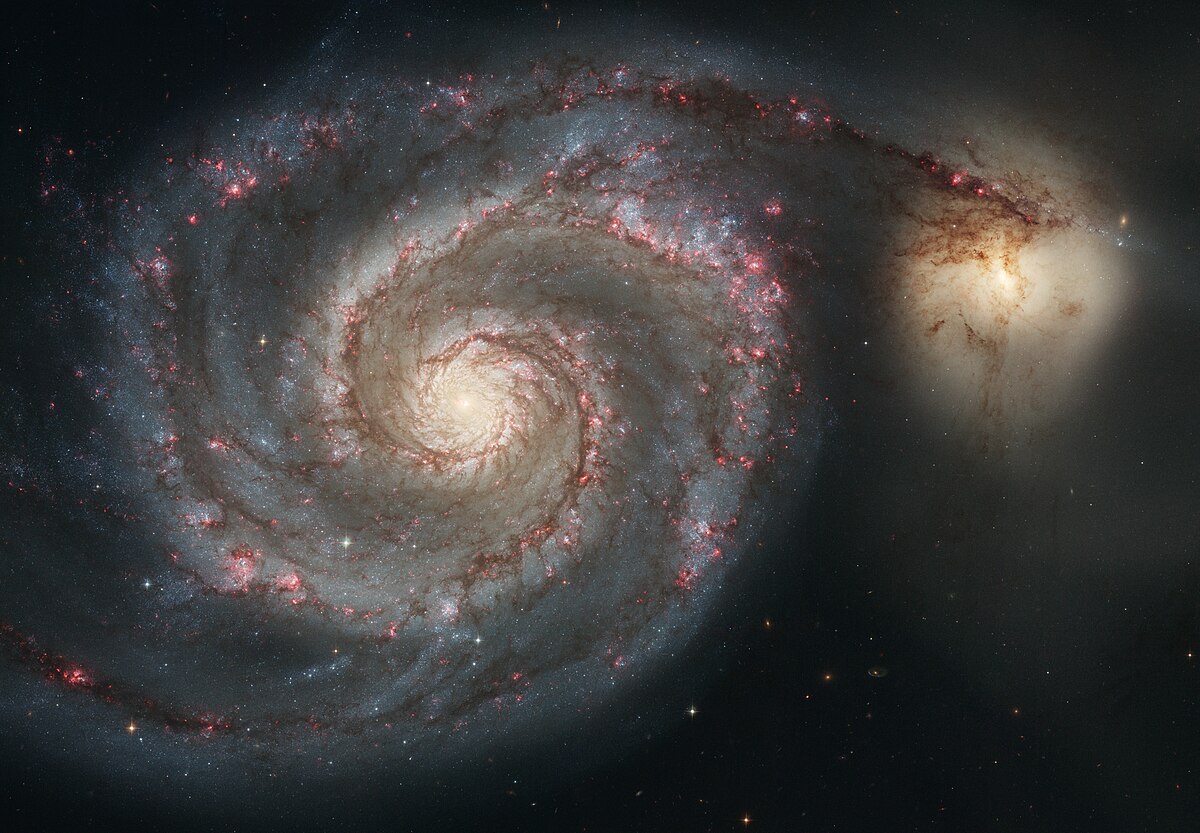
Whirlpool Galaxy
GalaxyWikipedia
5
MENTIONS
5
EPISODES
5
PODCASTS
Search complete. 5 mentions across 5 episodes found for "Whirlpool Galaxy".
Oct 8, 2026

Billy TeetsGUEST
I mean, it's not gonna be like, you know, you're not gonna see a nebula, for example, or a galaxy like you're gonna see in some of these really beautiful images that you see online.
Billy TeetsGUEST
But even setting up telescopes just outside of the city, you'll be able to see that little smudge and realize, oh, this is the Orion Nebula or the Whirlpool Galaxy.
Billy TeetsGUEST
As long as you have kind of an appreciation for it, I mean, th- that's what really helps to make the difference as well.
Billy TeetsGUEST
You know that you're looking at something that's a hundred million light-years away and, you know, it looks like a little smudge, but you realize what it is, and that really kinda makes up for it in a way.

Chuck TomasiHOST
Whirlpool.
Chuck TomasiHOST
Because we saw the Whirlpool Galaxy was one of them.
Craig SteppHOST
Search
Chuck TomasiHOST
for Whirlpool.

Chris LehtoHOST
We see 50,000 light years.
Chris LehtoHOST
We're passing Sombrero Galaxy, Triangulum Galaxy, Whirlpool Galaxy.
Chris LehtoHOST
then what do we find at the next step up from star cluster again 10 to the three the milky way so the milky way is that radius is 5 times 10 to the 20 meters so again if you round that up it's 10 to the 21 meters and there is some variation you see the milky way is smaller than andromeda right but it's larger than other galaxies like dwarf galaxy so it is a full-size galaxy And we see from galaxies, they are in the order of 10 to the 21 meters across.
Chris LehtoHOST
That's again, the average log scale is 2.98 across all these scales.

DataHOST
As of now, none have been conclusively confirmed in another galaxy.
DataHOST
The best known candidate is M51-ULS1B in the Whirlpool Galaxy, about 28 million light years away.
DataHOST
NASA reported it in 2021 after Chandra saw an X-ray source dim in a way consistent with a Saturn-sized planet transiting an X-ray binary, but it remains a candidate because the orbit may be so long that we could wait decades for another transit to confirm it.
DataHOST
So the scorecard is basically thousands confirmed in the Milky Way, zero confirmed extragalactic planets, but at least one very intriguing candidate.

John MoustakasGUEST
So the very tip of the catalog has things that are in the Messier catalog, for example.
John MoustakasGUEST
So M fifty-one, the Whirlpool Galaxy, M one-o-one, M one-ten, all famous galaxies that have been studied for, you know, a hundred and fifty years, even before we knew they were galaxies.
John MoustakasGUEST
So what the Legacy Surveys allows us to do for, uh, studies like this is because it's this homogeneous, uh, data set, we've, we've analyzed all the data all together, even though it comes from a few different instruments.
John MoustakasGUEST
You can then build a catalog that becomes a reference catalog, and that's the first step towards doing science to try to understand things like how do galaxies form? Why don't galaxies all look the same? Why do they look different? And yet, you know, why are there commonalities and then distinctions? It all gets back to the physics of astrophysics.