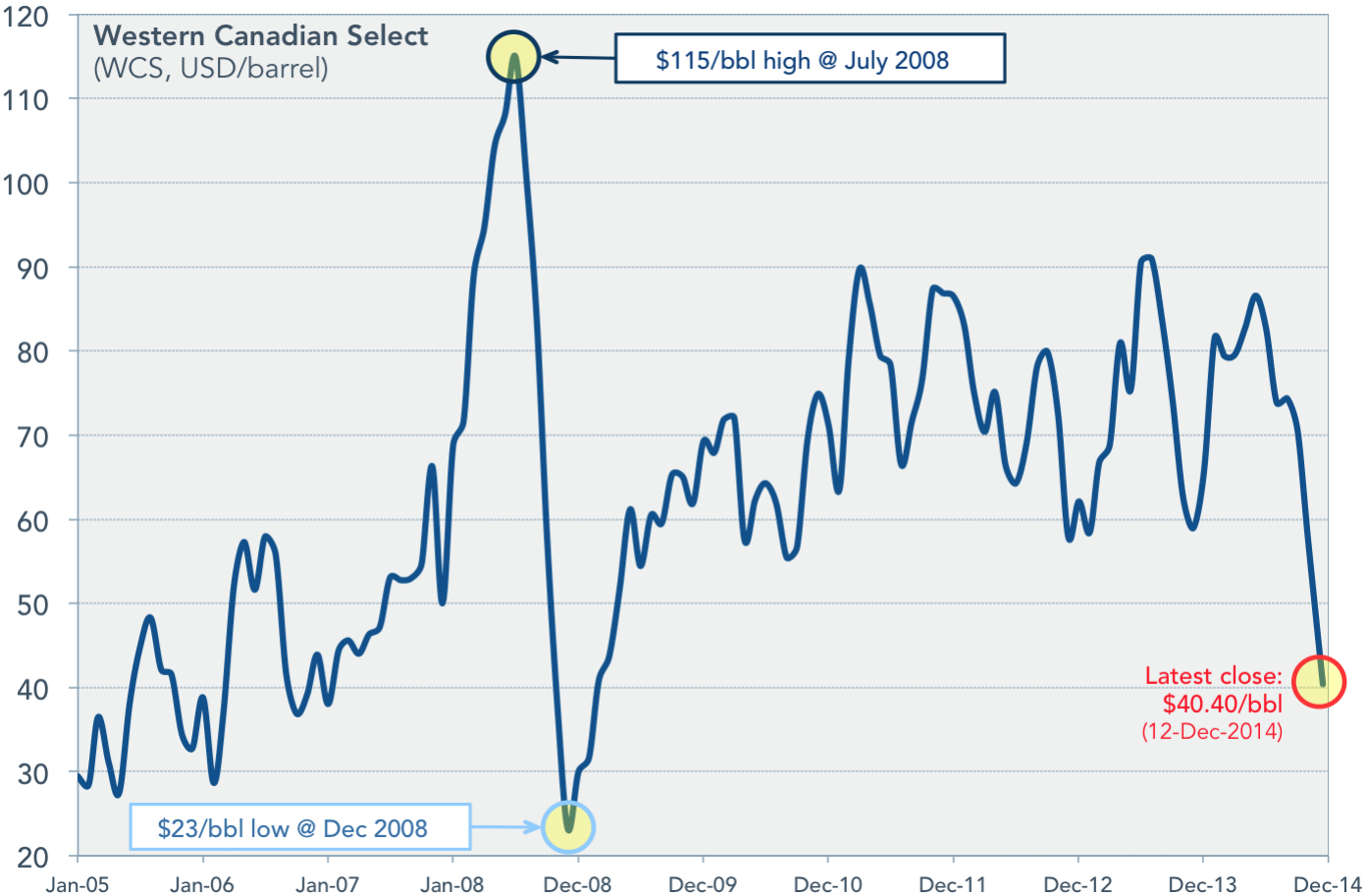
Western Canadian Select
46
MENTIONS
35
EPISODES
17
PODCASTS
Search complete. 46 mentions across 35 episodes found for "Western Canadian Select".
Sep 18, 2026

Rory JohnstonGUEST
That's weakened heavy oil markets.
Rory JohnstonGUEST
This is where Canada comes in.
Rory JohnstonGUEST
So WCS, or Western Canadian Selected Differentials, which is the main market-driven heavy oil benchmark now in Houston, that widened from around $3, $4 a barrel under WTI in Houston to $8 a barrel under.
Rory JohnstonGUEST
So it kind of doubled that.
Rory JohnstonGUEST
That is the Venezuela effect.

Marella FernandezHOST
Uh, let's go to this next email from Fred.
Marella FernandezHOST
Uh, the spread between, uh, West Texas Intermediate and Western Canadian Select, which historically was between 12 and 15, uh, is now at 27.
Marella FernandezHOST
Is there any reason for this? We're gonna pull up, uh, the board for First West Texas.
Marella FernandezHOST
This is the October contract, uh, at 101.70, uh, and, uh, we'll take a look at Western Canadian Select.
Marella FernandezHOST
Uh, yesterday it had the close done before it.
Marella FernandezHOST
Let me just look.

Brian ZinchukGUEST
So if we don't get our stuff to a coast, w- if...
Brian ZinchukGUEST
At minimum, we're gonna see a huge increase in the, uh, differential between West Fes- West Texas Intermediate and West Canadian Select, and we'll be giving away our oil for next to nothing like we did eight years ago.
Deidre GarrickGUEST
Well, and that's why your... how you vote and the government structure that you bring in is very important.
Deidre GarrickGUEST
Your, your question about what's going on in Alberta does have far-reaching implications, right? Like, the Venezuelan government did not invest adequately in its oil and gas development.

Jim CsekHOST
It's, um- That's where, that's where it's at.
Jim CsekHOST
So, you know, like places that are having a tougher time accessing it, they're paying a lot more than, than even what's showing on the screen there at, you know, like when, uh, Brent and, and West Tex- West Texas Intermediate are showing a different number and Western Canadian Select, right? So, so expect-
Iain BurnsHOST
And yesterday
Jim CsekHOST
... more of this pain.
Jim CsekHOST
Like look...
Jim CsekHOST
I mean, it's a windfall right now for, you know, Canadian companies too.
Jim CsekHOST
Western Canadian Select at $93.
Jim CsekHOST
Who'd have thought you saw $93 for Western Canadian Select? $93.48 actually for Western Canadian Select.

Mirella FernandezCORRESPONDENT
The Canadian dollar is up to $71.48 U.S. West Texas Intermediate is down over $3 to $102.43 U.S. a barrel.
Mirella FernandezCORRESPONDENT
Western Canadian Select also down close to $3 to $75.29. And the TSX dropped 90 points today.
Mirella FernandezCORRESPONDENT
Those are your business headlines.
Mirella FernandezCORRESPONDENT
I'm Mirella Fernandez.

Automated VoicesNARRATOR
What does it mean for Canada? A resurgence of Venezuelan oil production could cut into Canada's heavy oil market share.
Automated VoicesNARRATOR
Even growth of a few hundred thousand barrels would compete head-to-head in Gulf Coast refineries and could result in a widened differential or discount between the West Texas Intermediate benchmark crude price and the Western Canadian Select crude price.
Automated VoicesNARRATOR
As such, it is a threat that should be taken seriously.
Automated VoicesNARRATOR
That said, the global oil market is cutthroat and highly competitive, and Canada is constantly competing to retain and grow its market share from Venezuela and dozens of others.
Mirella FernandezCORRESPONDENT
West Texas Intermediate is up to 101.39 US a barrel.
Mirella FernandezCORRESPONDENT
Western Canadian Select is down to 77.60, and the TSX barely moved today, ending the day five points higher.
Mirella FernandezCORRESPONDENT
Those are your business headlines.
Mirella FernandezCORRESPONDENT
I'm Morella Fernandez.

Atanu MukherjeeGUEST
Like I told you last time, you know, the world is much more resilient in terms of a supply system to oil and gas shocks compared to what it was 30 years back, right? So if you look at the nature of the shocks that this was there this time, 20 million barrels approximately, right, getting kind of like disrupted, quite frankly, you know, it did not disrupt, right, the supply side that much, not significantly.
Atanu MukherjeeGUEST
And a lot of things have got to do with obviously how China adapted in terms of using its reserves, how some of the oil was rerouted, right, instead of Hormuz through the pipelines to Saudi Arabia and Red Sea and, you know, UAE through the pipelines, how new sources became more available from Guyana to Western Canadian Select.
Atanu MukherjeeGUEST
So if you combine all these things together, the net effect was not that significant as it should have been for a 20 million barrel loss.
Atanu MukherjeeGUEST
That's a big shock if you look at the numbers, right? So the resilience in the system is much more today than it was, you know, 30 years back.

Paul Van EijlGUEST
Um, so [laughs] here's the thing about the oil too.
Paul Van EijlGUEST
Um, Canada regularly sells its primary crude oil blend, the Western Canadian Select, at a discount compared to the US benchmark, which is the West Texas Intermediate.
Paul Van EijlGUEST
The discount is approximately 10 to $20 per barrel, and that helps to keep the United States gas prices down.
Chris JacobsonHOST
Right, yep.

FrejaHOST
The decline rates shoot back up, capital costs spike, and those pristine margins compress rapidly.
FrejaHOST
Second, there's the notorious price volatility of Western Canadian Select, or WCS.
FrejaHOST
Heavy crude inherently trades at a discount to WTI because it requires complex, expensive refining and blending with lighter condensates just to flow through a pipeline.
FrejaHOST
When regional Canadian pipelines bottleneck, or when major refineries in the US Midwest go down for maintenance, that WCS discount blows out aggressively.
FrejaHOST
Even if global WTI is sky high, a blown-out differential can absolutely destroy Headwaters' realized prices.
FrejaHOST
And finally, integration risk.
8 MINS LATER
FrejaHOST
You can track this in their quarterly management discussion and analysis.
FrejaHOST
If they're pumping too much water relative to oil, it means their decline rates are going to miss expectations and capital efficiency is degrading.
25 more episodes mention Western Canadian Select.
Create an account to see the whole feed, search across every transcript, and follow the entities you care about.