Warring States period

Warring States period

Search complete. 124 mentions across 19 episodes found for "Warring States period".

Sep 9, 2026

Laszlo MontgomeryHOST
0:11
Over the past four hours and two episodes, we've traced the China history timeline from mythical times in the 3rd millennium BC all the way up to the 4th century BC.
Laszlo MontgomeryHOST
0:21
This is the Warring States period in China.
Laszlo MontgomeryHOST
0:25
We looked at mythical times and the Shang that gave rise to the 790-year Zhou Dynasty.
Laszlo MontgomeryHOST
0:32
In 770 BC, the Zhou rulers were forced out of their capital in Haojing and fled east to Luoyang, still called Chengzhou.
Laszlo MontgomeryHOST
0:41
And during this Eastern Zhou period, during the two phases of the Spring and Autumn and Warring States periods, the remaining independent fiefdoms and mini-kingdoms threw their lot in with nearby stronger kingdoms.
Laszlo MontgomeryHOST
0:54
We looked at the rise of the Qin and how they evolved.
Laszlo MontgomeryHOST
0:59
We left off last time in 316 BC with the conquest of Shu and Ba, the two ancient kingdoms in and around Chengdu and Chongqing.
Laszlo MontgomeryHOST
2:41
He's three kings after Duke Xiao, and we remember Duke Xiao for bringing Xiangyang into the government where his reforms ignited Qin's rise.
Zach McCrearyHOST
24:03
Ooh, I like that
René RodriguezPANELIST
24:04
... uh, it takes place, like, during the Warring States period and is also about the unification of China.
René RodriguezPANELIST
24:09
So there are a lot of actual historical characters in here, but the story is completely fictitious.
René RodriguezPANELIST
24:16
Um, but it's about a war opha- a war orphan, uh, named Shin who wants to become the greatest general under the heavens.
Doug CampbellHOST
1:18
I assume that he was a real person as many scholars think he was.
Doug CampbellHOST
1:25
He was born around 280 BC in Warring States period China.
Doug CampbellHOST
1:30
The Han Fei as a series of texts that are, you know, the book Han Fei is an anthology, The teachings in that are attributed to him.
Doug CampbellHOST
1:39
That's why the book is named after him.
Doug CampbellHOST
3:17
They are animated, and Han Fei is animated by this really big, urgent practical question, which is how to bring about unity.
Doug CampbellHOST
3:26
So Han Fei, again, we're not exactly sure about when he's born, but he's most likely born around 280 BC.
Doug CampbellHOST
3:35
And that's in the midst of the Warring States period in Chinese history.
Doug CampbellHOST
3:40
This is the period that comes after Confucius' period, which is the spring and autumn period.

Unknown podcast

The Great Wall of China: Two Thousand Years of Stone and Sand | History For Sleep

Sep 6 · 8 Mentions

speaker_5HOST
4:39
A Fractured Land.
speaker_5HOST
4:40
The Warring States and the Qin Unification.
speaker_5HOST
4:46
Long before there was a single country called China in the way we understand the word today, there was a wide stretch of land in East Asia populated by many different kingdoms, each with its own rulers, its own armies, its own customs, and its own uneasy relationships with its neighbors.
speaker_5HOST
5:06
Historians often call this the Warring States Period, a name that tells you almost everything you need to know about the mood of the time.
speaker_5HOST
5:15
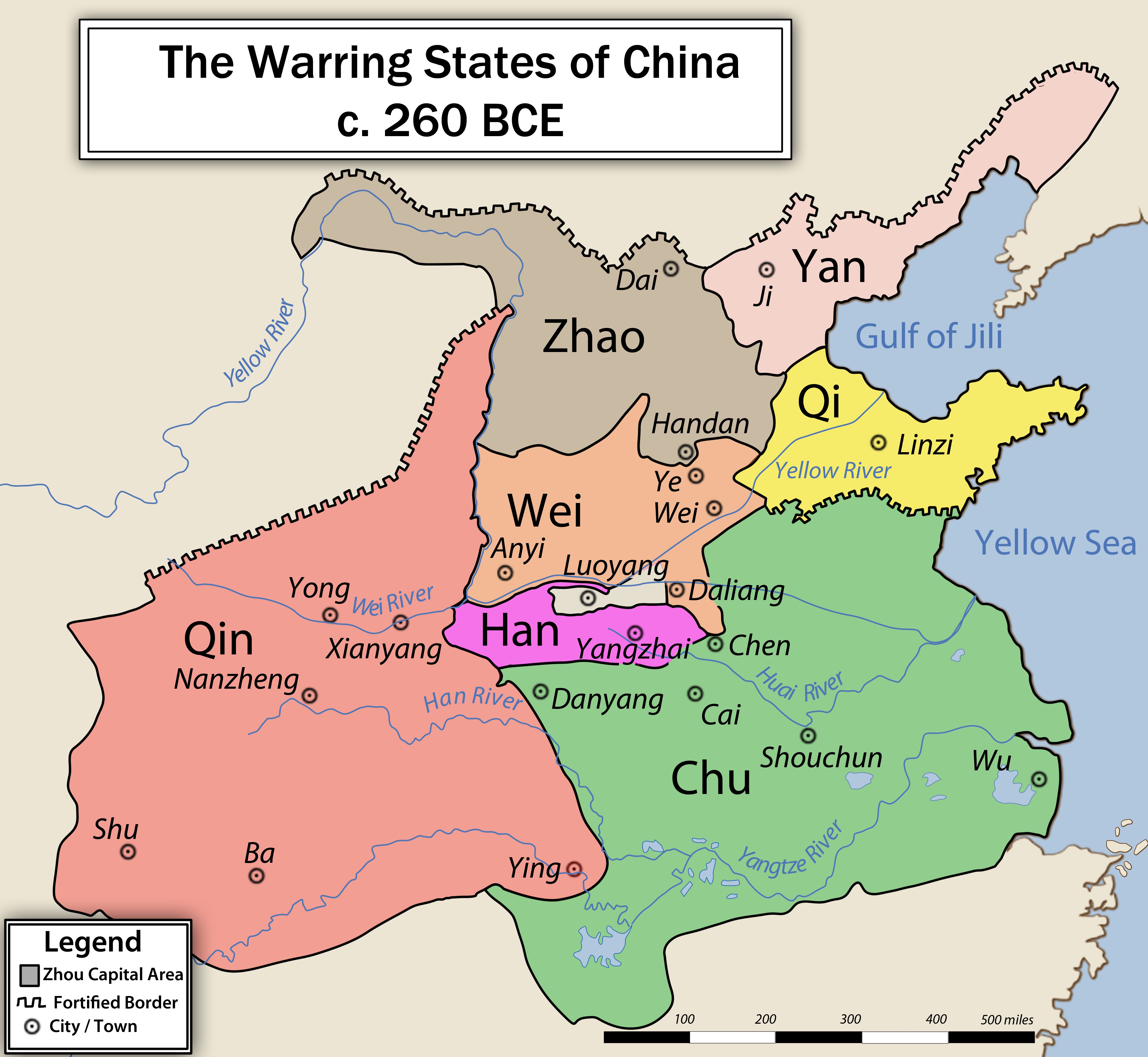
For roughly two and a half centuries, a handful of powerful states with names like Qin, Zhao, Yan, Wei, Han, Chu, and Qi fought, allied, betrayed, and fought again, each one trying to expand its own territory at the expense of the others.
speaker_5HOST
5:39
If you can imagine a landscape of shifting borders, where a river might mark the edge of one kingdom this decade and belong to a rival kingdom the next, you begin to understand why these states felt such a deep and constant anxiety about their frontiers.
speaker_5HOST
8:55
So did the state of Zhao, further east, and the state of Yan, in the northeast, closer to what is now the area around Beijing.
speaker_5HOST
9:05
Each wall was built for its own local purpose, defending its own local frontier, with no thought at all that one day these separate structures might be connected into something larger.
speaker_7NARRATOR
8:41
Armies grew until they numbered in the tens of thousands, and then the hundreds of thousands, and the fields were trampled and the roads filled with refugees, and the century wore on in a grinding music of war that would give the age its name.
speaker_7NARRATOR
8:56
Later historians would call it the Age of the Warring States, and it lasted in one form or another for the better part of five hundred years.
speaker_7NARRATOR
9:05
Out of that long emergency came something astonishing.
speaker_7NARRATOR
9:10
When an old order collapses, people are forced to ask from the ground up how a human being ought to live and how a society ought to be run.

49 MINS LATER

speaker_7NARRATOR
58:08
And they hold lightly to every height they reach, knowing it is a turning point and not a resting place, trusting the great tide that carries everything out and brings everything home.
speaker_7NARRATOR
58:19
It is a serene and slightly subversive way to move through a striving world.
speaker_7NARRATOR
58:25
And when a person who thinks like this is handed power over others, when the one who keeps to the valley is made to sit on a throne, the results are stranger and gentler than anything the age of warring states expected.
speaker_7NARRATOR
58:38
And it is to that unlikely ruler that we turn next.
William HanHOST
18:32
The records of the grand historian further tells us that Bianxue knew all medical specialties and could switch specialties depending on circumstances.
William HanHOST
18:42
This also shows that by the Warring States era, Chinese medicine already specialized.
William HanHOST
18:49
So that's an interesting reflection of social reality.
William HanHOST
18:53
Here's Sima Qian.
William HanHOST
19:27
He adapted his practice according to local customs.
William HanHOST
19:33
Bianque indeed went to the state of Qing.
William HanHOST
19:37
The stratagems of the Warring States tells us that he treated King Wu of Qing.
William HanHOST
19:43
But retainers and ministers around the king obstructed Bianque as he tried to treat the king.
Laszlo MontgomeryHOST
28:46
Zoroaster, Solon, Gautama Buddha, Socrates, Plato, Herodotus, Sophocles, Aristotle, Thucydides, Pythagoras, Hippocrates, the Babylonian captivity of the Jews, the Persian Empire, and their great king, Cyrus.
Laszlo MontgomeryHOST
29:03
And speaking of great, Alexander the Great triumphed during the time of the Warring States period.
Laszlo MontgomeryHOST
29:09
That time saw the birth of the Roman Republic.
Laszlo MontgomeryHOST
29:11
In fact, the First Punic War was already raging between Carthage and Rome when the Zhou Dynasty begins to breathe its last.
Laszlo MontgomeryHOST
29:33
Well, a lot lost, too.
Laszlo MontgomeryHOST
29:35
But there's less and less guessing about dates and who wrote or said what and when was this battle or that change of regime or this treaty.
Laszlo MontgomeryHOST
29:43
As I mentioned, this Eastern Zhou period was divided almost evenly between the spring and autumn period from 770 to 476 B.C., and the warring states from 475 to 221 BC.
Laszlo MontgomeryHOST
29:59
221 BC was the year when Qin Shi Huang finally defeated the last of these states, and China, or what comprised China back then, was under one single emperor.
Gary ArndtHOST
0:00
During the decline of the Zhou dynasty, warfare and clan violence escalated, threatening the stability of Chinese civilization and igniting an era known as the Warring States period.
Gary ArndtHOST
0:11
But out of this chaos emerged a prolific itinerant teacher offering a path away from bloodshed and political ruin.
Gary ArndtHOST
0:18
His teachings would sustain Chinese culture for more than two thousand five hundred years and would become the basis for almost every dynasty that followed him.
David Patrick HarryHOST
55:29
And this period is divided between what's called the spring and the autumn period.
David Patrick HarryHOST
55:35
And it leads into the Warring States period.
David Patrick HarryHOST
55:37
The Warring States is generally 475 to 221 B.C. And the spring and autumn period, the spring and autumn period is that they're searching for a way to unify this system.
David Patrick HarryHOST
55:48
And you can see we're now at 488.
David Patrick HarryHOST
55:51
It's still not unified.
David Patrick HarryHOST
55:53
And you can see these power factions grow and strengthen themselves.
David Patrick HarryHOST
55:57
And this is going to lead to 475, the warring states period, where they're going to figure out, try to establish who is the dominant power here.
David Patrick HarryHOST
56:05
And it's going to change Chinese history in regards to the emphasis on centralization.
Nicholas GordonHOST
0:12
In this podcast, we interview fiction and nonfiction authors working in, around, and about the Asia-Pacific region.
Nicholas GordonHOST
0:19
The springs and autumns period is a strange time in Chinese history, coming after the decline of the Zhou and before the famous Warring States period.
Nicholas GordonHOST
0:28
this period of chinese history features a large number of small states with no powerful hegemon no strong sense of the mandate of heaven rules of chivalry that wouldn't seem out of place in medieval europe and roles passed down through lineage and not awarded on the basis of merit Historian Yuri Pines calls this period China's aristocratic age in his book titled, appropriately, China's Aristocratic Age, Politics and Power in the Springs and Alms Period.
Nicholas GordonHOST
0:55
Yuri is the Michael W. Lipson Chair in Chinese Studies at Hebrew University of Jerusalem.
Yuri PinesGUEST
1:41
It starts with the collapse of the Zhou dynasty in the 771 BCE, and then it continues for three centuries, and then it will
Nicholas GordonHOST
1:49
be
Yuri PinesGUEST
1:50
transformed into the Warring States period, which is much better known.
Yuri PinesGUEST
1:55
The Spring and Autumn period is the period of fragmentation.

9 more episodes mention Warring States period.

Create an account to see the whole feed, search across every transcript, and follow the entities you care about.

We value your privacy

We use cookies to understand how you use our platform and to improve your experience. Click “Accept All” to consent, or “Decline non-essential” to opt out of non-essential cookies. Read our Privacy Policy.