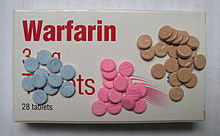
Warfarin
MedicationWikipedia
36
MENTIONS
27
EPISODES
23
PODCASTS
Search complete. 36 mentions across 27 episodes found for "Warfarin".
Sep 18, 2026

Nicole BhaveHOST
Yeah.
Nicole BhaveHOST
Along the lines of lifetime management, I think, you know, one of the big dividers obviously is Coumadin or Warfarin versus no Warfarin, right? And so I often find myself, and these are not conversations that, you know, it's a one and done.
Nicole BhaveHOST
Oftentimes you have to go back to the patient a few times and and sort of really get them to consider from all angles, you know, the risks and benefits of anticoagulation, the very real possibility of having multiple sternotomies in their lifetime, which I think is very difficult for people to wrap their heads around when they have never known anyone who's had open heart surgery before.
Nicole BhaveHOST
Um, and, and, and just the fact that, you know, bioprocesses can degenerate faster in younger patients.
Nicole BhaveHOST
Any last comments at all?
Ashwini KherkarHOST
I think the last comment that I will make is that we talk a lot about the rural-urban divide, and it's about access to the TAVR itself.
Ashwini KherkarHOST
But if you think about these patients who also, since we're talking about a younger age group and in a lower-risk population, the follow-up is also key, right? So I think that in rural centers where mechanical valves have existed for a long time, they might have a surgeon, they might have an INR or Coumadin clinic.
Ashwini KherkarHOST
But getting these patients into TAVR clinic, getting them a TAVR isn't the last step.
Nicole BhaveHOST
Yeah.
Nicole BhaveHOST
Along the lines of lifetime management, I think, you know, one of the big dividers obviously is Coumadin or Warfarin versus no Warfarin, right? And so I often find myself, and these are not conversations that, you know, it's a one and done.
Nicole BhaveHOST
Oftentimes you have to go back to the patient a few times and and sort of really get them to consider from all angles, you know, the risks and benefits of anticoagulation, the very real possibility of having multiple sternotomies in their lifetime, which I think is very difficult for people to wrap their heads around when they have never known anyone who's had open heart surgery before.
Nicole BhaveHOST
Um, and, and, and just the fact that, you know, bioprocesses can degenerate faster in younger patients.
Nicole BhaveHOST
Any last comments at all?
Ashwini KerkarHOST
I think the last comment that I will make is that we talk a lot about the rural-urban divide, and it's about access to the TAVR itself.
Ashwini KerkarHOST
But if you think about these patients who also, since we're talking about a younger age group and in a lower-risk population, the follow-up is also key, right? So I think that in rural centers where mechanical valves have existed for a long time, they might have a surgeon, they might have an INR or Coumadin clinic.
Ashwini KerkarHOST
But getting these patients into TAVR clinic, getting them a TAVR isn't the last step.

Ken BerryHOST
And if you do, you have to be aware of this and you have to take the steps that I talk about later.
Ken BerryHOST
The blood thinner Coumadin or Warfarin significantly lowers your CoQ10 levels.
Ken BerryHOST
Now, taking a CoQ10 supplement can actually affect your Coumadin levels.
Ken BerryHOST
So if you're taking Coumadin or Warfarin, then you want to get on a steady daily dose of CoQ10.
Ken BerryHOST
and then your doctor can adjust your Coumadin level so that your INR is good, but also you're getting plenty of coenzyme Q10 as well.
Ken BerryHOST
Blood pressure medications is the next big topic.
Ken BerryHOST
So all the beta blockers like labetalol, tenolol, propranolol, they all lower your CoQ10 levels.

speaker_13AUDIENCE
And they said to me, oh, her leg is swollen because she has a deep venous thrombosis, which is a clot.
speaker_13AUDIENCE
We'll put her on Coumadin.
speaker_13AUDIENCE
I mean, I sued them successfully.
Walter SterlingHOST
Nothing good comes after the word Coumadin.
speaker_13AUDIENCE
Yeah, well, if you don't get rid of a clot, you can get a stroke.
speaker_13AUDIENCE
See, if it detaches and becomes an embolism will come up to the lungs.

Kara DGUEST
Heparin works very quickly and is often used in patients who are hospitalized.
Kara DGUEST
Warfarin, on the other hand, works more slowly and requires INR monitoring.
Kara DGUEST
Then we have the DOACs, like apixaban and Xarelto, which directly inhibit clotting factors and generally don't require routine INR monitoring.
Kara DGUEST
One bored pearl I always remind students about, mechanical heart valves still equal warfarin.
Anna MillerHOST
Another question here for you.
Anna MillerHOST
What blood thinner is typically used if the patient has a mechanical heart valve?
Kara DGUEST
Warfarin.
Anna MillerHOST
You got it.

Jen CoffindafferHOST
And that's because of my experience with people on blood thinners, like many of you have people, you know, on blood thinners and their arms are always bruised in this way because, you know, they bleed very easy.
Jen CoffindafferHOST
That's Coumadin.
Jen CoffindafferHOST
or whichever thinner she was on.
Jen CoffindafferHOST
I don't know which one.

Max McFarlandGUEST
So quick timeline on anticoagulants.
Max McFarlandGUEST
I'm sure folks listening in will be familiar with the product Warfarin.
Max McFarlandGUEST
So back in the 1940s, that was first developed as a bait for rodents to thin their blood and stop their clotting, ultimately killing them.
Max McFarlandGUEST
And that quickly became adopted across the U.S. and the Western Hemisphere as a rodent bait.

Philip SnyderGUEST
Yeah, I looked that up just to verify, and there's no evidence with the newer medicines.
Philip SnyderGUEST
When people are on Coumadin or Warfarin, it's the same thing.
Philip SnyderGUEST
So many things interact with that, and doctors have been used to prescribing Warfarin for years for anticoagulation.
Philip SnyderGUEST
We tell them, don't take supplements because your INR just goes up and down and up and down.

Mike HardenbrookHOST
that.
Percy MenziesGUEST
And I said, I could explain to physicians how to treat blood clots because we had a drug called Coumadin and other substances.
Percy MenziesGUEST
So I thought to myself, I almost felt that I was a knight in shining armor going out to help people.
Percy MenziesGUEST
So that's what I started.

Gregory LipGUEST
And I'll take us back to an old trial called ACTIV-W, which was in general patients with atrial fibrillation.
Gregory LipGUEST
When warfarin was compared to essentially DAT, which was aspirin plus clopidogrel, Warfarin did better than DAPT in reducing stroke and thromboembolism, but the rate of major bleeding and the rate of intracranial bleeding was no different between Warfarin and DAPT and dual antiplatelet therapy.
Gregory LipGUEST
So dual antiplatelet therapy, while some practitioners like to keep those patients on it after implanting a left atrial appendage occlusion, Well, you could almost say that it's like putting them on warfarin afterwards in a sort of rather crude manner.
Gregory LipGUEST
So no surprise what we found really is in terms of the major bleed rate, it was high and it was higher than comparing to reduced dose DOA.
17 more episodes mention Warfarin.
Create an account to see the whole feed, search across every transcript, and follow the entities you care about.