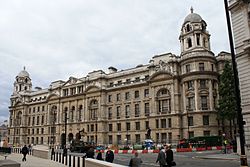
War Office
Government officeWikipedia
227
MENTIONS
70
EPISODES
62
PODCASTS
Search complete. 227 mentions across 70 episodes found for "War Office".
Oct 26, 2026

Derren BrownHOST
HH probably was Harry Houdini.
Derren BrownHOST
So when, on April 26th, 1903, Melville wrote in his diary, called at War Office to pass on letter from HH, what could that letter have said? The War Office wouldn't have been a place to store personal correspondence.
Derren BrownHOST
And less than a week later, Houdini departed for Russia.
Derren BrownHOST
What might he have been able to report back? Well, he was given access to a lot of information.

Timothy FergusonNARRATOR
and also during the american civil war these operations however were of a sporadic character They were not part and parcel of an organized military section.
Timothy FergusonNARRATOR
It is not generally known that the British War Office virtually pioneered the military use of balloons, and subsequently the methods perfected in Britain became recognized as a kind of standard and were adopted generally by the powers with such modifications as local exigencies seemed to demand.
Timothy FergusonNARRATOR
The British Military Balloon Department was inaugurated at Chatham under Captain Templer in 1879.
Timothy FergusonNARRATOR
It was devoted essentially to the employment of captive balloons in war, and in 1880 a company of the Royal Engineers was detailed to the care of this work in the field.

Tom WeissNARRATOR
"'It's a trophy, all right,' Nora declared.
Tom WeissNARRATOR
"'One of the crew, probably the commander, must have come on board in a hurry and changed into uniform after they had started.' "'It is my painful duty, Miss Nora,' Harrison announced solemnly, "'to inform you on behalf of Captain Griffiths that all articles of whatsoever description found in the vicinity of Dutchman's Common, which might possibly have belonged to anyone in the Zeppelin, must be sent at once to the War Office.' "'Rubbish!' Nora scoffed.
Tom WeissNARRATOR
"'The War Office aren't going to have my hat!' "'Duty,' the young man began.
Tom WeissNARRATOR
you can go back to the depot and do your duty then mr harrison nora interrupted but you're not going to have my hat i'd throw it into the fire sooner than give it up military regulations must be obeyed miss nora captain griffiths ventured thoughtfully nothing so important as hats harrison put in you see they fit somebody The girl's gesture was irreverent but convincing.
Tom WeissNARRATOR
"'I'd listen to anything Captain Griffiths had to say,' she declared.
7 MINS LATER
Tom WeissNARRATOR
"'I haven't any heart for anything just now.' He took a somber but agitated leave of his hostess, and went out into the twilight cursing his lack of ease, remembering the things which he had meant to say, and hating himself for having forgotten them.
Tom WeissNARRATOR
Philippa, to whom his departure had been, as it always was, a relief, was already leaning forward in her chair with her arm around Helen's neck.
Tom WeissNARRATOR
i thought that extraordinary man would never go she exclaimed and i was longing to send for you helen london has been such a dreary chapter of disappointments what a sickening time you must have had dear it was horrid philippa assented sadly but you know henry is no use at all and i should have felt miserable unless i had gone i have been to every friend at the war office and every friend who has friends there i have made every sort of enquiry and i know just as much now as i did when i left here that richard was a prisoner at wittenberg the last they heard and that they have received no notification whatever concerning him for the last two months helen glanced at the calendar "'It is just two months to-day,' she said mournfully, since we heard.
Timothy FergusonNARRATOR
Therefore we marched, or, to be more truthful, shambled on, shouting lusty choruses with an air of boisterous gaiety which was anything but genuine.
Timothy FergusonNARRATOR
you do as i do and you'll do all right fall in and follow me was a favorite with number twelve platoon their enthusiasm might have carried conviction had it not been for their personal appearance which certainly did not number fifteen platoon would strive manfully for a hearing with steadily shoulder to shoulder steadily blade by blade marching along sturdy and strong like the boys of the old brigade as a strictly accurate historian i must confess that none of these assertions were quite true we marched neither steadily nor shoulder to shoulder nor blade by blade we staggered all over the road and kept step only with the sergeant-major doubling forward warning us with threats of extra drills to keep in our fours and pick it up in fact the boys of the old brigade whoever they may have been would have scornfully repudiated any suggestion that we resembled them in any respect they would have been justified in doing so had any of them seen us at the end of six weeks of training for however reluctantly we were forced to admit that sergeant harris was right when he called us a raw bunch of rookies unpromising we were not there was good stuff in the ranks the material from which real soldiers are made and were made but it had not yet been rounded into shape we were still nothing more than a homogeneous assembly of individuals we declined to accept the responsibility for the seeming slowness of our progress we threw it unhesitatingly upon the war office which had not equipped us in a manner befitting our new station in life although we were recruited immediately after the outbreak of war less than half of our number had been provided with uniforms many still wore old civilian clothing others were dressed in canvas fatigue suits or the worn-out uniforms of policemen and tram-car conductors every old clothes shop on petticoat lane must have contributed its allotment of cast-off apparel our arms and equipment were of an equally nondescript character we might easily have been mistaken for a mob of vagrants which had pillaged the seventeenth century arsenal with a few slight changes in costuming for the sake of historical fidelity we would have served as a citizen army for a realistic motion picture drama depicting an episode in the French Revolution.
Timothy FergusonNARRATOR
We derived what comfort we could from the knowledge that we were but one of many battalions of Kitchener's first hundred thousand equipped in the same makeshift fashion.
Timothy FergusonNARRATOR
We did not need the repeated assurances of cabinet ministers that England was not prepared for war.
13 MINS LATER
Timothy FergusonNARRATOR
Three batteries of field artillery and four machine guns have blown you to blazes.
Timothy FergusonNARRATOR
You haven't a man left.
Timothy FergusonNARRATOR
sometimes we reached our objective with less fearful slaughter but at the moment when there should have been the sharp clash and clang of steel on steel the cries and groans of men fighting for their lives we heard the bugles from far and near sounding the stand-by and friend and enemy dropped warily to the ground for a rest while our officers assembled in conference around the motor of the divisional general all this was playing at war and tommy was fed up with play as we marched back to barracks after a long day of monotonous field maneuvers he eased his mind by making sarcastic comments upon this inconclusive kind of warfare he began to doubt the good faith of the war office in calling ours a service battalion as likely as not we were for home defense and would never be sent abroad left right left right why did i join the army oh why did i ever join kitchener's mob oh lummy let's ever been blommy became the favorite homeward bound marching song and so he groused and grumbled after the manner of tommy's the world over and in the meantime he was daily approaching more nearly the standard of efficiency set by england's inexorable warlord it was interesting to note the physical improvement in the men wrought by a life of healthy well-ordered routine my battalion was recruited largely from what is known in england as the lower middle classes there were shop assistants clerks railway and city employees tradesmen and a generous sprinkling of common laborers many of them had been used to indoor life practically all of them to city life and needed months of the hardest kind of training before they could be made physically fit before they could be seasoned and toughened to withstand the hardships of active service plenty of hard work in the open air brought great and welcome changes the men talked of their food and anticipated it with a zest which came from realizing for the first time the joy of being genuinely hungry they watched their muscles harden with the satisfaction known to every normal man when he is becoming physically efficient food exercise and rest taken in wholesome quantities and at regular intervals were having the usual excellent results for my own part i had never before been in such splendid health i wished that it might at all times be possible for democracies to exercise a beneficent paternalism over the lives of their citizenry at least in matters of health it seems a great pity that the principle of personal freedom should be responsible for so many ill-shaped and ill-sorted physical incompetents my fellow tommies were living really living for the first time they had never before known what it means to be radiantly buoyantly Healthy.
Timothy FergusonNARRATOR
there were as well more profound and subtle changes in thoughts and habits the restraints of discipline and the very exacting character of military life and training gave them self-control mental alertness at the beginning they were individuals no more cohesive than so many grains of wet sand after nine months of training they acted as a unit obeying orders with that instinctive promptness of action which is so essential on the field of battle when men think scarcely at all.

Murtry KelsallSOUNDBITE_SPEAKER
For a week or two, nothing disturbed the even tenor of our way.
Murtry KelsallSOUNDBITE_SPEAKER
Then came a message from the War Office to say that a Mr. Mowat was on his way to fill the vacancy in my team.
Murtry KelsallSOUNDBITE_SPEAKER
I decided to stick to my tale that the turret room was... frightfully draughty with a howl from the outside grill, and that Maud would be very well advised to share a room with one of the others.
Murtry KelsallSOUNDBITE_SPEAKER
Oh, I'd reckoned without our new recruit.
Murtry KelsallSOUNDBITE_SPEAKER
Mowat, did you say? She cried with a kind of a wild look in her eyes.
Murtry KelsallSOUNDBITE_SPEAKER
A moat is it! Oh, may heaven save him! And with that, she hobbled away.
Murtry KelsallSOUNDBITE_SPEAKER
Then, early in June 1940, the War Office suddenly decided to disband my team.
Murtry KelsallSOUNDBITE_SPEAKER
We left Cantoul, and in the urgency of new tasks, the mystery of Black Dougal and the turret room gradually lost its hold and became just a bad memory and little more.

ExpatriateNARRATOR
Impossible to describe the mysterious processes by which we managed it.
ExpatriateNARRATOR
I think the War Office kicked us out twice, and the Admiralty once, though what we were doing with the Admiralty I don't to this day understand.
ExpatriateNARRATOR
The British Red Cross kicked us steadily all the time on general principles.
ExpatriateNARRATOR
The Americans snubbed us rather badly.
ExpatriateNARRATOR
Whenever a horse was shot dead under its rider, an Amazon was to dash up with another whose rider had been shot dead.
ExpatriateNARRATOR
It was all perfectly simple and only needed a little organization.
ExpatriateNARRATOR
For four weeks the lure of the battlefield kept our volunteers dancing round the War Office and the Red Cross societies, and for four weeks their progress to the front was frustrated by Lord Kitchener.
ExpatriateNARRATOR
Some dropped off disheartened, but others came on, and a regenerated committee dealt with them.

Brian ScottHOST
He was one of the pioneers of British aviation.
Brian ScottHOST
The War Office hired him in 1906 to design military aircraft, which made him the first man ever paid by a British government to do that job.
Brian ScottHOST
He worked at the Army Balloon Factory at Farnborough under conditions of real secrecy, testing his machines in a Scottish Glen behind a cordon of Black Watch soldiers.
Brian ScottHOST
His obsession was stability.

David WalesNARRATOR
To these must be added the Royal Engineers, the Army Service Corps, the Royal Ordnance Department, the Royal Army Medical Corps, the Army Pay Corps, and other non-combatant units necessary to the domestic and general internal working of an army.
David WalesNARRATOR
Today these various forces are increased to such an extent that no man outside the War Office can tell the strength of infantry, cavalry, and artillery.
David WalesNARRATOR
No man either can tell what will be the permanent strength of the army on a peace footing when the present urgent need for men no longer exists, and there is only to be considered the maintenance of a force sufficient for the garrisoning of colonial and foreign stations and for ordinary defensive needs at home.
David WalesNARRATOR
Generally speaking, the soldier at home, no matter to what arm or branch of the service he belongs, undergoes a continuous training.
3 HRS 13 MINS LATER
David WalesNARRATOR
Gradually, however, commercial conditions began to improve, and for the past year or two, in consequence of a very small percentage of unemployment among the laboring classes, recruiting has suffered.
David WalesNARRATOR
The army does not offer as much as the ordinary civilian employer, either in wages or conditions of life, and consequently men will not enlist as long as they can get something to do in a regular way.
David WalesNARRATOR
Hence the War Office advertisements, which had very little effect on the recruiting statistics, and were wrongly conceived so far as appealing to the right class of man, was in question.
David WalesNARRATOR
It was not until Lord Kitchener had assumed control of the War Office that the advertisements emanating from that establishment made a real personal appeal to the recruit.

Corrie SamuelNARRATOR
I shall make no excuse to my readers for giving them a pretty full history of my struggles to become a Crimean heroine.
Corrie SamuelNARRATOR
My first idea, and knowing that I was well fitted for the work and would be the right woman in the right place, the reader can fancy my audacity, was to apply to the War Office for the post of hospital nurse.
Corrie SamuelNARRATOR
Among the diseases which I understood were most prevalent in the Crimea were cholera, diarrhea, and dysentery, all of them more or less known in tropical climates, and with which, as the reader will remember, my Panama experience had made me tolerably familiar.
Corrie SamuelNARRATOR
Now, no one will accuse me of presumption if I say that I thought, and so it afterwards proved, that my knowledge of these human ills would not only render my services as a nurse more valuable, but would enable me to be of use to the overworked doctors.
Corrie SamuelNARRATOR
Her peculiar fitness, in a constitutional point of view, for the duties of a medical attendant needs no comment.
Corrie SamuelNARRATOR
Signed, H.E.M., late Medical Officer, West Granada Gold Mining Company.
Corrie SamuelNARRATOR
So I made long and unwearied application at the War Office in blissful ignorance of the labor and time I was throwing away.
Corrie SamuelNARRATOR
I have reason to believe that I considerably interfered with the repose of sundry messengers and disturbed, to an alarming degree, the official rarity of some nice gentlemanly young fellows who were working out their salaries in an easy, offhand way.

Jay DyerHOST
Britain's Foreign Intelligence Service, the SIS, or what is known as MI6, was an interdepartmental service of the Foreign Office during wartimes.
Jay DyerHOST
It was known as the War Office.
Jay DyerHOST
All of this was run by interlocking members of the Lord Cecil, Lord Milner Group, or
speaker_5VOICE_ACTOR
was Cecil Rhodes a lord? I think he was.
60 more episodes mention War Office.
Create an account to see the whole feed, search across every transcript, and follow the entities you care about.