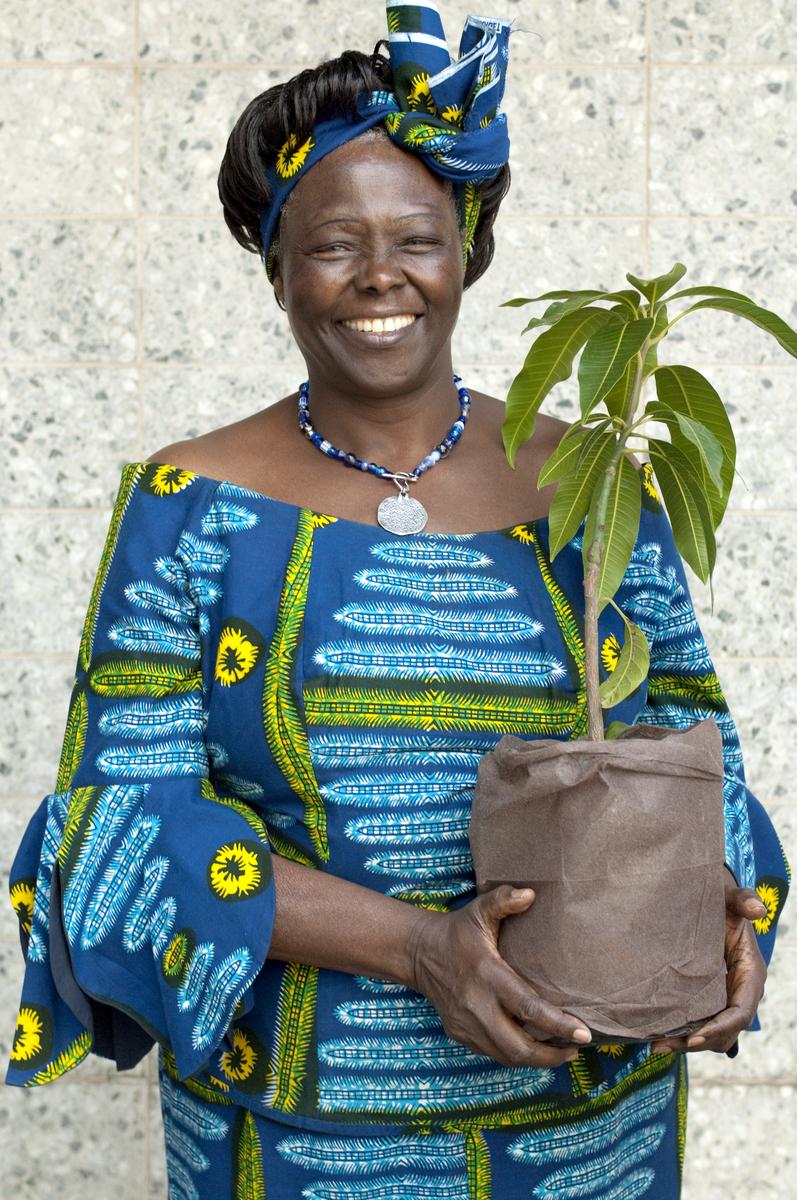
Wangari Maathai
Kenyan political activistWikipedia
13
MENTIONS
10
EPISODES
10
PODCASTS
Search complete. 13 mentions across 10 episodes found for "Wangari Maathai".
Oct 15, 2026

speaker_1HOST
Mm-hmm.
Nzambi MateeGUEST
But I also wanted to do, uh, uh, solutions that are impacting the environment positively because one of the biggest motivations was Wangari Maathai.
speaker_1HOST
Mm-hmm.
Nzambi MateeGUEST
Because I, I used to look at her and, and how much zeal and, and result, uh, resolve she has as far as, like, her purpose is, is concerned, and that, for me, gave me a, like, that, like, bulb-

Ruth KamauHOST
...
Ruth KamauHOST
Wangari Maathai's-
Osei KofiGUEST
Yeah
Ruth KamauHOST
... lives come onto stage.
Ruth KamauHOST
The kind of intelligence that they had.
Osei KofiGUEST
Yep.
Ruth KamauHOST
You know, you know, Wangari Maathai is well known.
Ruth KamauHOST
She won a Nobel Peace Prize.

Roger BarnettGUEST
So, um, and then people, people...
Roger BarnettGUEST
You know, we partnered with a, a, a, a woman who won the, the first person to win the Nobel Peace Prize for the environment, a wonderful woman out of Kenya named Wangari Maathai.
Roger BarnettGUEST
And she won the Nobel Peace Prize for organizing people to plant trees in Kenya.
Roger BarnettGUEST
And she would pay them eight cents a tree after the tree was planted, after it survived, and after it was replanted in the forest.

Faustina MwololoGUEST
And that initiative went a long way for them, for the whole team.
Faustina MwololoGUEST
Like the Nobel Prize was not for Wangari Maathai alone, it was for the whole team of women who joined and planted trees.
Faustina MwololoGUEST
And that's how like a small local input can make a big difference because decisions, we need to be at the decision-making table.
Faustina MwololoGUEST
We're the ones at the ground, yeah?

Matthias ConroyHOST
The civil rights movement in the United States of America, closely associated with the testimony of Martin Luther King Jr., or the end of apartheid in South Africa following the release of Nelson Mandela and his decision not to surrender the future to hatred.
Matthias ConroyHOST
In different contexts, many courageous and generous women have also stood out, including St. Laura Montoya, St. Teresa of Calcutta, Dorothy Day, Mary Sklodo- Sklodowska Curie, Maria Montessori, Elizabeth Elliott, Wangari Maathai, Benazir Bhutto, and countless others from every continent whose commitment has contributed to making history more humane.
Matthias ConroyHOST
Obviously, I was thinking I, I had a very male-focused [chuckles] list, and certainly, uh, the, the role of women in, I mean, even the, the, uh, the Universal Declaration of Human Rights, uh, sort of spearheaded by, uh, Eleanor Roosevelt.
Matthias ConroyHOST
And certainly, uh, I mean, I think that anyone who watches the, the I Have a Dream speech by Martin Luther King Jr., I don't know how anyone could persist in racism [chuckles] after watching the eloquence and the, the conviction with which, uh, Martin Luther King Jr. delivered that speech.

Dora KamauHOST
That's faithful investment.
Dora KamauHOST
Wangari Maathai, a Kenyan environmentalist and Nobel laureate, started planting trees on degraded land in the 1970s, and then she was arrested for it.
Dora KamauHOST
She planted 47 million trees over her lifetime, knowing that she'd never sit in the shade of most of them.
Dora KamauHOST
But she planted anyway.

Liaqat Ali AazamSOUNDBITE_SPEAKER
So it's important that it is in our hands.
Liaqat Ali AazamSOUNDBITE_SPEAKER
You know, one of the other Nobel laureates is Wangari Maathai, who also led this Green Belt movement and, uh, where they planted millions of trees.
Liaqat Ali AazamSOUNDBITE_SPEAKER
And, um, you know, she said, "When you plant a tree, you are planting hope." So we are planting a seed of future of hope and this, that from one seed, a forest grows.
Liaqat Ali AazamSOUNDBITE_SPEAKER
So you never know the impact you make.

speaker_1HOST
Hmm.
speaker_2HOST
He looks at Wangari Maathai and the Green Belt movement in Kenya.
speaker_2HOST
It is a perfect example of linking systemic thinking to inclusion.
speaker_1HOST
Yes, because she didn't just tell people to plant trees.

Marisa GoudyHOST
Mm.
Dee MulrooneyGUEST
And I just felt like that wood, and I, and learning more and more, like I was saying about the trees, you know? And I don't know if you would know about Wangari Maathai, but she was a Kenyan woman who won the Nobel Peace Prize for, she created the Green Belt Movement in Kenya.
Dee MulrooneyGUEST
And she tells the story of the little hummingbird who, the forest is on fire, and all the animals are watching, and their home is burning down.
Dee MulrooneyGUEST
And the little hummingbird decides, "Well, I'm not just gonna stand around with you lot looking at this.
Dee MulrooneyGUEST
I'm gonna do something." So she goes to the lake, and she takes up a little drop in her beak, and she drops it on the fire.
Dee MulrooneyGUEST
And she keeps going back, you know, hundreds of times.
Dee MulrooneyGUEST
And the elephant says to her, "What a fool you are, you know? That's not gonna do anything." And she basically says, "Well, I'm doing the best I can." So that was Wangari Maathai's message.
Dee MulrooneyGUEST
And I feel like that's all we can do.

Lucia RibisiGUEST
people should not be afraid of that.
Lucia RibisiGUEST
When you're speaking, it reminds me of this Nobel Peace Prize winner, Wangari Maathai talking about discovering tadpoles and just for hours sitting there playing with the frog eggs in the river and just feeling like, how could you not want to protect earth at all costs having these sensual experiences in nature?
Francesca Root-DodsonHOST
Hi, everyone.
Francesca Root-DodsonHOST
My name is Francesca.
7 MINS LATER
Francesca Root-DodsonHOST
squelching my toes in this like thick black mud in michigan as i listen to the frogs croak and you know what i mean it's like nature's kind of horny
Lucia RibisiGUEST
nature is horny nature is so horny nature's horny and it's okay People should not be afraid of that.
Lucia RibisiGUEST
When you're speaking, it reminds me of this Nobel Peace Prize winner, Wangari Maathai, talking about discovering tadpoles and just for hours sitting there playing with the frog eggs in the river and just feeling like, how could you not want to protect Earth at all costs having these sensual experiences in nature?
Francesca Root-DodsonHOST
I totally agree.