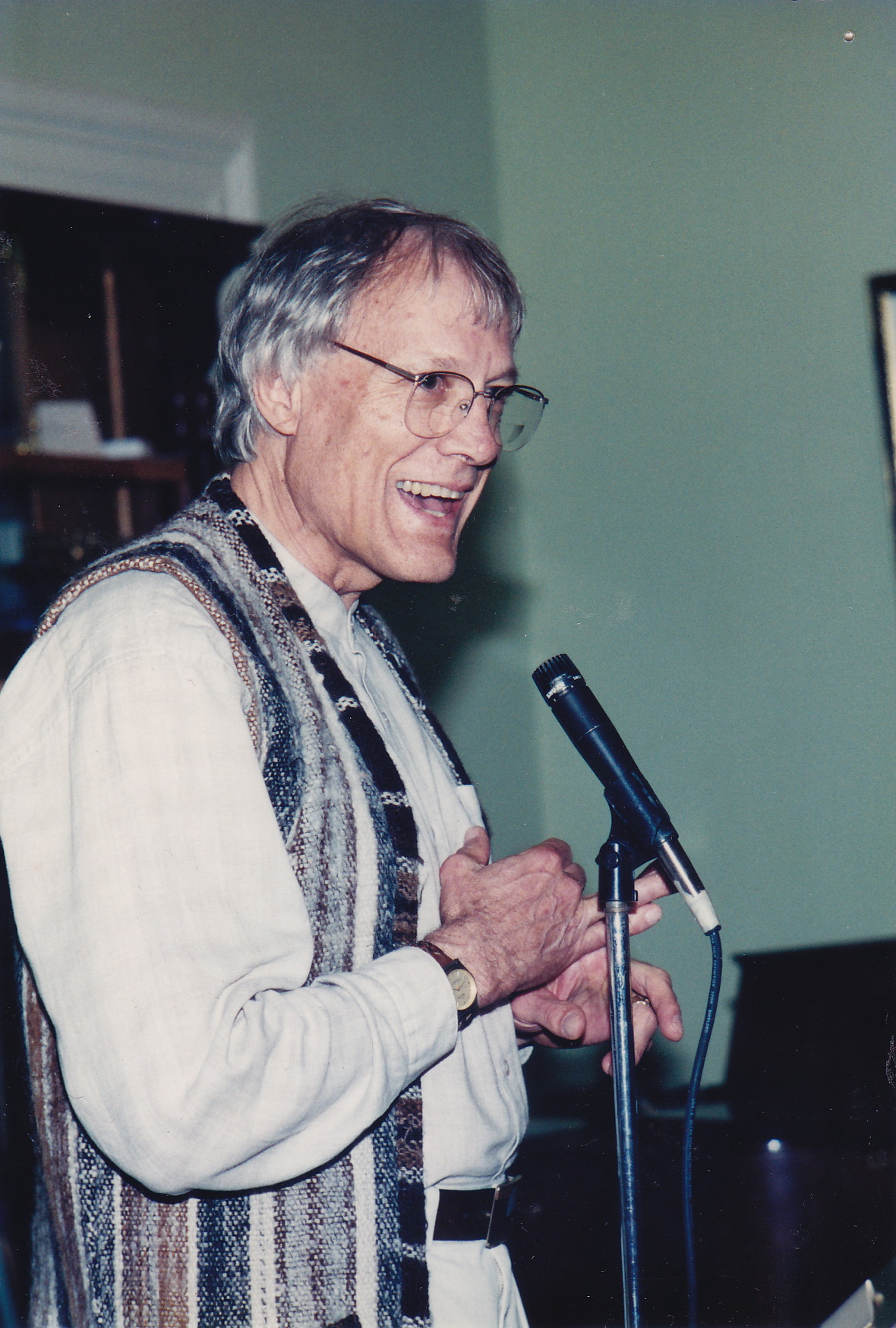
Walter Wink
American scholar and theologianWikipedia
11
MENTIONS
7
EPISODES
6
PODCASTS
Search complete. 11 mentions across 7 episodes found for "Walter Wink".
Nov 4, 2026

Rachelle LambHOST
If we are, in fact, misrecognizing our needs, then simply discovering that we have them takes us only so far.
Rachelle LambHOST
When people asked Marshall, so when do we get off track? What happened? He would make reference to Walter Wink, who wrote a book called The Powers That Be.
Rachelle LambHOST
And he would say that Wink talks about how some thousands of years ago, a male god crushed a female goddess and she broke into a thousand pieces.
Rachelle LambHOST
In workshops, he didn't usually elaborate further than that, other than to encourage audiences to read Wink's book.

Neal StephensonGUEST
It's okay.
Nick GillespieHOST
uh came out and um one thing that stood out which i think is worth revisiting is that you talked a lot about um a uh a jesuit priest theorist named walter wink oh yeah talked about the need to understand domination systems yeah not in ideological terms but in other terms because this is You know, I think the U.S. is far enough away from the Cold War where we can start to think about things without immediately falling into, you know, you're either a John Birch Society member or, you know, a plant for the CPUSA.
Nick GillespieHOST
Although we're slow to kind of make it more complicated.
Nick GillespieHOST
But can you talk about domination systems, both in D, but your work more generally? Because that seems to be the one thing that kind of goes through everything.
Neal StephensonGUEST
Yeah, well, it's been a long time since I thought about Walter Wink.
Neal StephensonGUEST
In fact, just the other day, I was trying to remember his name.
Neal StephensonGUEST
But he wrote about...

Marion RoseHOST
However, in the DDC, what generally happens as babies and children is we are trained out of this innate wisdom.
Marion RoseHOST
because of the cultural beliefs in the disconnected domination culture about what children, in inverted commas, should do, should being one of the core words of the DDC, which I learned from Marshall Rosenberg, Creative Nonviolent Communication, His term was domination culture, which he got from Walter Wink, which Walter Wink got from Rian Eisler.
Marion RoseHOST
Rian Eisler coined the term.
Marion RoseHOST
And then what I realized is it's not just about domination, that in my map, domination comes as a result of disconnection.

Tony Golsby-SmithHOST
And...
Tony Golsby-SmithHOST
Coincidentally, I had been reading on our trip some of Walter Wink's book called The Powers That Be.
Tony Golsby-SmithHOST
Walter Wink's well worth reading.
Tony Golsby-SmithHOST
Won't go into that now.
Tony Golsby-SmithHOST
Anyway, his dominant picture there is that christ has introduced a alternative kingdom to anything earthly ever conceived and all of the earthly systems assist what he calls domination systems and that what he explains is that the way domination systems work, sure they're national, sure they're social, but they actually often get encased in the family.
6 MINS LATER
Tony Golsby-SmithHOST
So what might have been implicit, if we, for instance, were to read the story of David and Goliath, we could imply various moral implications.
Tony Golsby-SmithHOST
But when we're reading the Sermon on the Mount, we're getting them from the mouth of Christ, mouth of Jesus.
Tony Golsby-SmithHOST
And it is a very, I mean, Wink is very powerful in this, Walter Wink.

Brandon CookHOST
Instead, you make the text about certainty and knowing.
Brandon CookHOST
Now, in this series, I'm exploring how powers fall, powers to use Walter Wink's term, institutions, movements, corporations, parties, nations, and how they fall when they shrink down their mission and mandate and abandon their values in order to accrue power.
Brandon CookHOST
Powers generally have some sort of holy text, a charter, a constitution, a party platform, a sacred text.
Brandon CookHOST
I'm using evangelicalism as a case study in this series, Evangelicalism of Power, which I believe has fallen.

Steve StewartHOST
But, um, generally regarded as the foremost Old Testament scholar and theologian, and he calls this system totalism.
Steve StewartHOST
Now, another very influential author for me is Walter Wink, and he uses the term domination system.
Steve StewartHOST
So we're gonna dig down into this a little bit.
Steve StewartHOST
We're gonna look at how, um, [chuckles] how Moses revealed this system, and next time, um, if we, if we could do a big long one, I'd keep this all together, but we gotta divide it.
7 MINS LATER
Steve StewartHOST
Pardon me.
Steve StewartHOST
Now, that's a real brief view of Brueggemann, and if people wanna know more, have them write in, and I'll give you a whole list of books and articles and everything else.
Steve StewartHOST
The second person we wanna look at is Walter Wink, who's also had a big influence on me for years, and he wrote, uh, several books.
Steve StewartHOST
One of them I really like, The Powers That Be.
Steve StewartHOST
It's what got into the fabric and it's carried on in different iterations but let's i'm going to resist the urge to go down that road because we're going to go down it much more properly um so when we say thy kingdom come it's yes it's a request But it's a statement of commitment.
Steve StewartHOST
We're saying we're not going to participate in what Walter Wink calls the domination system.
Steve StewartHOST
Again, we're going to look at that in the next week or two.
Steve StewartHOST
But we're committed to fairness.