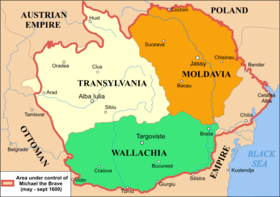
Wallachia
EmpireWikipedia
125
MENTIONS
55
EPISODES
54
PODCASTS
Search complete. 125 mentions across 55 episodes found for "Wallachia".
Sep 12, 2026

speaker_6NARRATOR
The nation was now divided into two tribes.
speaker_6NARRATOR
The Visigoths, whose tribal name was the Thervings, lay more to the south, in what are now the countries of Moldavia, Wallachia, and southern Hungary.
speaker_6NARRATOR
The Ostrogoths, or tribe of the Gruthungs, lay more to the north and east, in Bessarabia, Transylvania, and the Dniester Valley.
speaker_6NARRATOR
But a totally unexpected series of events were now to show how prescient Constantine had been in rearing his great fortress capital to serve as the central place of arms of the Balkan Peninsula.
speaker_6NARRATOR
The Ostrogoths made a desperate attempt to defend the line of the Dniester against the oncoming savages, men with faces that can hardly be called faces, rather shapeless black collops of flesh with little points instead of eyes, little in stature, but lithe and active, skillful in riding, broad-shouldered, good at the bow, stiff-necked and proud, hiding under a barely human form the ferocity of the wild beast.
speaker_6NARRATOR
But the enemy whom the Gothic historian describes in these uninviting terms was too strong for the Teutons of the East.
speaker_6NARRATOR
The Ostrogoths were crushed and compelled to become vassals of the Huns, save a remnant who fought their way southward to the Wallachian shore, near the marshes of the delta of the Danube.
speaker_6NARRATOR
Then the Huns fell on the Visigoths.

Piotr NaterNARRATOR
While the religious parties were fighting their quarrels, Sigismund II had obtained important diplomatic and military successes, which make his reign one of the most memorable in Polish annals.
Piotr NaterNARRATOR
He won brilliant victories over the Hospodar of Wallachia and forced him to surrender considerable parts of his territory.
Piotr NaterNARRATOR
His conquests in Livonia on the Baltic Sea were far more valuable.
Piotr NaterNARRATOR
The Teutonic Order at the beginning of the sixteenth century held the former possessions of the Order of the Sword, Livonia, Estonia, and Courland, which it entrusted to the administration of a special commander.

Dan CumminsHOST
And Nicholas was pissed.
Dan CumminsHOST
He decided he would then occupy Moldavia and, well, Wallachia.
Dan CumminsHOST
Moldavia and Wallachia, there we go, which were controlled by Turkey.
Dan CumminsHOST
The western half of Moldavia, now part of Romania.
Dan CumminsHOST
Eastern side belonged to the Republic of Moldova.
Dan CumminsHOST
This part of the world, they love to fucking throw the names around every couple decades.
Dan CumminsHOST
Northern, southeastern parts or territories, Ukraine.
Dan CumminsHOST
Wallachia is just fucked.

Mr. MystHOST
Bram Stoker wrote Dracula, one of the most famous horror novels in the world.
Mr. MystHOST
Almost as famous as the monster himself is the belief that Count Dracula was based on Vlad the Impaler, the brutal prince of Wallachia.
Mr. MystHOST
But new details have led literary historians to re-examine the author's notes to find out if we were wrong about Stoker's inspiration.
Mr. MystHOST
So if Dracula wasn't actually inspired by Vlad the Impaler, where did Bram Stoker find the world's most famous vampire? Welcome to the mysteries of mythology, the real origins of Dracula.
Mr. MystHOST
If you ask someone where the inspiration for Dracula came from, you'll probably get the same answer.
Mr. MystHOST
Vlad III, commonly known as Vlad the Impaler, the 15th century prince of Wallachia who earned a terrifying reputation for executing his enemies on wooden stakes.
Mr. MystHOST
Wartime shish kebabs.
Mr. MystHOST
It's an idea that's been culturally embedded for a couple of decades now.

Tail DraggerHOST
Crews called the airplane the Flying Coffin and the Liberator, though they didn't always say it affectionately, and tidal wave was going to take it down to 200 feet over one of the most heavily defended targets in occupied Europe.
Tail DraggerHOST
The objective was the Ploesti Oil Complex, a cluster of refineries spread across the Wallachian plain north of Bucharest.
Tail DraggerHOST
In 1943, Ploesti was producing somewhere between a quarter and a third of all the refined petroleum products the Axis powers were burning, depending on whose estimate you use.
Tail DraggerHOST
aviation fuel, diesel, lubricants.
Tail DraggerHOST
One went into the sea shortly after takeoff.
Tail DraggerHOST
So the number that actually pressed into the Balkans was somewhere around 164. already short of what the planners had put on paper.
Tail DraggerHOST
Then, over the Wallachian plain, something went wrong.
Tail DraggerHOST
At a key navigation checkpoint, a rail junction the lead navigators were using as their initial turn point, there was confusion in the lead element.

JossHOST
Yeah, [laughs] sometimes even three.
JossHOST
No, but a very specific vampire, right? But while Dracula the Count is famously fiction created by Bram Stoker, that whole story was inspired by nearby, like, 15th century ruler of Wallachia, Vlad Dracula.
JossHOST
And not only that character, but Bram Stoker was really inspired by Transylvania as a whole, the aforementioned architecture and foggy forests kind of en- encapsulated by the mountains.
MoniqueHOST
Yeah.

Piotr NaterNARRATOR
While the religious parties were fighting their quarrels, Sigismund II had obtained important diplomatic and military successes, which make his reign one of the most memorable in Polish annals.
Piotr NaterNARRATOR
He won brilliant victories over the Hospodar of Wallachia and forced him to surrender considerable parts of his territory.
Piotr NaterNARRATOR
His conquests in Livonia on the Baltic Sea were far more valuable.
Piotr NaterNARRATOR
The Teutonic Order, at the beginning of the 16th century, held the former possessions of the Order of the Sword, Livonia, Estonia, and Courland, which it entrusted to the administration of a special commander.

Piotr NaterNARRATOR
While the religious parties were fighting their quarrels, Sigismund II had obtained important diplomatic and military successes which make his reign one of the most memorable in Polish annals.
Piotr NaterNARRATOR
He won brilliant victories over the Hospodar of Wallachia and forced him to surrender considerable parts of his territory.
Piotr NaterNARRATOR
His conquests in Livonia on the Baltic Sea were far more valuable.
Piotr NaterNARRATOR
The Teutonic Order at the beginning of the 16th century held the former possessions of the Order of the Sword, Livonia, Estonia, and Courland, which it entrusted to the administration of a special commander.

Deborah Beach GiordanoNARRATOR
"Yesterday we were passing between Servia and Hungary.
Deborah Beach GiordanoNARRATOR
To-day we have Wallachia on the north and Servia on the south.
Deborah Beach GiordanoNARRATOR
To-morrow you will be in Bulgaria.
Deborah Beach GiordanoNARRATOR
But though the people of these countries are half wild, they have an astonishing faculty for speaking many languages."
Deborah Beach GiordanoNARRATOR
"You are very witty," said the captain.
Deborah Beach GiordanoNARRATOR
"Well, I didn't know it before; but perhaps I have been talking wit all my life without knowing it, as Monsieur Jourdain talked prose." As we were two days behind our time, some of the company were thrown very much on each other's society.
Deborah Beach GiordanoNARRATOR
One highly educated lady, the wife of a Wallachian general, entertained us by her intelligent remarks on many interesting subjects.
Deborah Beach GiordanoNARRATOR
We thought we could slightly trace in them the effects of the evangelical kiosk at the Paris Exhibition on those of a different faith.

Pamela NagamiNARRATOR
The anarchic condition of the far east of Europe began toward the close of this epoch to assume shape and consistency by the growing importance of Moscow and its recognition as a center of national life and national aspirations for Tartar-ridden Russia, as well as by the union of the kingdoms of Poland and Hungary under the scepter of Louis the Great.
Pamela NagamiNARRATOR
All along that monarch's southeastern frontier the crescent gleamed, for northern Greece and Servia and Wallachia were subdued and occupied by the Janissaries of Sultan Amaranth I, who had already established the long-enduring dominions of the Turk on the ruins of the Roman Empire of the East.
Pamela NagamiNARRATOR
On the northern and southern shores of Europe this was the day of wealthy and powerful trading republics.
Pamela NagamiNARRATOR
The rising communities on the Baltic as well as on the Tuscan and Adriatic seaboards enriched themselves by the struggles, to the parties themselves worse than unproductive, of the greater powers and became the bankers, carriers, purveyors, and clothiers of the civilized world.
45 more episodes mention Wallachia.
Create an account to see the whole feed, search across every transcript, and follow the entities you care about.