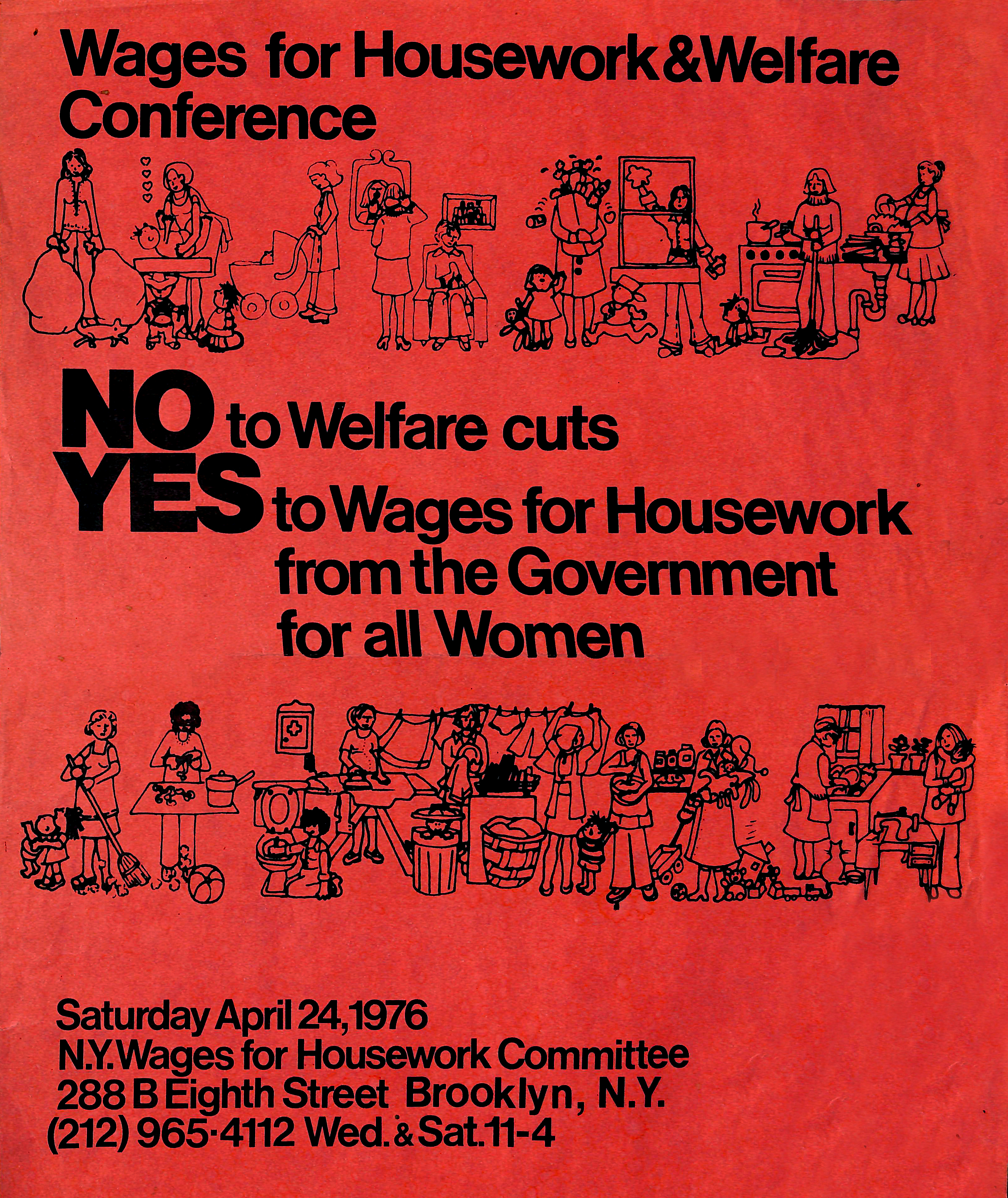
Wages for housework
47
MENTIONS
7
EPISODES
7
PODCASTS
Search complete. 47 mentions across 7 episodes found for "Wages for housework".
Sep 12, 2026

speaker_6HOST
It's incredible.
speaker_6HOST
The Wages for Housework Movement is fundamentally a radical, almost Marxist feminist talking point.
speaker_5HOST
Right.
speaker_6HOST
The idea that domestic labor is real labor and should be economically recognized by the government was fiercely progressive.

Eva BrioschiGUEST
And for instance, uh, referring also to this, uh, this creativity of refusal, uh, Mili Gandini did a very important performance with, um, Mariuccia Seccol's daughter, uh, as, uh, uh, as an actor in the s- in the performance.
Eva BrioschiGUEST
So the photographic series, uh, Wages for Housework, uh, was, uh, um, an accumulation of dust on, on the furniture in the house, rejecting the women's labor, the housework labor, and, uh, uh, this accumulation of dust on which she asked, uh, Mirella Toniolo to write with her fingers or, uh, with lipsticks, uh, Wages for Housework.
Eva BrioschiGUEST
This became a s- a, a, a visual symbol of this domestic rebellion and, uh, um, the refusal of, of the social a- a- uh, expectations.
Eva BrioschiGUEST
So it was, of course, very important, this, uh, um, mutual and daily dialogue that she was having with, uh, her, uh, female, um, friends.

Sophie LewisGUEST
But politicizing it by precisely insisting that we have to return to this under conditions of post-work freedom, you know, very, very differently from some of the 70s feminists who saw femininity very undialectically as a cage or a shackle or a prison.
Sophie LewisGUEST
There have been, and it's not just the Waiters for Housework tradition, but many other thinkers too, who I'm working with in the introduction to this book, saw something in femininity worth fighting for, worth preserving, actualizing, exploding.
Sophie LewisGUEST
In the Femme Shark Manifesto, it's all about being girls turned inside out, exploded, remixed.
Sophie LewisGUEST
In the Femme Inist Manifesto, it's about rejecting the field of girl by nature in favor of the open horizon of girl by choice.

G SampathHOST
There is a raging debate on whether unconditional cash transfers are crowding out state expenditure on social infrastructure, such as public health and education.
G SampathHOST
Now, a new book by Prabha Kotiswaran titled Wages for Housework: India's Experiment with Unconditional Cash Transfers to Women, defends such payouts from a feminist perspective.
G SampathHOST
It argues that they are a form of financial, social, and political recognition of women's unpaid domestic and care work.
G SampathHOST
Prabha Kotiswaran is professor of law and social justice at King's College London, and she joins us today for a discussion on women-centric cash transfers.
G SampathHOST
Prabha, welcome to In Focus.
G SampathHOST
Thank you for joining us today.
G SampathHOST
Can you give us a quick overview of what exactly is social reproduction theory and this entire wages for housework, uh, movement, which forms the framework through which you are looking at unconditional cash transfers schemes in India?
Prabha KotiswaranGUEST
Mm-hmm.

Barnaby RaineHOST
Uh, in a classic 1974 essay in Race Today, Selma wrote, "Marxism, in this case Marxist feminism, aims to destroy capitalist power that forces us to work, making commodities, and being commodities, and thinking of ourselves and each other as commodities, sexism, and racism." And we're gonna explore those words today.
Barnaby RaineHOST
Selma is best known as a founder of the Wages for Housework movement, and as a longtime partner and collaborator of CLR James, and we'll talk about both of those and more.
Barnaby RaineHOST
And Selma's wonderful son, Sam Weinstein, is here to help us today, so thank you so much, Sam, for being here.
Sam WeinsteinGUEST
Thank you.
19 MINS LATER
Barnaby RaineHOST
Mm, mm.
Barnaby RaineHOST
By 1972, when you were in Britain, you, um, prepared a pamphlet and a paper for a conference of the Women's Liberation Movement in Manchester, which was a very sharp kind of intervention about what feminist politics should be about.
Barnaby RaineHOST
Um, and this is sometimes seen as one of the moments of the birth of your kind of involvement in what becomes Wages for Housework.
Selma JamesGUEST
Yeah.

TonyHOST
Davis had already demonstrated the priority of symbolic ideology over material outcomes much earlier.
TonyHOST
In the nineteen seventies, she vehemently opposed the Wages for Housework movement, which proposed compensating women directly for domestic labor, in effect, a basic income that would have expanded women's economic independence from both husbands and employers.
TonyHOST
Davis rejected this on the grounds that it would entrench gender roles and send women back to the kitchen, preferring the communist prescription of collectivized childcare and mass female workforce participation, which she argued would expand the proletariat and accelerate the conditions for revolution.
TonyHOST
Whatever the merits of the Wages for Housework proposal, Davis' rejection of it was not a materialist argument.
TonyHOST
It was an ideological one.
TonyHOST
It prioritized the symbolic meaning of women's labor over the concrete economic independence of actual women.

Ayesha MinhazHOST
Today, we are here to discuss a book that explores this tension.
Ayesha MinhazHOST
The book is titled Wages for Housework: India's Experiment with Unconditional Cash Transfers to Women.
Ayesha MinhazHOST
It's an open access title published by Oxford University Press.
Ayesha MinhazHOST
It was authored by Professor Prabha Koteshwaran, Professor of Law and Social Justice at King's College London.
Ayesha MinhazHOST
Wages for Housework examines India's experiment with unconditional cash transfer to women.
Ayesha MinhazHOST
It looks at the schemes through the lens of feminist social reproduction theory and explores the implementation in three states: Goa, Assam, and West Bengal.
Ayesha MinhazHOST
Welcome, Professor Prabha.
Ayesha MinhazHOST
Thank you for joining us.