Voyager program
ProgramWikipedia
105
MENTIONS
40
EPISODES
34
PODCASTS
Search complete. 105 mentions across 40 episodes found for "Voyager program".
Sep 18, 2026

HenryPANELIST
How about color television? It was invented by electrical engineer Guillermo Gonzalez Camarena.
HenryPANELIST
He invented it in 1940, patented in 1942, and later on NASA was using it in the Voyager mission.
HenryPANELIST
Okay.
HenryPANELIST
So something cool.
HenryHOST
How about color television? It was invented by electrical engineer Guillermo Gonzalez Camarena.
HenryHOST
He invented it in 1940, patented it in 1942, and later on NASA was using it in the Voyager mission.
HenryHOST
Okay.
HenryHOST
Something cool.

speaker_5HOST
Mm-hmm.
speaker_1HOST
Utilized on the Voyager probes, the Cassini mission to Saturn, and the Curiosity and Perseverance rovers on Mars.
speaker_1HOST
An RTG does not involve nuclear fission like a reactor.
speaker_1HOST
There are no moving parts.
speaker_5HOST
This means its heat output steadily declines from the absolute moment it is manufactured.
speaker_5HOST
Furthermore, the thermocouples themselves degrade over time due to the constant heat and radiation exposure.
speaker_5HOST
I mean, the Voyager probes are slowly turning off instruments today because their RTGs are failing after 40 years.
speaker_1HOST
This is an unavoidable reality of the tech.

speaker_4HOST
We specifically targeted star clusters with the Arecibo message in 1974, beaming our biological makeup and location directly into deep space.
speaker_3HOST
And don't forget the Voyager probes.
speaker_4HOST
Oh, the golden records?
speaker_3HOST
Yes.
speaker_3HOST
It is entirely too late for us.
speaker_4HOST
Yeah.
speaker_4HOST
Those radio waves and Voyager probes are already out there traveling at the speed of light.
speaker_4HOST
You cannot unwing a bell in a vacuum.

Jeremy SochaHOST
If you know one thing about Saturn's poles or have been listening to the show back when Jeff was a regular, you have probably heard about the infamous hexagon.
Jeremy SochaHOST
That massive six-sided jet stream pattern at Saturn's North Pole has been there for more than 40 years, confirmed as far back as the Voyager missions in the 1980s, and has shown up every single time anyone has looked for it since.
Jeremy SochaHOST
That part isn't new, and if you've heard about a geometric storm on Saturn before, that's almost certainly what you were thinking of.
Jeremy SochaHOST
What is new, though, is something completely different sitting at the opposite pole.
Jeremy SochaHOST
Here it is.
Jeremy SochaHOST
Here you go.
Jeremy SochaHOST
So this has been something that we've known was there since Cassini and Voyager.
Jeremy SochaHOST
Voyager was way earlier than Cassini, but when the Voyager probes passed by Saturn, we, we recognized this.

Joey BairdHOST
And the uniqueness of space in itself that...
Joey BairdHOST
The fascination of like Voyager 1 and 2, they shot these things off in like 78, 77, 78, 79.
Joey BairdHOST
And they are now way past what we know as normal space.
Joey BairdHOST
And they were able to calculate that, OK, we're going to shoot this off at this particular time and it's going to take pictures of Mars and then it's going to.

Chris WardleVOICE_ACTOR
Yep.
Chris WardleVOICE_ACTOR
I'm taking the Voyager plaque back home where it belongs.
Kate BellVOICE_ACTOR
Why?
Chris WardleVOICE_ACTOR
Knowing the Navy, I doubt they would want our position being shown to any possible hostile entities.
23 MINS LATER
Grace KellyVOICE_ACTOR
Please, have a seat, the both of you.
Grace KellyVOICE_ACTOR
We have read over your reports in great detail, Mr. Wardle.
Grace KellyVOICE_ACTOR
I trust you have Ms. Bell's code and the Voyager plaque?
Chris WardleVOICE_ACTOR
Both in here, Admiral.

Alya Al NuaimiHOST
A message, our message, our music, sounds, greetings from all of us on planet Earth to whoever might be out there.
Alya Al NuaimiHOST
Will aliens ever find it? We're talking about the Voyager golden record, and this story might just be the most beautiful thing you'll hear all week.
Alya Al NuaimiHOST
Right.
Alya Al NuaimiHOST
Four incredible topics, one amazing journey, and you are right here with us for all of it.
20 MINS LATER
Alya Al NuaimiHOST
Not between two people, of course, but between us and the universe, basically.
Alya Al NuaimiHOST
And it starts in the year 1977.
Alya Al NuaimiHOST
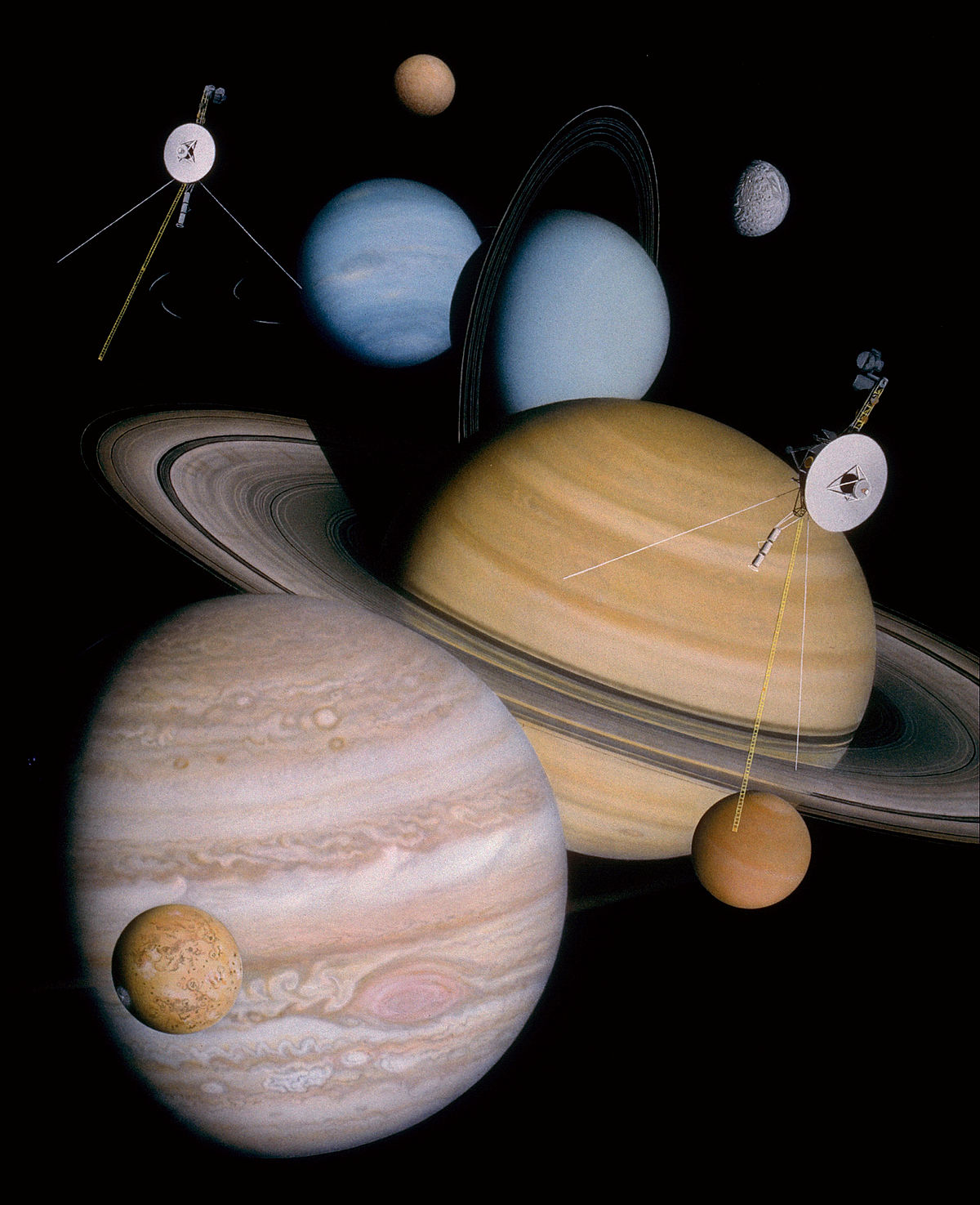
Almost 50 years ago, NASA launched two small spacecraft called Voyager 1 and Voyager 2, of course, two little robots sent out into the dark with a job to do.
Alya Al NuaimiHOST
They were meant to fly past the planets of our solar system, take pictures, collect information, and then send them all back home.
Alya Al NuaimiHOST
And here is why.
Alya Al NuaimiHOST
We know, thanks to old NASA missions, of course, called Voyager and Galileo, that Europa has a global ocean underneath its frozen crust.
Alya Al NuaimiHOST
Not a small ocean, not a pond, a massive enormous body of water that contains more than double of the water all of Earth's oceans combined.
Alya Al NuaimiHOST
Imagine, double the water of Earth's oceans combined on a moon.

Trevor BarryGUEST
Things have happened in its atmosphere that we knew of in the northern hemisphere.
Trevor BarryGUEST
So in 1980 and 1981 the Voyager probes did flybys of Saturn and they actually discovered a perfect six-sided hexagonal feature surrounding Saturn's North Pole.
Trevor BarryGUEST
So
Julian MorrowHOST
we've seen there's a hexagon in the North.
30 more episodes mention Voyager program.
Create an account to see the whole feed, search across every transcript, and follow the entities you care about.