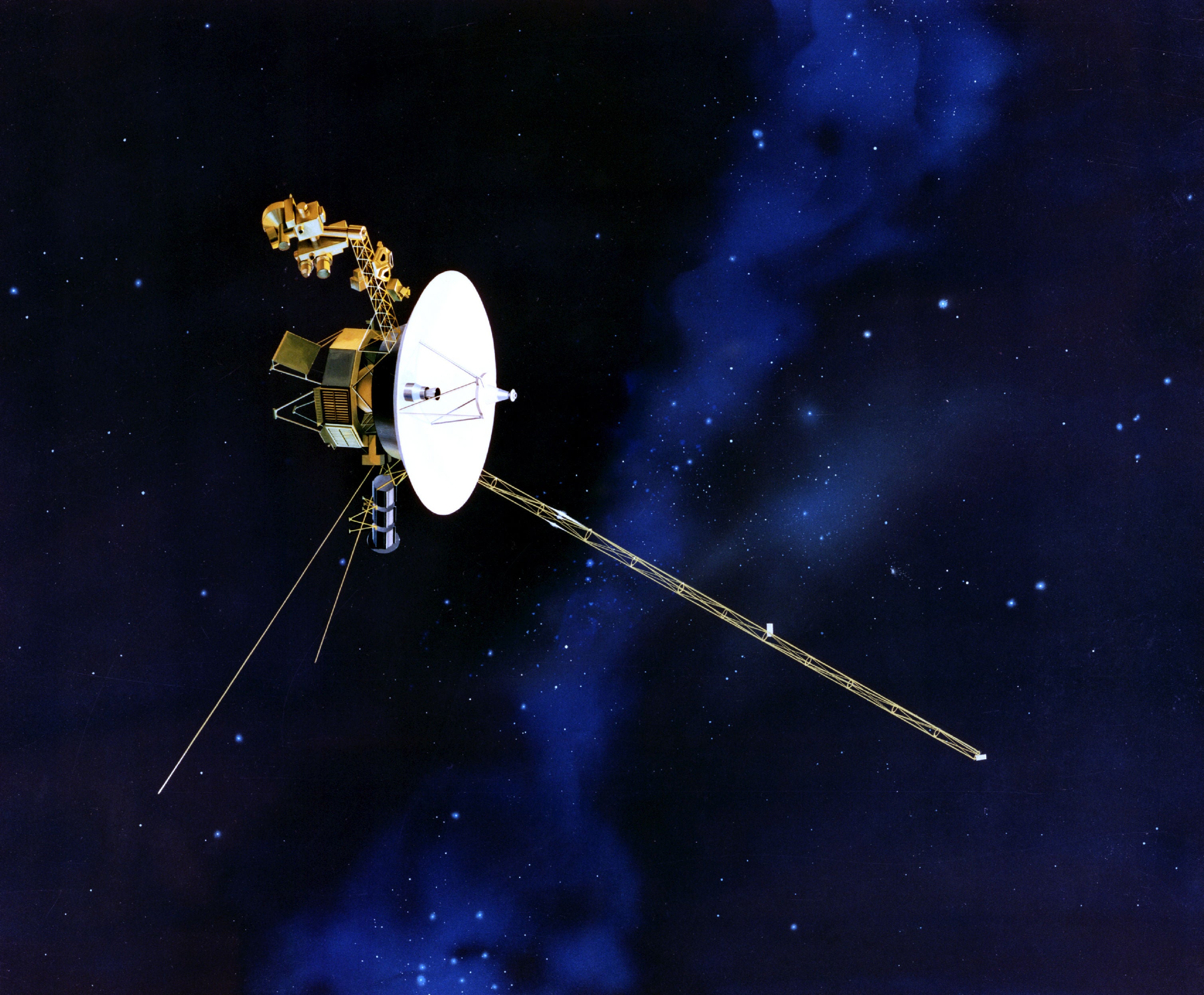
Voyager 1
Space probeWikipedia
1.4k
MENTIONS
160
EPISODES
83
PODCASTS
Search complete. 1388 mentions across 160 episodes found for "Voyager 1".
Sep 22, 2026

Paul MackinHOST
And it shows you, you know, in 260 years, how far we'd come from being sort of able to estimate the speed of light to actually going out into space, take a picture, of the Earth and Moon together.
Paul MackinHOST
The photographer in this case was Voyager 1, and this was just 13 days earlier.
Paul MackinHOST
It was launched 13 days earlier, and it began a long journey towards Jupiter and Saturn, or at least was thought at the time it was going to go to Jupiter and Saturn.
Paul MackinHOST
It did, but then things kept going.
Paul MackinHOST
From that distance, our planet and moon no longer filled the sky.
Paul MackinHOST
They appeared as two small crescents on our planet.
Paul MackinHOST
website for the podcast or a podcast page today we've got a picture of this um suspended against the darkness of space now earth is below uh with eastern asia the western pacific uh and part of the arctic visible and the moon is above it from voyager's perspective slightly farther away Voyager 1, interestingly, happened to be positioned almost directly over Mount Everest when it took this picture.
Paul MackinHOST
But Everest itself was over the Terminator on the night side, as seen from the spacecraft.

James HakeHOST
Radio waves are a form of electromagnetic radiation, like light.
James HakeHOST
And did you know that, like, the Voyager 1 thing, I think that's the thing that you guys called a satellite.
James HakeHOST
We launched it out there in the 70s.
James HakeHOST
it's going it's going you know like faster than the speed of sound but not faster than the speed of light and it sends radio to us and it takes like a day a light day to get to us something like that anyway um it's like billions of miles away or something i don't know whatever info may be false Over vast, okay, so, um, electromagnetic radiation like light, and they bend when they pass through different air densities, and the air is of different densities sometimes.

Hannah FryHOST
What's that? Voyager?
Michael StevensHOST
Voyager 1.
Hannah FryHOST
Mm-hmm.
Michael StevensHOST
But not only have humans, you know, gone not that far from Earth, really, even our robots have gone far but, like, barely left the Solar System.
Hannah FryHOST
They're not even up to another star yet.
Michael StevensHOST
Voyager 1 is .006% of the way to another star.
Hannah FryHOST
[laughs]
Michael StevensHOST
Okay, I could find you seven experts today-

Gary ArndtHOST
Support the show and check them out at H-E-X-C-L-A-D.com/daily, and make sure to let them know that I sent you.
Gary ArndtHOST
[whooshing] The Voyager 1 and 2 missions have been mentioned in several previous episodes of the podcast.
Gary ArndtHOST
They were first mentioned in the episode on the Golden Record, which was attached to each spacecraft to teach anyone who might find it centuries or thousands of years from now about our world.
Gary ArndtHOST
Likewise, there were episodes on Jupiter, Saturn, Uranus, and Neptune, as well as the Kuiper Belt, which also featured the Voyager missions.
Gary ArndtHOST
As the missions were planned, both Voyagers 1 and 2 were considered a success.
Gary ArndtHOST
Voyager 1 made a flyby of Jupiter, Saturn, and Saturn's largest moon, Titan.
Gary ArndtHOST
Voyager 2 also did a flyby of Jupiter and Saturn and became the first probe ever to fly by Uranus and Neptune.
Gary ArndtHOST
After Voyager 1's flyby of Saturn in November of 1990, the mission objectives had all been completed.

speaker_3NARRATOR
Jupiter, with its massive and turbulent atmosphere, produces lightning that is far more powerful than anything on our planet.
speaker_3NARRATOR
The Voyager 1 spacecraft first detected lightning on Jupiter in 1979, observing bright flashes on the planet's nightside.
speaker_3NARRATOR
Subsequent missions, including the Galileo orbiter and the Juno spacecraft, have confirmed and studied Jovian lightning in much greater detail.
speaker_3NARRATOR
Juno's instruments revealed that lightning on Jupiter occurs primarily near the poles, which is in contrast to Earth, where lightning is most common near the equator.

Katie MackGUEST
No. There's this thing that I sometimes bring up when I'm talking about dark matter and dark energy and the nature of the cosmos in talks where, you know, the famous image of the Earth as the pale blue dot.
Katie MackGUEST
Right, so this is Carl Sagan, and it was Voyager 1.
Katie MackGUEST
They took a picture of the Earth from billions of kilometers away, and it just looks like a speck of dust.
Katie MackGUEST
Carl Sagan gave this beautiful speech about how, you know, on that speck of dust, you know, every nation and every powerful ruler and every...

BradHOST
In 1964, The Addams Family premiered on ABC.
BradHOST
In 1977, the Voyager 1 spacecraft took the first space photograph of Earth and the moon together.
BradHOST
In 2004, and they say it wouldn't last...
BradHOST
Britney Spears married Kevin Federline.

Charles LiuGUEST
That makes sense.
Charles LiuGUEST
So if the space probes that have left our solar system, you know, Voyager One and Two, Pioneer 10, Pioneer 11, if they were ever to come within sensor detector range of another civilization, they could tell immediately that it's not your average asteroid or interstellar object that's flying through.
Charles LiuGUEST
Uh, they will see things, and they should know-
Neil deGrasse TysonHOST
Yeah.

Carla CockrumHOST
That's tragic.
John SpencerHOST
On this date in 1977, Voyager 1 photographed Earth and the moon together in a single frame.
Carla CockrumHOST
The
John SpencerHOST
first spacecraft image to show them fully together from millions of miles away.
19 MINS LATER
John SpencerHOST
United States Nation's Secretary General Dog Hammerskjold and 15 other people died when their plane crashed near Ndola in northern Rhodesia, which is now Zambia, during a peace mission that was to connect and try to end the Congo crisis.
Carla CockrumHOST
That's tragic.
John SpencerHOST
On this date in 1977, Voyager 1 photographed Earth and the moon together in a single frame.
Carla CockrumHOST
The

J.J. PatekHOST
In 1973, Governor George Jimmy Carter documented in October 19, 1969 UFO sighting in a report new describes seeing a bright object in the sky changing colors and moving erratically before vanishing.
J.J. PatekHOST
And in 1977, the Voyager 1 captured the first ever image of the Earth and the moon together in a single frame.
Don WilliamsHOST
Hmm.
Don WilliamsHOST
Well, we've got a few minutes left in our first hour.
150 more episodes mention Voyager 1.
Create an account to see the whole feed, search across every transcript, and follow the entities you care about.