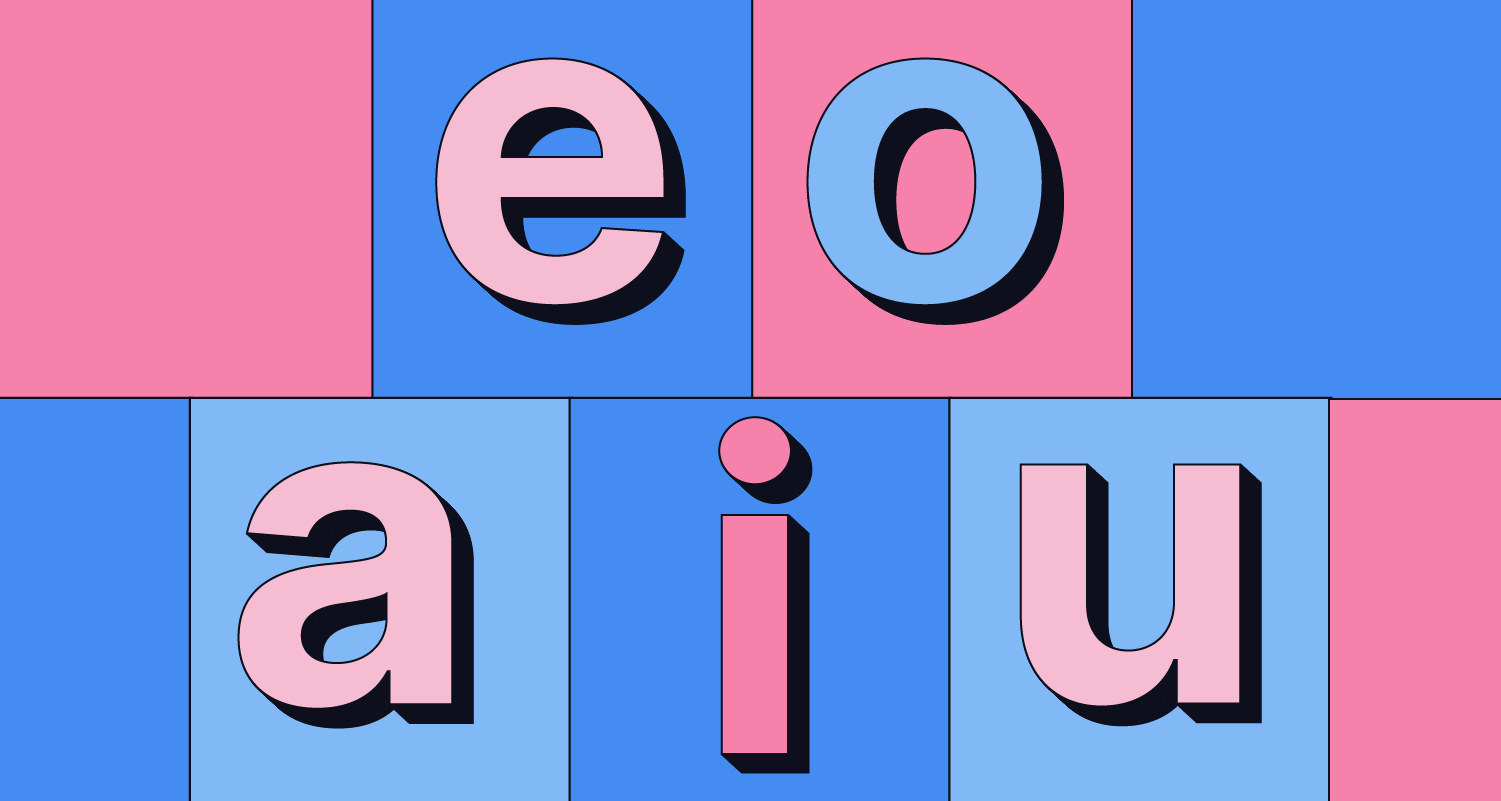
Vowel
18
MENTIONS
15
EPISODES
15
PODCASTS
Search complete. 18 mentions across 15 episodes found for "Vowel".
Sep 5, 2026

Valerie FridlandGUEST
Oregon.
Valerie FridlandGUEST
Vowels are very variable.
Valerie FridlandGUEST
It's true.
Valerie FridlandGUEST
They're more variable than consonants.

Christine LakinHOST
I remember you were helping me with something and we were, what's it called? Like
Rachael LawrenceGUEST
Vowel modulation or? Vowel modification, probably.
Rachael LawrenceGUEST
Or, you know, there are some different phrases for it, but you can change a vowel to make the word easier to sing.
Rachael LawrenceGUEST
There's a

Ruth GoldingNARRATOR
Section 6.
Ruth GoldingNARRATOR
The Attack and the Vowels Our ear perceives sounds.
Ruth GoldingNARRATOR
A single tone, as ordinarily held in the conception of singer and listener, does not really exist.
Ruth GoldingNARRATOR
To the musician, each separate tone holds component parts that give height, strength and depth.

John McWhorterHOST
Anybody speaks today.
John McWhorterHOST
In other words, you can see that especially with vowels, vowels are always changing around.
John McWhorterHOST
Vowels are just one place in the vowel cosmos at a particular time.
John McWhorterHOST
There's no reason for them to stay where they are.
John McWhorterHOST
It's all just constantly kaleidoscopically, lava-lampically changing.
John McWhorterHOST
Vowels change, sometimes slowly, sometimes quickly, but never not.
John McWhorterHOST
In words where we spell the sound ah with an o, like pot and hot.
John McWhorterHOST
In mainstream Northeastern American English in, say, the late 1700s and then past the turn of that century,

Ruth GoldingNARRATOR
There is also x, the last letter of our alphabet, which we could dispense with as easily as with ψ.
Ruth GoldingNARRATOR
Again, the teacher of literature will have to determine whether certain vowels have not been consonantalized; for instance, iam and etiam are both spelt with an i, vos and tuos both with u. Vowels, however, when joined as vowels, either make one long vowel [compare the obsolete method of indicating a long vowel by doubling it as the equivalent of the circumflex] or a diphthong, though some hold that even three vowels can form a single syllable.
Ruth GoldingNARRATOR
This, however, is only possible if one or more assume the role of consonants.
Ruth GoldingNARRATOR
He will also inquire why it is that there are two vowels which may be repeated, while a consonant can only be followed and modified by a different consonant.

speaker_0NARRATOR
There is also x, the last letter of our alphabet, which we could dispense with as easily as with ψ.
speaker_0NARRATOR
Again, the teacher of literature will have to determine whether certain vowels have not been consonantalized.
speaker_0NARRATOR
For instance, jam and etiam are both spelt with an i; uos and tuos both with u. Vowels, however, when joined as vowels, either make one long vowel [compare the obsolete method of indicating a long vowel by doubling it as the equivalent of the circumflex] or a diphthong, though some hold that even three vowels can form a single syllable.
speaker_0NARRATOR
This, however, is only possible if one or more assume the role of consonants.
speaker_0NARRATOR
He will also inquire why it is that there are two vowels which may be repeated, while a consonant can only be followed and modified by a different consonant.

speaker_4NARRATOR
There is also x, the last letter of our alphabet, which we could dispense with as easily as with ψ.
speaker_4NARRATOR
Again, the teacher of literature will have to determine whether certain vowels have not been consonantalized; for instance, jam and etiam are both spelt with an i, vos and tuos both with u. Vowels, however, when joined as vowels, either make one long vowel (compare the obsolete method of indicating a long vowel by doubling it, as the equivalent of the circumflex) or a diphthong; though some hold that even three vowels can form a single syllable.
speaker_4NARRATOR
This, however, is only possible if one or more assume the role of consonants.
speaker_4NARRATOR
He will also inquire why it is that there are two vowels which may be repeated, while a consonant can only be followed and modified by a different consonant.

Ptim CallanHOST
So for instance this one and sometimes only contains the letter Y as a vowel.
Ptim CallanHOST
It's a poem where the only vowel is Y. right? And so that's the kind of thing that he does in this one here.
Ptim CallanHOST
Vowels only contains anagrams of the word vowel.
Ptim CallanHOST
So some or all of the letters and vowels are the only things that are in that poem.
Ptim CallanHOST
So he does that kind of thing a lot.

David WalesNARRATOR
There is also x, the last letter of our alphabet, which we could dispense with as easily as with ψ.
David WalesNARRATOR
Again, the teacher of literature will have to determine whether certain vowels have not been consonantalized; for instance, jam and etiam are both spelt with an i, vos and tuos both with u. Vowels, however, when joined as vowels, either make one long vowel—compare the obsolete method of indicating a long vowel by doubling it as the equivalent of the circumflex—or a diphthong, though some hold that even three vowels can form a single syllable.
David WalesNARRATOR
This, however, is only possible if one or more assume the role of consonants.
David WalesNARRATOR
He will also inquire why it is that there are two vowels which may be repeated, while a consonant can only be followed and modified by a different consonant.
5 more episodes mention Vowel.
Create an account to see the whole feed, search across every transcript, and follow the entities you care about.