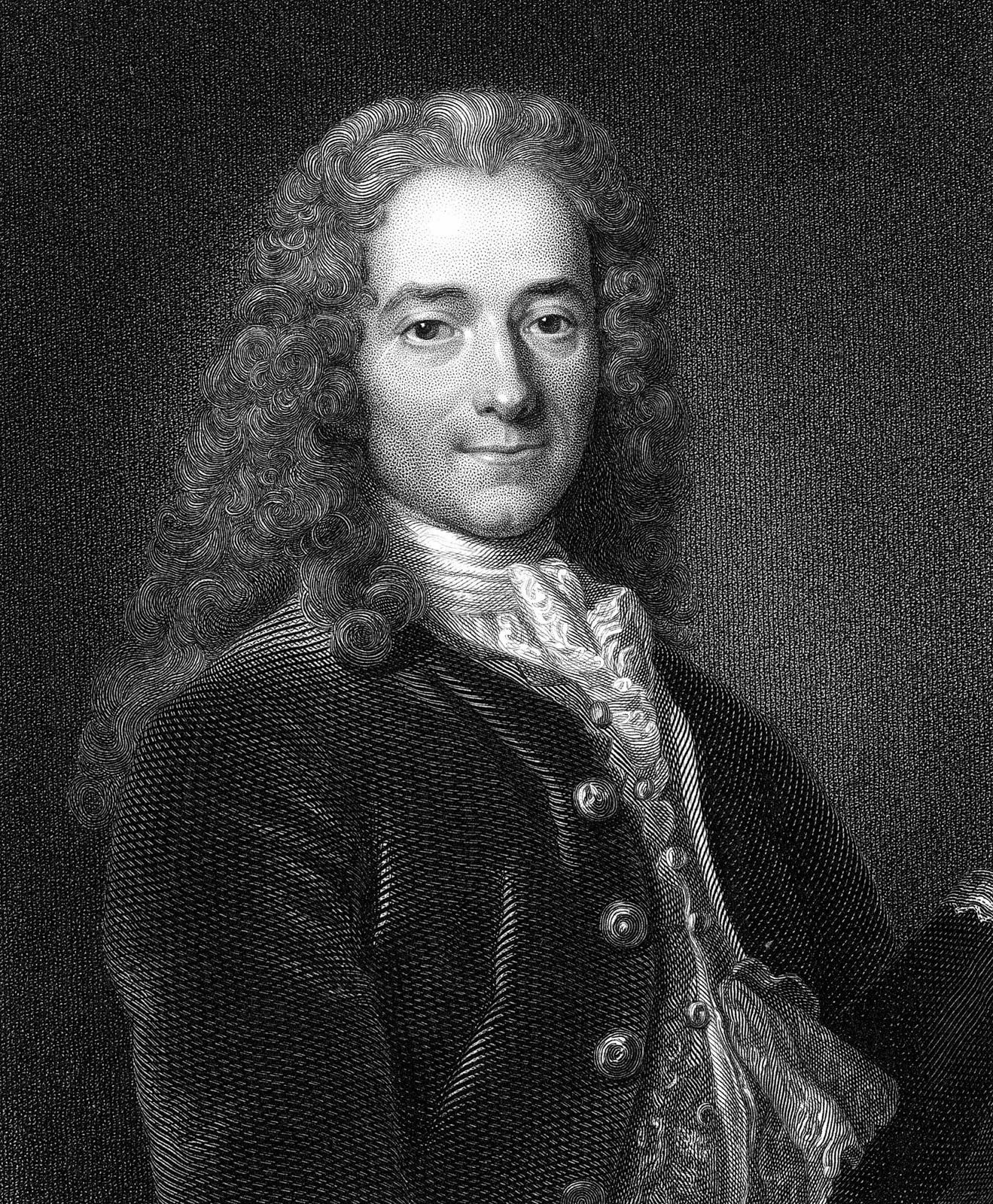
Voltaire
French writer and philosopherWikipedia
1.3k
MENTIONS
415
EPISODES
328
PODCASTS
Search complete. 1268 mentions across 415 episodes found for "Voltaire".
Oct 27, 2026

Winston MarshallGUEST
I think this happened in three simple parts.
Winston MarshallGUEST
Part one was the Enlightenment, and you have the likes of Edward Gibbon and Voltaire, who claim the...
Winston MarshallGUEST
Sorry, actually, part one was the Reformation, sorry, with Martin Luther, who... said anything to do with the Catholic Church was evil.
Winston MarshallGUEST
So he put the Crusades in that camp, although he did slightly change his tune on the Siege of Vienna, rather ironically.
Winston MarshallGUEST
Then part two is the Enlightenment with the likes of Edward Gibbon and Voltaire, who, because they become sort of more materialist, they find it harder and harder to understand how anyone could do anything for spiritual reasons, because they themselves, I think, could relate to that less.
Winston MarshallGUEST
And you have, after the Second World War, this is perhaps the biggest impact on contemporary thought of crusaders is Runciman, the historian, who hated the
Stephen K. BannonHOST
crusades.

Gary NullHOST
In 1907, the French philosopher Henri Bergson coined the phrase, Il en vitale, the vital impulse.
Gary NullHOST
By the way, there's a whole group of people during the Age of Reason who believed in vitalism, Montaigne, Voltaire, that there is some energy that was not defined any further, but it is the pulse of life.
Gary NullHOST
When that pulse is strong, just like when your heart pulse is strong, there's vitalism.
Gary NullHOST
The ideas surge forward unobstructed.

David WalesNARRATOR
said to be fair game for authors and so far no close season
David WalesNARRATOR
has been proclaimed for them few men attain to the age of seventy-odd without some warning that they are mortal and that the grave is waiting of course there is the classic instance of voltaire who from the age of sixty-odd complained of mortal illness and yet recovering lived to a vast age wizened malicious and peaky as a rat but then like mr blake voltaire was a regular out-and-out hardened sinner and words could not possibly express the contempt that he felt for the mediaeval devil of eighteenth-century christianity probably he persisted in living on just to cheat the devil of his just due because he despised him so as a matter of fact we often find that soon after fifty some illness attacks a man from which he never really recovers even though he may appear to
David WalesNARRATOR
be well there is always the
David WalesNARRATOR
trifling difference
4 HRS 9 MINS LATER
David WalesNARRATOR
many ways his favourite language was french and his great ambition was to be a poet although he could speak three languages he could spell none
David WalesNARRATOR
and
David WalesNARRATOR
a writer in the quarterly for eighteen forty seven gives some instances of his peculiarities in that respect when writing a letter he used to add in his own handwriting some words often of bitter gibe or of sardonic humor and these words were generally wrongly spelt thus he used to spell winter y verde actrice actrice old biere and pay that he never learned to spell pay properly was doubtless because he hated to think of such a thing throughout his life economy was his ruling passion to improve his spelling grammar and poetical construction he invited voltaire to stay with him at sans souci and every one knows that the two poets did not get on well together macaulay took the squabble too seriously and worked himself up into a rage over it with much about voltaire's withering irony and other early victorian and exaggerated phrases it has been left for mr lytton strakey the man who told us the truth about queen
David WalesNARRATOR
victoria to tell us the truth about the famous voltaire frederic squabble and he makes it possible to compress it into a phrase they were two poets each trying to overreach the other frederic in the eyes

Pamela NagamiNARRATOR
every revolution therefore presupposes an intellectual basis in the opposition of men of thought to prevailing opinion and a material basis in the resolve of the many to the removal of the practical grievances of which they complain In the case of the great French Revolution, for instance, this double tendency is plainly seen.
Pamela NagamiNARRATOR
Voltaire and the encyclopedists, by upholding the supremacy of reason, appealed mainly to the cultivated and intellectual class.
Pamela NagamiNARRATOR
Rousseau, by preaching equality and the sovereignty of the people, swayed the masses, who were eager to throw off their material burdens.
Pamela NagamiNARRATOR
the great upheaval resulted from the fusion of the two though the connection under ordinary circumstances was not a necessary one in our own revolution the evil to be combated was less monstrous and less deeply rooted and consequently the remedies supplied were more moderate Still, we have the same combination in the precursors of resistance.
Pamela NagamiNARRATOR
For Voltaire in the Encyclopedists, we have the Puritans, upholding a religious life which not only has no necessary connection with the rule of the majority, but which appeals for support to something very different from the popular judgment.
Pamela NagamiNARRATOR
on the other hand we have lawyers and constitutionalists appealing to the authority of a parliament which if it was not directly elected by the numerical majority of the nation was at least sufficiently representative of the nation as a whole for the purposes of the day the difference in character and doctrine between the precursors of the two revolutions is obvious enough and need not be discussed here yet there is one point on which comparison may be profitable after more than a century has passed the essential points in the teaching of voltaire and rousseau are still living in france when a century had passed after the english uprising in sixteen forty the development of the parliamentary system had more than fulfilled the expectations of cook or eliot was it the same with puritanism or was the puritanism of the seventeenth century a mere backwater produced by the sudden intervention of an obstacle in the course of national progress and destined to fade away when its purposes had been served before such a question can be profitably answered it is necessary in some measure at least to define what we mean by puritanism like all great movements it was far from being simple in its character and gives rise to many different judgments in accordance with the point of view from which it is regarded puritanism may be thought of as exemplified in the religion of milton or howe or in the minute scrupulosity of a venetian ambassador once even complained of charles i when he was prince of wales as being too much of a puritan apparently because he was at that time eager for a war with spain the noblest part of every great movement religious or otherwise is invariably that which is universal that is to say which is under the influence of thoughts capable of combination with thoughts arising in the minds of its opponents that which is local or intellectually exaggerated may be called out by special circumstances of time or place may even have worked for good under these limitations but becomes purely noxious when the circumstances which once called it forth have passed away of the religion and character of the puritans of the seventeenth century there is indeed much and that too of the highest that they had to offer which has never passed away nor as we may fervently hope will ever pass away from amongst us the high spiritual and moral aims the strong individual energy on behalf of everything that they held lovely and of good report and the contempt alike for outward formalities apart from spiritual grace and for the commands of their fellow-men whether kings or parliaments to act otherwise than in accordance with the dictates of their consciences In these things, however, Puritanism was but the highest expression of Protestantism, and it seems better to reserve the name of Protestantism for this higher religion which has perpetuated itself by permeating the lives of men who would be the first to disown fellowship with the Puritans of the sixteenth century.
Pamela NagamiNARRATOR
every spirit must take to itself a form and the spirit of protestantism took to itself a form in its struggles against the papacy and the secular authorities by which the papacy was supported wherever protestantism was on its defence it developed intellectually the calvinist creed and whereas in scotland protestantism was threatened not merely by invasion from abroad but by attack from the ruler in whose hands lay the reins of government it adopted the presbyterian organization as its best means of presenting a firm front against the assaults of a government working in the papal interest nor was it only by a creed and an organization that militant puritanism was known it strove its best to be ascetic in those directions to which the asceticism of the church of rome had not extended touch not taste not handle not was written on its banners it erected into a dogma the extreme sabbatarianism which converted the sacred festival of christianity into a day of gloom it set its face against amusements which might in any wise serve as temptations to looseness of life such pleasures as it permitted must be taken seriously and sadly this creed and discipline were offered to the world not as mere temporary expedients but as immovable pillars of the divine temple, without which perhaps no real Christianity could exist, and which must therefore be imposed on all men without consideration of their wishes.

Gary HoffmannHOST
The happiest of all lives is a busy solitude.
Gary HoffmannHOST
Voltaire.
Gary HoffmannHOST
Whoever so is delighted in solitude is either a wild beast or a god.
Gary HoffmannHOST
See, that's what I like to think I am.

Nick JubberGUEST
But the one that really interested me actually was Arno Pola in a place called Mevedja in southern Serbia, because that's when the word vampire... moves across into, especially into the English language.
Nick JubberGUEST
So the 1730s was described by Voltaire, the great French satirist.
Nick JubberGUEST
I think he put it that in the 1730s, he was very specific about it.
Nick JubberGUEST
From 1730 to 1735, he said nothing was spoken about more than vampires.

John TrauthGUEST
So that wouldn't work.
John TrauthGUEST
But I'm going back to one of my favorite philosophers, Voltaire, who wrote Candide, of course.
John TrauthGUEST
That's his most famous book.
John TrauthGUEST
And Candide and Pangloss... unhappy with what's going on around them.

David OxleyHOST
I don't want to come across as something of an idiot rather than being listened to generously.
David OxleyHOST
I was also reminded and somewhat intimidated by Voltaire who said, judge a man by his questions rather than his answers.
David OxleyHOST
I was thinking to myself, well, once again, I'm probably going to fail in that sense.
David OxleyHOST
The only thing that I think that has helped me as I've got older is Perhaps I care a little bit less about what other people think of me today than I did when I was in my twenties and thirties.

Winston MarshallGUEST
I think this happened in three simple parts.
Winston MarshallGUEST
Part one was the Enlightenment, and you have the likes of Edward Gibbon and Voltaire who claim the...
Winston MarshallGUEST
Sorry, actually, part one was the Reformation, sorry, with...
Winston MarshallGUEST
Martin Luther, who said anything to do with the Catholic Church was evil.
Winston MarshallGUEST
So he put the Crusades in that camp, although he did slightly change his tune on the Siege of Vienna, rather ironically.
Winston MarshallGUEST
Then part two is the Enlightenment with the likes of Edward Gibbon and Voltaire, who, because they become sort of more materialist, they find it harder and harder to understand how anyone could do anything for spiritual reasons, because they themselves, I think, could relate to that less.
Winston MarshallGUEST
And you have, after the Second World War, this is perhaps the biggest impact on contemporary thought of crusaders is Runciman, the historian, who hated the
Steve BannonHOST
crusades.

DarrenHOST
It is up to us to give ourselves the gift of living well.
DarrenHOST
That's Voltaire.
DarrenHOST
I'm Darren, and this is Three Things for Monday, October the 26th.
DarrenHOST
Brazil's President Silva secured a fourth non-consecutive term with 51.8% of the runoff vote.
405 more episodes mention Voltaire.
Create an account to see the whole feed, search across every transcript, and follow the entities you care about.