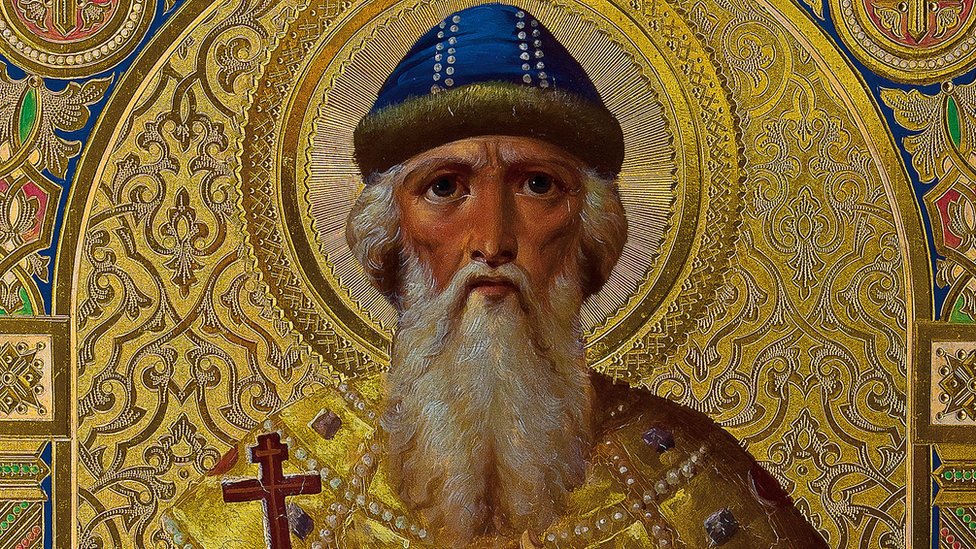
Volodymyr the Great
Former Grand Prince of KievWikipedia
48
MENTIONS
16
EPISODES
11
PODCASTS
Search complete. 48 mentions across 16 episodes found for "Volodymyr the Great".
Oct 5, 2026
AlistairNARRATOR
Of the many signs of patriotic revival in the Ukraine, perhaps none is more significant than the continued activity of certain prominent Russian statesmen of pronounced autocratic and pan-Slavonic tendencies.
AlistairNARRATOR
Some of you, ladies and gentlemen, may have read at intervals since March 10th, 1912, long letters in the Times and other papers from the pen of Count Vladimir Bobrinsky and of one of his partisans in this country, a Mr. Birkbeck, under the heading Religious Persecution in Galicia.
AlistairNARRATOR
I fully realize, of course, that letters from a member of the parliament of a friendly country must be allotted space in the Times, and no one can blame that once impartial, that still now reputed impartial organ, if there were scarcely a word of truth in these particular epistles.
AlistairNARRATOR
Although the importance of a letter to the Times can be overestimated, yet the special publicity thus gained gives a certain cachet to a cause, making it impossible to prove mendacious statements calculated to do harm by the reason of the prominence and authority with which in this manner they become invested.
AlistairNARRATOR
Some years ago, Count Vladimir Bobrinsky devoted himself to the Ukrainian question, just as any other politician worth his salt makes his business to specialize in one field or another.
AlistairNARRATOR
He belongs to that party in Russia who rightly enough, from their point of view, recognize that a strong movement is afoot, both among the Little Russians and the Ruthenians, that is, the Ukrainians of Russia and Austria, once more to concentrate their energies upon obtaining full rights as a separate nation.
AlistairNARRATOR
The primary object of his campaign is a wholly legitimate one, and the policy he pursues is, I must frankly admit, a policy that may appeal strongly to an ambitious man.
7 MINS LATER
Luke HamiltonNARRATOR
As early as the 9th century, we hear of treaties with Byzantium.

Matthew Raphael JohnsonGUEST
It was immensely popular.
Matthew Raphael JohnsonGUEST
In fact, I'll go so far as to say, and in my Ukraine book I, I say this, that Khmelnytsky is the second most important person in Ukrainian history after, you know, of course, St. Vladimir of, of Kiev.
Matthew Raphael JohnsonGUEST
Um, he is the hero And the people who control the colonial administration in Kiev now, of course, either don't understand that or don't want to understand that.
Matthew Raphael JohnsonGUEST
And it's a Jewish government there anyway.
5 HRS 59 MINS LATER
Matthew Raphael JohnsonGUEST
You know, in 1652, there was an invasion of the Polish nobility's hired army that would have destroyed the host had not the Russians stepped in.
Matthew Raphael JohnsonGUEST
So I will continue.
Matthew Raphael JohnsonGUEST
In my book on Ukrainian nationalism, I say Khmelnytsky is quite possibly the most important single person in Ukrainian history after St. Vladimir himself.
Matthew Raphael JohnsonGUEST
Early on, he defeated the Poles en masse.

Matthew Raphael JohnsonGUEST
It was immensely popular.
Matthew Raphael JohnsonGUEST
In fact, I'll go so far as to say, and in my Ukraine book I, I say this, that Khmelnytsky is the second most important person in Ukrainian history after, you know, of course, St. Vladimir of, of Kiev.
Matthew Raphael JohnsonGUEST
Um, he is the hero And the people who control the colonial administration in Kiev now, of course, either don't understand that or don't want to understand that.
Matthew Raphael JohnsonGUEST
And it's a Jewish government there anyway.
5 HRS 59 MINS LATER
Matthew Raphael JohnsonGUEST
You know, in 1652, there was an invasion of the Polish nobility's hired army that would have destroyed the host had not the Russians stepped in.
Matthew Raphael JohnsonGUEST
So I will continue.
Matthew Raphael JohnsonGUEST
In my book on Ukrainian nationalism, I say Khmelnytsky is quite possibly the most important single person in Ukrainian history after St. Vladimir himself.
Matthew Raphael JohnsonGUEST
Early on, he defeated the Poles en masse.

Doug NormanGUEST
And one of the stories I love the most out of this is the conversion of Kiev, or the Ukraine.
Doug NormanGUEST
And it's the story of Vladimir the Great.
Doug NormanGUEST
He was the crown prince of Kiev.
Doug NormanGUEST
He converts to Christianity in 988 AD.

speaker_14NARRATOR
The Ukrainian History, Part 1. though the ukrainian people was for several centuries of its history under polish and russian rule there can be no doubt that the ukrainians have a history of their own and that their historical traditions are of a type entirely different from those of the poles or russians Long before the beginning of the Polish and Muscovite states, the southern group of the Eastern Slav tribes founded the state of Kiev, the first state formation of the people that today is known under the name of Ukrainians.
speaker_14NARRATOR
originally the state of kiev the foundation of which took place at the beginning of the ninth century had the name of rusi to which in the latin chronicles corresponds to the appellation of ruthenia this is the origin of the name of rutheni which was first applied to the population of the state of kiev as early as the tenth century the appellation of ukrania appears for the first time in the twelfth century and at that time already comprehends all the territories on which the ukrainian people were settled but it is only since the seventeenth century that this appellation was generally used especially since the revolt of the whole ukrainian people under the hetman kamelnitsky a change of names which is not isolated in history c f roumania that formerly was called moldavia and wallachia respectively only in the western parts of ukraina especially in galicia vukovina and in north hungary the original appellation of ruthene still remained in use for a long time but had to give way to the common name of ukrainians in the last decades before the war after the new rise of ukrainian civilization the russians wrongly claimed the foundation of the state of kiev to themselves as the cradle of the russian people the later russian empire did not originate in the state of kiev but in the principality of sozdal northeast of moscow this was not founded before the twelfth century and in its foundation other peoples took part than in the formation of the empire of kiev they were the ratamitches and vijamitches who belonged to the northern group of the eastern slav tribes besides the finns who are not of slav descent the russians are not a purely slav race but a blending of slav blood with finn that the old state of kiev was not the work of the russian but of another people whose descendants are called ukrainians is proved by the fact that the literary documents of that period show ukrainian linguistic features and besides by the fact that the constitution of that time in spite of the authority of the prince shows a democratic stamp which is a characteristic feature of the ukrainian nationality the position of the popular assembly called vichy is a phenomenon not only without a parallel in the history of that time but utterly inconsistent with russian or polish constitutions at any time The period of the princes of Kiev was, moreover, of great importance for Ukrainian history, because in its bloom, i.e., under the Grand Prince Volodymyr the Great, 980-1015, and under his immediate successors, the whole Ukrainian people was united under the scepter of the Grand Princes, and with its national civilization, predominated over Eastern Europe of that time.
speaker_14NARRATOR
especially the whole country which at present is known under the geographical name of east galicia formed an intricate part of the empire of kief and when afterwards the latter was divided into several principalities east galicia for a long time still remained in a close alliance with the empire of kief nay what is still more when the former empire of kiev by being divided into several principalities was considerably weakened so that it was not able any longer to resist the wild hordes of the mongols in the thirteenth century the traditions of the state of kiev passed on the principality soon afterwards the kingdom of halich in the ukrainian territories of east galicia and north hungary the name of galicia comes from halich while in east ukraina the mongols devastated the country and little by little the influence of the new muscovite empire made itself felt the kingdom of halich remained a powerful state which however could not last more than one century it could not resist the tartars on one hand and the poles and lithuanians on the other after the dying out of the dynasty of halich the kingdom fell to poland in thirteen forty the rest of the ukrainian territory volhynia and kieff was taken possession of by lithuania so the first state formation of the ukrainian people perished In Lithuania, the highest civilization of the Ukrainian element at first gained preponderance.
speaker_14NARRATOR
The Ukrainian language predominated at the court of the Lithuanian princes and even in legislation.
1 HR 7 MINS LATER
speaker_14NARRATOR
This time, too, she is ready to perform a similar mission against Bolshevism, but she demands loyal support in return and admission into the European Community of Peoples.
InkelNARRATOR
As far as this history can be traced back, the Ukrainian people was, on the whole, settled on the same territory as at present.
InkelNARRATOR
Thus, at the time of the great Prince Volodymyr the Great in the 10th century, the frontiers of the state of Kyiv did not include much more, nor essentially other territories, than belonged to the ethnographically coherent national territory of the Ukrainian people at present.
InkelNARRATOR
It may justly be said, therefore, that the present Ukrainian territory is marked out not only by history but also by ethnography, hence that the territory claimed by the Ukrainians is their ethnographical as well as historical territory.

Riley KnightHOST
Because the Vikings did launch full-scale invasions of Ireland with hundreds of ships and thousands of warriors.
Riley KnightHOST
Some were pushed back by coalitions of Irish leaders, eventually united under a high king.
Riley KnightHOST
But as the Vikings consolidated their position in Ireland, particularly in the east around Dublin, something very interesting took place.
Riley KnightHOST
Unlike in England, where the Vikings seized land to establish the Danelaw, or in France, where they essentially colonised the north with the approval of the crown, the Vikings in Ireland took a different approach.
16 MINS LATER
Riley KnightHOST
It was nonetheless a fundamental part of what facilitated the governance and good order of the Icelandic Commonwealth, as it became known, a society that was based on communal, decentralized governments.
Riley KnightHOST
It was a society that was much more focused on whether someone had a good reputation, whether they were honest and trustworthy, rather than whether they were the strongest or had the sharpest sword.
Riley KnightHOST
Iceland was and remained highly decentralized throughout its early history under the authority of local chieftains or lords, although it would eventually come under the authority of Norway in the mid-13th century, long after the Viking Age had ended in this part of the world.
Riley KnightHOST
But the Althing itself, this legislative assembly that emerged in the early 10th century, it has survived.

JP BristowHOST
I'm your host, JP Bristow, and this is Season 1, The Forest, the Step, and the Birth of the Russian Empire, Episode 123, The Russian Orthodox Church.
JP BristowHOST
When Vladimir the Great baptised Rus', he brought the Orthodox Church to the Rus', but he did not create a Russian Orthodox Church.
JP BristowHOST
We should in any case remember that these official conversions are largely fictional ways of describing what is usually a long-term process.
JP BristowHOST
There were Christians in Roman Britain.
JP BristowHOST
If we think back to the early days of the Mongol era, the northeastern Knyazestva had turned in on themselves.
JP BristowHOST
You'll recall that the southwestern Knyazestva quickly disappear from the chronicles.
JP BristowHOST
The grand Knyazes of Vladimir are focused on their authority in the northeast.
JP BristowHOST
They no longer spend their time trying to take Kiev.
Matthew Raphael JohnsonGUEST
Um, and, um, so I don't want people thinking this was just something, you know, made up.
Matthew Raphael JohnsonGUEST
Uh, of course, there are political considerations, but when St. Vladimir chose, um, what they would ca- I guess call the Greek faith or the Byzantine faith, Roman faith at the time, Eastern Roman faith, uh, he took it very seriously because he had, being a former, uh, pagan, he had...
Matthew Raphael JohnsonGUEST
You know, got hundreds of wives.
Matthew Raphael JohnsonGUEST
Um, he wasn't...
Matthew Raphael JohnsonGUEST
And it led to the murder of millions, as we all know.
Pete QuiñonesHOST
V. Bloom in Moscow Evening could brazenly demand the removal of history's garbage from the squares, city squares, to remove Minin Pozharsky monument from the Red Square, to remove the monuments to Russia's thousand-year anniversary in Novgorod and a statue of St. Vladimir on the hill in Kiev.
Pete QuiñonesHOST
Quote, those tons of metal are needed for raw material.
Pete QuiñonesHOST
The ethnic coloring of the new names has already been noted.
6 more episodes mention Volodymyr the Great.
Create an account to see the whole feed, search across every transcript, and follow the entities you care about.