Visigoths
PeopleWikipedia
288
MENTIONS
127
EPISODES
112
PODCASTS
Search complete. 288 mentions across 127 episodes found for "Visigoths".
Sep 12, 2026

Ryan BetheaHOST
And if not, you're somehow...
Ryan BetheaHOST
And I, I think it's important to remember that so much of history and God's plan seems to unfold through quiet, ordinary, just normal lives of people just doing the best they can farming vegetables and hoping the Huns or the Visigoths don't just come raid their village that day, right?
Gregory PineGUEST
Nice.
Gregory PineGUEST
Yeah, those are different kinds of raiders who, who lived at different times, but I'm glad that you reminded of both.

Mark GaffneyGUEST
So there's a bitter, it's a kind of a bitter feud within the truce community.
William RamseyHOST
There is a thing, you know, I don't know if you've ever heard of Visigoth.
William RamseyHOST
He ran the Grassy Knoll.
William RamseyHOST
Have you heard that name before? It's like an early
14 MINS LATER
William RamseyHOST
I won't either.
William RamseyHOST
I should have planned a show today of, like, people telling where they were on the day of the event.
William RamseyHOST
And let's also go back to the archives of Visigoth because he literally interviewed people who were in – manhattan on 9 11 and and they told their stories a very important historic historical stuff um bart says lex wexner gave epson house of my dad lives in ohio any chance he helped finance the acquisition of the thermate cutter charges do you know anything about like these requisitions or i mean there's well i would
Mark GaffneyGUEST
not be surprised if it turned out that uh an israeli company uh quietly produced the thermate for the uh you know, the charges that were used at the Twin Towers and they were produced in Israel.

speaker_12NARRATOR
Chapter 3.
speaker_12NARRATOR
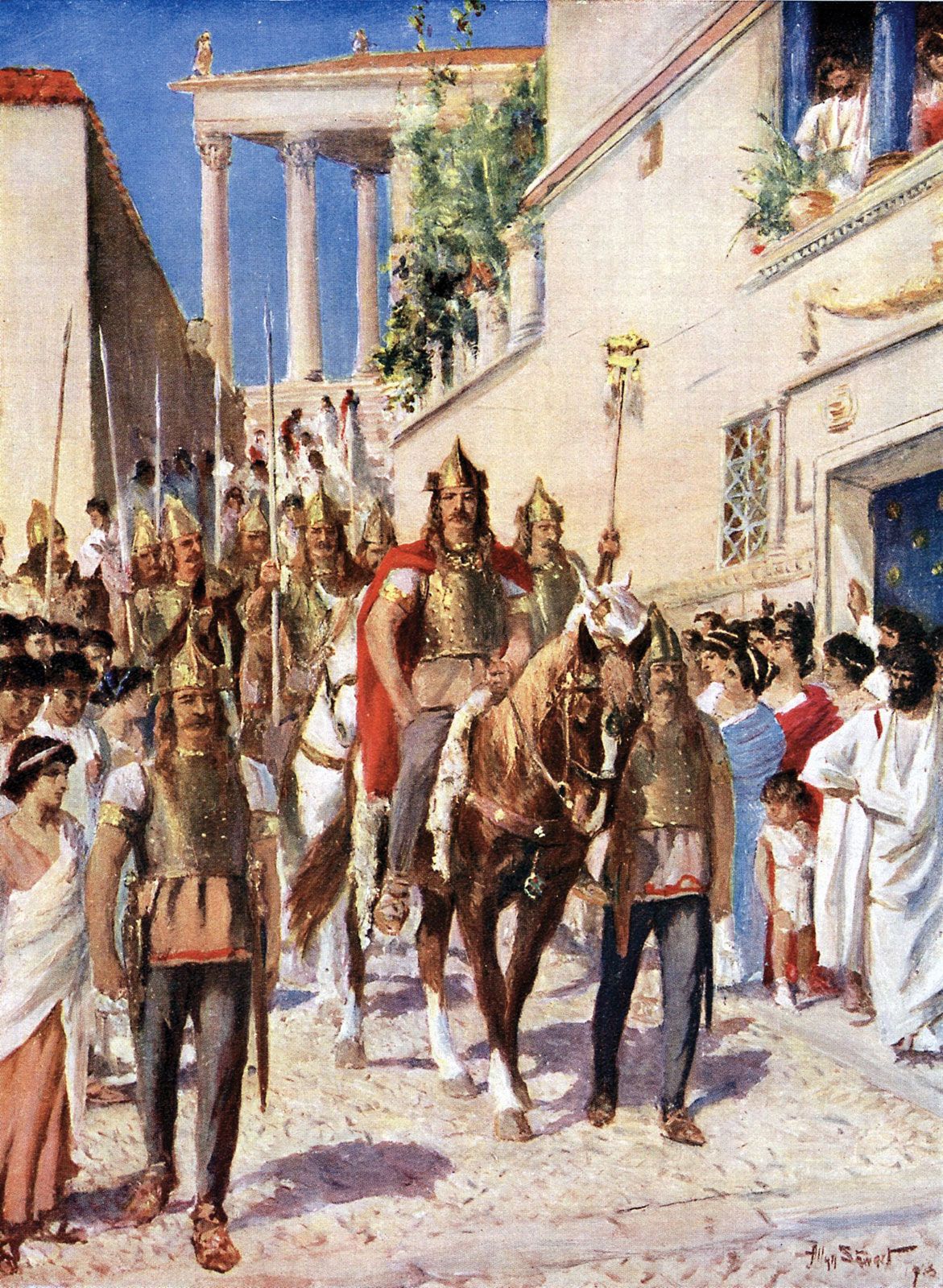
Alaric the Visigoth.
speaker_12NARRATOR
King from 394 to 410 A.D. Long before the beginning of the period, known as the Middle Ages, a tribe of barbarians called the Goths lived north of the river Danube in the country which is now known as Romania.
speaker_12NARRATOR
It was then a part of the great Roman Empire which at that time had two capitals, Constantinople, the new city of Constantine, and Rome.
speaker_12NARRATOR
Your people may cross the Danube and settle on our land.
speaker_12NARRATOR
As long as you remain true to Rome, we will protect you against your enemies.
speaker_12NARRATOR
These Goths were known as Visigoths or Western Goths.
speaker_12NARRATOR
Other tribes of Goths who had settled in southern Russia were called Ostrogoths or Eastern Goths.

speaker_6NARRATOR
The nation was now divided into two tribes.
speaker_6NARRATOR
The Visigoths, whose tribal name was the Thervings, lay more to the south, in what are now the countries of Moldavia, Wallachia, and southern Hungary.
speaker_6NARRATOR
The Ostrogoths, or tribe of the Gruthungs, lay more to the north and east, in Bessarabia, Transylvania, and the Dniester Valley.
speaker_6NARRATOR
But a totally unexpected series of events were now to show how prescient Constantine had been in rearing his great fortress capital to serve as the central place of arms of the Balkan Peninsula.
speaker_6NARRATOR
But the enemy whom the Gothic historian describes in these uninviting terms was too strong for the Teutons of the East.
speaker_6NARRATOR
The Ostrogoths were crushed and compelled to become vassals of the Huns, save a remnant who fought their way southward to the Wallachian shore, near the marshes of the delta of the Danube.
speaker_6NARRATOR
Then the Huns fell on the Visigoths.
speaker_6NARRATOR
The wave of invasion pressed on.

Melissa Schilling SmithHOST
So they let the Israelites and other peoples that they were conquering, they put them on the western border so they could have the people, they would say, look, we won't kill you, we will give you this land, but you have to defend it.
Melissa Schilling SmithHOST
So then these people would end up fighting the Visigoths and the barbarians of that region.
Melissa Schilling SmithHOST
And gradually, the Assyrian army The Assyrian Empire continued to grow westward through that dispersion progression of using their conquered peoples, not killing them, putting them on the edge of their territory and letting them defend their land.
Melissa Schilling SmithHOST
And of course, most people are like, oh great, we didn't die.

RolyHOST
Now, throughout the 5th century, as we discussed in the past here, Roman administration in the West began to collapse.
RolyHOST
In 413 AD, the Visigoths took control of the region, technically as federati, so they were supposedly loyal to the emperor, but the truth is, for all intents and purposes, they were operating as an independent kingdom of the German Visigoths.
RolyHOST
Now, for most of the 5th century, Valentia essentially was an autonomous community.
RolyHOST
Again, not under Visigothic control, but

Martin GeesonNARRATOR
The barbarians sacked Gaul.
Martin GeesonNARRATOR
Paralyzed Rome, pillaged by the Visigoths, felt its life grow feeble, perceived its extremities, the Occident and the Orient, writhe in blood and grow more exhausted from day to day.
Martin GeesonNARRATOR
In this general dissolution, in the successive assassination of the Caesars, in the turmoil of carnage from one end of Europe to another, there resounded a terrible shout of triumph, stifling all clamors, silencing all voices.
Martin GeesonNARRATOR
On the banks of the Danube, thousands of men astride on small horses, clad in rat-skin coats, monstrous Tartars with enormous heads, flat noses, chins gullied with scars and gashes, and jaundiced faces bare of hair, rushed at full speed to envelop the territories of the lower empire like a whirlwind.

S.S. KimNARRATOR
But as it happened, there was a quarrel at that time between Julian the governor of Ceuta and Roderick the king of Spain, which opened the doors to the Arabs.
S.S. KimNARRATOR
Spain was then under the rule of Visigoths, or West Goths, a tribe of barbarians, like many others who overran the provinces of Roman Empire in its decline.
S.S. KimNARRATOR
The Ostrogoths had occupied Italy, and their kinsmen, the Visigoths, displacing or subduing the Suevi, or Suebians, and other rude German tribes, established themselves in the Roman province of Iberia, Spain, in the 5th century after Christ.
S.S. KimNARRATOR
They found the country in the same condition of effeminate luxury and degeneracy that had proved the ruin of other parts of the empire.
S.S. KimNARRATOR
Like many warlike people, the Romans, when their work was accomplished and the world was at their feet, had rested contentedly from their labors and abandoned themselves to pleasure that wealth and security permit.

John PapolaHOST
That's all Arabic, that's all the Moors, that's all Arab influence.
Richard MiniterGUEST
Yeah, we could also blame the Visigoths who ruled Sicily for a period, but yeah, sure, right.
Richard MiniterGUEST
But yeah, family structure dictates political outlook.
Richard MiniterGUEST
That's why communism seems to work more or less in Russia and in China.

Phylicia MasonheimerHOST
They can become more of a structured reality.
Phylicia MasonheimerHOST
When Rome falls in the 400s, we see a massive shift because when the Visigoths come down and conquer Rome, the entire governmental structure of the empire, I mean, it's falling apart.
Phylicia MasonheimerHOST
Nobody thought this day would come.
Phylicia MasonheimerHOST
And yet here it is.
117 more episodes mention Visigoths.
Create an account to see the whole feed, search across every transcript, and follow the entities you care about.