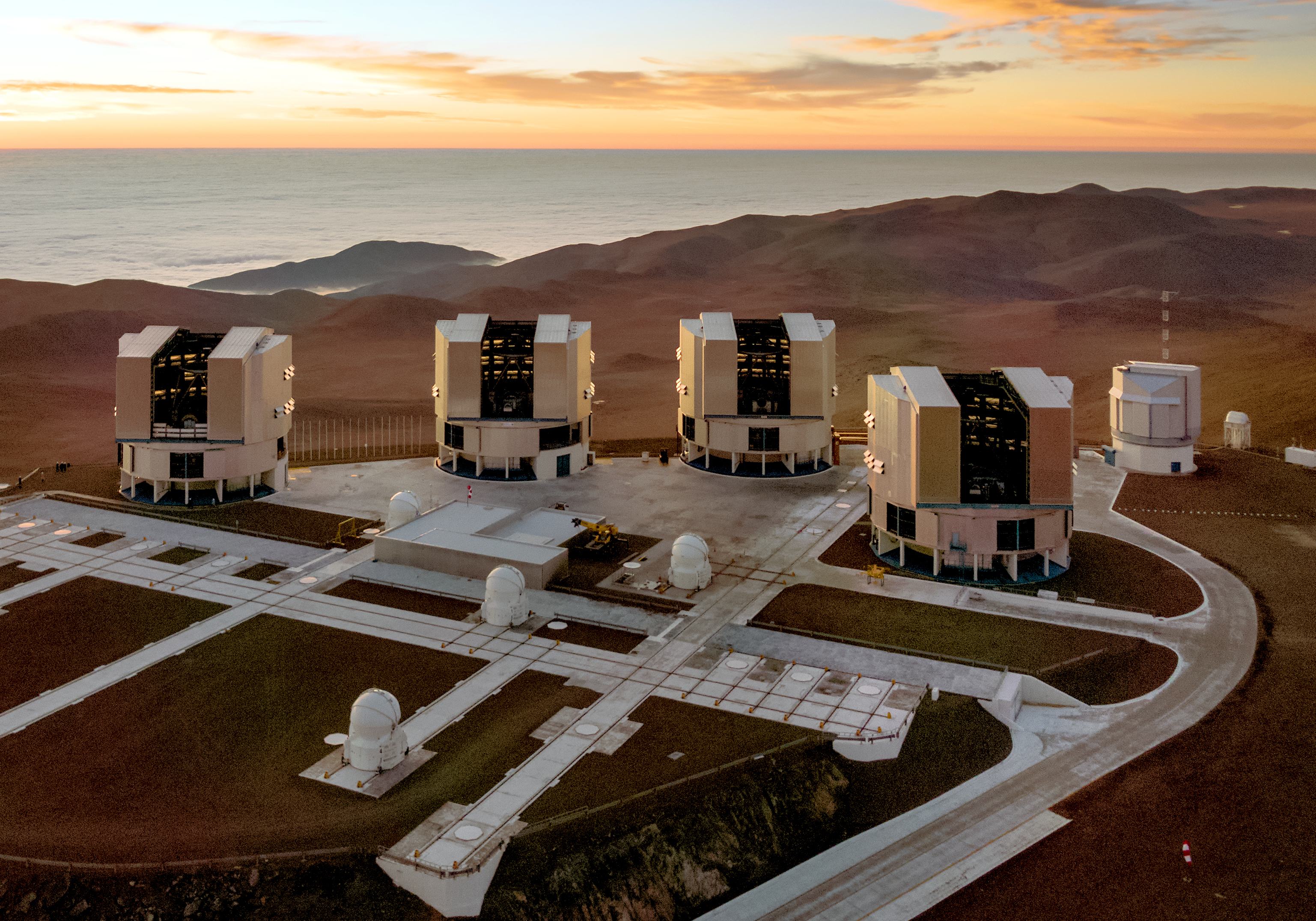
Very Large Telescope
Observatory in ChileWikipedia
21
MENTIONS
14
EPISODES
12
PODCASTS
Search complete. 21 mentions across 14 episodes found for "Very Large Telescope".
Oct 12, 2026

John BatchelorHOST
Right, still possible with neutrinos.
John BatchelorHOST
You went to the Very Large Telescope for this experiment.
John BatchelorHOST
They were tracking the bullet cluster, and you believe that when the Extra Large Telescope, what is it, the Extremely Large
Govert SchillingGUEST
Telescope,

Allison SheridanHOST
Now, on the other hand, when I asked Siri AI whether physics Nobel laureate and my personal hero, Dr. Andrea Ghez, and her team were the group who discovered and tracked the star S301 with an even faster elliptical orbit around the supermassive black hole at the center of the galaxy, Siri AI easily and quickly explained that it was the team of her Nobel co-laureate.
Allison SheridanHOST
Wasn't the answer I wanted, but it also gave me more detail about what telescope was used, the Very Large Telescope Interferometer in Chile, and information on how fast this star is going.
Allison SheridanHOST
It's over 8% the speed of light.
Allison SheridanHOST
Dude, that's fast.

Sean CruzenHOST
We just don't have any.
Sean CruzenHOST
And so, so then, okay, well, if there's a three-tiered hierarchy of the kinds of objects, big objects, that orbit around the parent star, where we only have a two-tier hierarchy, how do we define what a moon is? Well, Kevin Hoye, who's an astronomer at the European Southern Observatory, who's part of the team that helped discover brown dwarf CD 35 2722 and its object orbiting around it, b, with the European Southern Observatory's Very Large Telescope more than two years ago and have been tracking the shifts in the spectrum ever since that tell us that it's there, well, these folks have opinions.
Sean CruzenHOST
And so, so Kevin Hoye says this, quote, "The exosatellite is clearly massive enough to be a planet, but it does not orbit a star, though it orbits an object that orbits a star, so therefore, being the third wheel in this system makes us wanna call it a moon, even though it's nothing like a small moon, l- like the small rocky moons in our own solar system." Unquote.
Sean CruzenHOST
Okay, so you have star, you have brown dwarf orbiting the star.

Stuart GaryHOST
astronomers have found new clues about the origin of interstellar comet 3i Atlas, suggesting it may be more than twice as old as our sun and solar system.
Stuart GaryHOST
The findings, reported in the journal Nature Astronomy, are based on observations by the European Southern Observatory's Very Large Telescope in Chile, which studied the composition of the alien visitor, which is now considered to be the brightest interstellar object ever seen in detail.
Stuart GaryHOST
by measuring specific chemical fingerprints.
Stuart GaryHOST
The first observations of this kind for a comet formed outside our solar system, the authors found that 3I Atlas likely originated in the outskirts of an older star system.

Dakotah TylerHOST
Those are the telescopes that, some of the telescopes I used in my PhD research.
Dakotah TylerHOST
The VLT, which is short for the Very Large Telescope, shout out to astronomers for naming things in that way, and it is a very large telescope, so, uh, highly descriptive.
Dakotah TylerHOST
And ALMA, which is an array of radio telescopes.
Dakotah TylerHOST
So we have, uh, a couple different images, a couple different data sets of this system, which are necessary to make the discovery that they made.

speaker_5HOST
What was the next step?
speaker_6HOST
Step two involved another facility in Chile, the European Southern Observatory's Very Large Telescope, or VLT.
speaker_6HOST
Using highly advanced infrared imaging, which is slightly better at penetrating dust than visible light, they stared incredibly hard into that specific gap identified by ALMA, and they found something.
speaker_5HOST
They did.

speaker_0NARRATOR
About a decade ago, observations from the Atacama Large Millimeter-submillimeter Array, or ALMA, revealed a gap in the dusty disk surrounding the young star.
speaker_0NARRATOR
Later observations from the European Southern Observatory's Very Large Telescope detected a faint point of light inside that gap.
speaker_0NARRATOR
The potential planet raised questions because existing planet formation models suggested a giant planet should not have been able to form so quickly at such a large distance from its star.
speaker_0NARRATOR
Researchers eventually turned to observations from the WM Keck Observatory in Hawaii stored in the Keck Observatory Archive, a NASA-funded partnership between the observatory and the NASA Exoplanet Science Institute at Caltech-IPAC.

speaker_4NARRATOR
The Atacama hosts more major astronomical installations than any other region on Earth.
speaker_4NARRATOR
The European Southern Observatory's Very Large Telescope sits at Cerro Paranal at an altitude of 2,600 meters.
speaker_4NARRATOR
where the median number of clear nights per year exceeds 330.
speaker_4NARRATOR
The Atacama Large Millimetre Array operates at over 5,000 metres on the Chajnantor Plateau, where the air is so thin and dry that visitors must carry supplemental oxygen and the humidity is sometimes too low for the instruments to accurately measure.

AnnaHOST
They line up, and then the confirmation needed a third instrument.
AnnaHOST
ESO's Very Large Telescope at Paranal in the Atacama had also caught a faint point of light in that gap.
AnnaHOST
Put the three together, ALMA showing you the gap in millimeter dust, the VLT and Keck both showing you an infrared source sitting in it at two separate epochs two years apart, so you can check it is moving with the star rather than being a background object, and you have a planet.
AveryHOST
Bernardi made a point of that in the release, something like, "We usually hear about telescopes working separately, but this confirmation was only possible by using multiple telescopes together." Which is worth sitting with for a second because it is also a story about hemispheres.
15 MINS LATER
AveryHOST
Imagine watching the one event you have been waiting a career for, and the object pulls a curtain across itself.
AveryHOST
What this team has done is get back in.
AveryHOST
They used ESO's very large telescope in Chile for spectroscopy.
AveryHOST
They used ALMA, and they compared what they saw against models built for Wolf-Rayet stars, the hot, stripped, fiercely windy stars that show strong carbon and helium signatures.
AnnaHOST
and then the confirmation needed a third instrument.
AnnaHOST
ESO's Very Large Telescope at Paranal in the Atacama had also caught a faint point of light in that gap.
AnnaHOST
Put the three together.
AnnaHOST
ALMA showing you the gap in millimeter dust, the VLT and Keck both showing you an infrared source sitting in it at two separate epochs two years apart so you can check it is moving with the star rather than being a background object.
16 MINS LATER
AveryHOST
Imagine watching the one event you have been waiting a career for, and the object pulls a curtain across itself.
AveryHOST
What this team has done is get back in.
AveryHOST
They used ESO's Very Large Telescope in Chile for spectroscopy, they used ALMA, and they compared what they saw against models built for Wolf-Rayet stars.
AveryHOST
the hot, stripped, fiercely windy stars that show strong carbon and helium signatures.
4 more episodes mention Very Large Telescope.
Create an account to see the whole feed, search across every transcript, and follow the entities you care about.