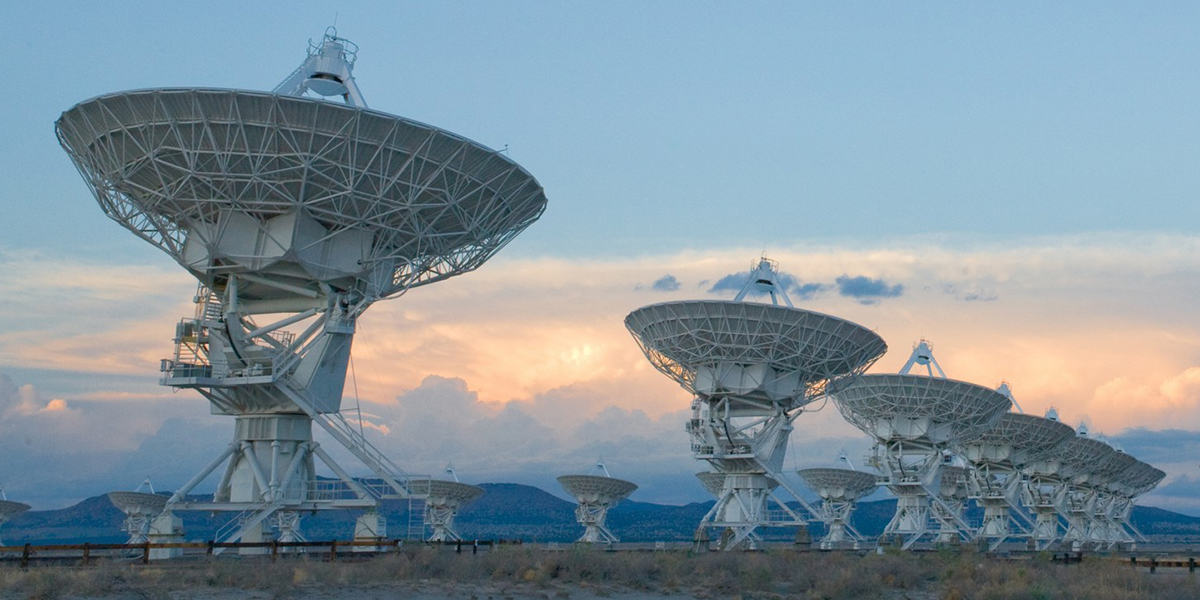
Karl G. Jansky Very Large Array
Observatory in Socorro County, New MexicoWikipedia
44
MENTIONS
13
EPISODES
11
PODCASTS
Search complete. 44 mentions across 13 episodes found for "Karl G. Jansky Very Large Array".
Sep 8, 2026

AveryHOST
What's in the data set?
AnnaHOST
ALMA, the Jansky Very Large Array, and JWST.
AnnaHOST
And the picture they build is two massive protostars about 200 astronomical units apart, so five times the Sun to Pluto distance, on a violently eccentric orbit.
AveryHOST
And the eccentricity is the evidence.

AnnaHOST
two separate cores forming independently that happen to fall past each other and don't escape a capture and that's what this team says they're watching the object is iras 07 299-1651 about 1680 parsecs away call it five and a half thousand light years The work is led by Yichen Zhang at Shanghai Jiao Tong University with Guido Garay at the Universidad de Chile, and it's built on eight years of observations from 2016 to 2024.
AnnaHOST
Eight years? What's in the data set? ALMA, the Jansky Very Large Array, and JWST.
AnnaHOST
And the picture they build is two massive protostars about 200 astronomical units apart, so five times the Sun to Pluto distance, on a violently eccentric orbit.
AveryHOST
And the eccentricity is the evidence.

JimmyHOST
Robert Dixon, the director of the SETI program at Ohio State, coordinated repeated attempts to find the signal again.
JimmyHOST
Other observatories, including the Very Large Array in New Mexico and the Oak Ridge Observatory in Massachusetts, also conducted targeted searches of the area.
JimmyHOST
None of them ever detected anything resembling the original signal.
JimmyHOST
This failure to replicate is one of the most important and frustrating aspects of the WOW signal.

speaker_0NARRATOR
The signal was not there.
speaker_0NARRATOR
Robert Gray, an independent researcher who became obsessed with the WOW signal, conducted dedicated searches using the Very Large Array in New Mexico and the University of Tasmania's radio telescope.
speaker_0NARRATOR
He observed the same coordinates for hours at a time, on multiple occasions over a period of years.
speaker_0NARRATOR
Nothing.

Waverly GrovesGUEST
At first, I was just building amps for...
Waverly GrovesGUEST
The main project was the Very Large Array out in New Mexico.
Waverly GrovesGUEST
If you've ever seen Contact, it's like where Jodie Foster is out in the desert.
Waverly GrovesGUEST
And the Green Bank Telescope, not far from here in West Virginia.

Marcus AmermanGUEST
They all hang separately.
Marcus AmermanGUEST
They could be sold separately or exhibited in a line, but they're made to be formed like that as like a giant shield themselves, kind of like the very large array, you know, that like there's power inside.
Marcus AmermanGUEST
in each individual one like combined like a net when they're together or something like that but they're supposed to represent uh lifetimes as a warrior you know which was the main job yeah so the lifetimes yeah you know and i think i also worked for royalty sometime like the mound builders you know making yeah working for a ruling class you know but still it's a job
Mark SubletteHOST
yeah well those so they're actual hubcaps right yeah and then you must have collected those over many many yeah yeah

Jace DowellGUEST
So we're at the Sevilleta National Wildlife Refuge where we have built our second LWA station.
Jace DowellGUEST
So the first one we built was around in 2010 and we did that out at the VLA.
Jace DowellGUEST
And that was a lot of fun.
Jace DowellGUEST
So we decided to build this one and we built this one in like 2015, 2016.
Jace DowellGUEST
Yeah, and they're all about five feet tall-ish.
Eric LloydHOST
So the antennas are just in the two spots, or the arrays rather?
Jace DowellGUEST
We have a third one that's at the end of the VLA's north arm, which is a quarter this size.
Jace DowellGUEST
So it has like the same physical footprint, but it has a quarter number of the elements.
3 more episodes mention Karl G. Jansky Very Large Array.
Create an account to see the whole feed, search across every transcript, and follow the entities you care about.