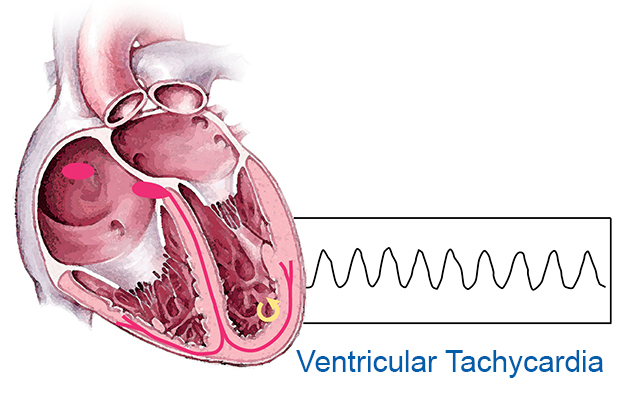
ventricular tachycardia
DisorderWikipedia
199
MENTIONS
21
EPISODES
19
PODCASTS
Search complete. 199 mentions across 21 episodes found for "ventricular tachycardia".
Nov 2, 2026

RezaHOST
So I would say this is polymorphic ventricular tachycardia resembling torsades de poin.
RezaHOST
And thinking of conduction disease, it can go both ways.
RezaHOST
Because one of the most common causes of VT is really scar tissue from prior coronary events.
RezaHOST
But I imagine if the heart is unhappy or the conduction system, it can all of a sudden send this electrical discharge.
RezaHOST
So the next main question, and I don't, you know, with monomorphic VT, you can definitely have a pulse and the patient can be talking to you like with a good blood pressure, but I don't know if that's the case with polymorphic.
RezaHOST
So pretty much like you sort of want to shock this patient and Start CPR, well, check a pulse, start CPR, shock, and transfer to the cath lab as soon as you get ROSC for intervention with a coronary injury.
RezaHOST
I'm really curious to see what that, I'm sure like you can predict which vessel is based on this polymorphic CT.
RabihHOST
Mr. opponent had rose risen from 367 to 1500.

John MandrolaHOST
But even this does not cinch the diagnosis of syncope, right? Because oodles of people can have nocturnal pauses of six seconds from sleep apnea, and this is not the cause of their syncopal event.
John MandrolaHOST
Many more people probably have non-sustained VT on a 14-day patch that has no relationship to their syncopal event.
John MandrolaHOST
But it's been argued whether we should do these 14-day patches in patients with undiagnosed syncope.
John MandrolaHOST
So the primary outcome of this trial was patient-reported syncopal episodes after one year.
John MandrolaHOST
Clinically significant arrhythmia noted on the patch, 22.0 versus 9.0, so that's an odds ratio of 2.95, almost 3x.
John MandrolaHOST
And it was found sooner with the ECG patch, 22 versus 54 days.
John MandrolaHOST
Now, clinically significant arrhythmia was defined as non-sustained VT, greater than 120 beats per minute for greater than 4 beats, pause greater than 6 seconds, sinus brady, less than 30 beats per minute, bradycardia, less than 40 beats per minute for greater than 30 seconds, sustained ventricular tachycardia, or Mobitz 2 or complete heart block.
John MandrolaHOST
All of these were considered... significant arrhythmias.

MikeHOST
So let's talk about a clinical topic to end this.
MikeHOST
And we're going to talk again about the VTAC thing because I think it needs to come up.
MikeHOST
You've always heard me say that when I have exposure to a topic and I think, oh, I'm going to talk about that on the coffee talk, the topic repeatedly starts to come up again.
MikeHOST
So I went to the Code Conference in the Poconos and I attended a really good lecture.
MikeHOST
I thought it was absolutely fantastic.
MikeHOST
I started like waving my pom poms in the back and was, you know, like an old lady in church, like, that's right.
MikeHOST
When he started talking about wide complex tachycardia and how If you see regular wide complex tachycardia, it is almost certainly going to be VTAC.
MikeHOST
And how nobody believes that it's VTAC.

Ajay KadakkalGUEST
One, the implications of identifying those people with AFib, that can be a cult to make sure you're protecting them from stroke risk with appropriate anticoagulation.
Ajay KadakkalGUEST
And also, if you do identify a preponderance of non-sustained VT, you would want to kind of do further risk stratification for defibrillator therapy.
Ajay KadakkalGUEST
Historically, amyloid patients were often recommended not to pursue defibrillator therapy with the thought process being that infiltrated fibrils increased the defibrillation threshold and made for less successful ICD shock therapy.
Ajay KadakkalGUEST
That has since been disproven, and ICD therapy remains indicative for those amyloid patients that have ventricular arrhythmias with an expected survival based on their staging of their AL amyloid doses of greater than one year.

Nick OveringtonHOST
And then we really want to keep doing repeat ECGs and monitor for dynamic changes.
Nick OveringtonHOST
We want to keep that plan in the back of our mind that if this patient does deteriorate and, you know, goes into VF or VT or something like that, we can administer a shock quite rapidly.
Nick OveringtonHOST
with these patients, you know, if they do go into those rhythms, we know that the shock is the treatment and hopefully that shock is just going to be what works and we don't even need to commence CPR, but being prepared if we do.
Megan CurrieHOST
That's probably a good point.
Nick OveringtonHOST
We know there's a thrombus and we know that that's definitively the cause and we know that treatment for that is PCI.
Nick OveringtonHOST
So getting them towards that PCI facility is key.
Megan CurrieHOST
And even if you deliver a shock or, you know, if they do go into a conscious VT and you give them amiodarone or whatever it may be, that clot is still going to be there.
Megan CurrieHOST
That occlusion is still going to be there and they need the PCI.

speaker_0UNKNOWN
Thank you.
Niraj SharmaHOST
Seeing the letters VT on a heart report can be confusing.
Niraj SharmaHOST
You may wonder what they mean, how serious the problem is, and what happens next.
Niraj SharmaHOST
Today, we'll work through those questions one step at a time.
Niraj SharmaHOST
please share this podcast with your healthcare team.
Niraj SharmaHOST
They can help you understand what applies to you.
Niraj SharmaHOST
VT stands for ventricular tachycardia.
Niraj SharmaHOST
That is a fast heart rhythm that starts in the heart's lower chambers.

Venu MenonGUEST
You know, like in the SCUD heft trial, patients with an ejection fraction less than 40%, New York Heart Association Class 2, Class 3 benefited from an ICD in that time period.
Venu MenonGUEST
as well as in MADIT1, if you had non-sustained VT more than three to ten days after an acute myocardial infarction, and those people went on to have an EP study, which we don't do now, and if they had sustained VT in that study, not suppressed by procainamide, there was a dramatic mortality benefit.
Venu MenonGUEST
So all of these are groups in which there is definite benefit for an ICD.
Venu MenonGUEST
Now, I said the way the guidelines are written now, it is because of the inclusion criteria that led to the randomized clinical trials that were done in clinical practice.
Venu MenonGUEST
So let's take, for example, here's a person who comes in with an LAD infarction and has a non-ejection fraction of 25%.
Venu MenonGUEST
They now have an inferior wall MI and their EF is 20%.
Venu MenonGUEST
And three days after hospitalization, they have a 28-beat run of non-sustained VT with some hypotension.
Venu MenonGUEST
That person's at extremely high risk for sudden cardiac death from VT.

Kamoa TamarisaGUEST
For the emergency management of Torsada Point, treating with IV magnesium and emergent cardioversion is the same, just like the ACLS protocols we use.
Kamoa TamarisaGUEST
Now moving on to CPVT.
Kamoa TamarisaGUEST
CPVT tends to be rare and not as common, but it also needs preconception planning, medication management, and monitoring.
Kamoa TamarisaGUEST
In the preconception planning stage, confirming ventricular arrhythmias and also seeing if they are suppressed using exercise stress test is very important.
Kamoa TamarisaGUEST
Discussing with the patient regarding preferred beta blockers, And the risk to benefit ratio of flaconide used during pregnancy is also important.

MeganHOST
really happen.
KateHOST
What do we think about what the writers got right? I mean, I think the wide complex tachycardia that they shocked isn't appropriate, right? If we're calling that VTAC, right? I think calcium gluke, like we said, is a treatment for hyperkalemia.
KateHOST
And he's not right.
KateHOST
He's not wrong.

DevinHOST
Sometimes.
Michael DeFilippoGUEST
We'll be beep bopping around and not realize that someone is in VT. Beep bop.
Michael DeFilippoGUEST
So, you know, essentially just what are all the other things we're looking at on a 12 lead EKG there? And I think, you know, the way I like to break it down is whenever I'm handed a 12 lead EKG, yes, first thing I'm looking for, and there's lots of faults to the STEMI system.
Michael DeFilippoGUEST
See our other podcasts related to that.
10 MINS LATER
Michael DeFilippoGUEST
Eventually you can get a sine wave, right? in severe states.
Michael DeFilippoGUEST
Your EKG is very, very sensitive at picking up electrolyte abnormalities.
Michael DeFilippoGUEST
So what you were talking about was, you know, theoretical case of someone going into VT and let's say you take blood real quick and just see, okay, I'm suspicious this is related to potassium, right? I'm curious and I want to check.
Michael DeFilippoGUEST
They could have totally normal electrolytes.
11 more episodes mention ventricular tachycardia.
Create an account to see the whole feed, search across every transcript, and follow the entities you care about.