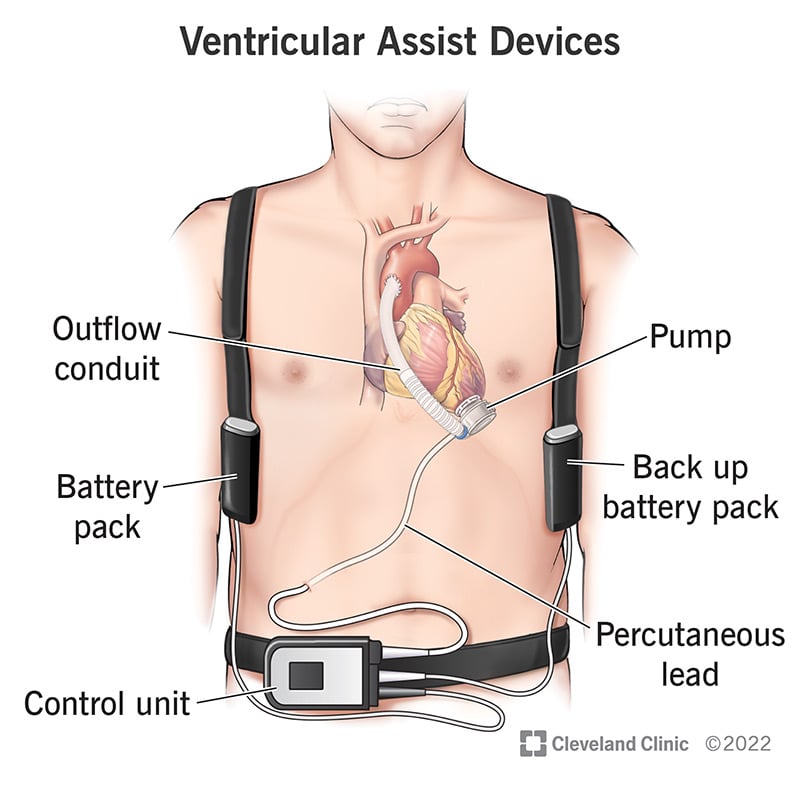
Ventricular assist device
110
MENTIONS
34
EPISODES
32
PODCASTS
Search complete. 110 mentions across 34 episodes found for "Ventricular assist device".
Nov 3, 2026

Heerajnarain BulluckGUEST
I am a consultant cardiologist from Leeds Teaching Hospital NHS Trust from the United Kingdom, and thank you for listening to this Jack Asia podcast.
Heerajnarain BulluckGUEST
Today I'm discussing an original research article titled, Real-World Evaluation of a Nationally Mandated Risk Stratification Tool for Destination Therapy LVAD in Japan.
Heerajnarain BulluckGUEST
It comes from JMAC investigators led by Dr. Tehuriko Imamura at the University of Toyama, drawing on Japanese registry for mechanically assisted circulatory support.
Heerajnarain BulluckGUEST
Let me set the scene.

Peter MarigoldGUEST
We will perform heart transplants or implant what's called a heart pump.
Peter MarigoldGUEST
The fancy name for it is an LVAD or left ventricle assist device.
Peter MarigoldGUEST
That in particular is, it's a machine, it's a pump that with open heart surgery gets put inside of the heart and it does the work of the heart for you.
Peter MarigoldGUEST
And you live off of that pump and it runs off of batteries.

Heather PierceHOST
And then he was a candidate for a machine.
Heather PierceHOST
It's basically a machine and device that's called an LVAD device.
Jeremy CarrHOST
Left ventricle assist device.
Jeremy CarrHOST
Yes.
Jeremy CarrHOST
Very close.
Heather PierceHOST
Very, and not something that's common, like only 14,000 people or something in the US have this thing.
Heather PierceHOST
And so he's going to talk extensively about his story there, what the LVAD has done for him in
Jeremy CarrHOST
all

Eiran Z. GorodeskiGUEST
Yeah.
Eiran Z. GorodeskiGUEST
So very briefly, for patients who have advanced heart failure, stage D heart failure, usually the trajectories are They may become candidates for advanced heart failure therapies, which in my world are either mechanical heart pumps called LVADs, left ventricular assist devices, or candidates for getting a heart transplant.
Eiran Z. GorodeskiGUEST
Those are advanced heart failure therapies, LVAD and transplant.
Eiran Z. GorodeskiGUEST
if it's either not desired by the patient or they don't qualify for one of many reasons for these advanced therapies, it's about trying to figure out a combination of treatments that really makes quality of life as good as it can be for the time that people have left.
Eiran Z. GorodeskiGUEST
And these medicines force the heart not to squeeze as hard and people feel better.
Eiran Z. GorodeskiGUEST
So these things are really on the cutting edge.
Eiran Z. GorodeskiGUEST
We mentioned LVADs before, these left ventricular assist devices.
Eiran Z. GorodeskiGUEST
One of the downsides about LVADS right now is that these pumps, after the surgeon connects them, implants them and connects them to the heart, the patient has to live with a driveline, which is a wire that is threaded through their body and comes out of their skin at the level of the abdomen.
Darshan BrahmbhattHOST
Welcome to the October 2026 edition of our podcast that includes a summary of three highlights from this month's issue.
Darshan BrahmbhattHOST
You hear about the coincidence of cognitive impairment with acute coronary syndrome, non-invasive treatment of premature ventricular contractions with yoga, but first we look at a study that attempts to predict right ventricular failure associated with durable LVAD therapy.
Darshan BrahmbhattHOST
The study, Ventricular Strain Predicts the Risk of Right Heart Failure After Durable Left Ventricular Assistive Ice Implantation, is by Dr. Schaefer and Senior Author Dr. Seltzman from the University of Utah, Salt Lake City, Utah, USA.
Darshan BrahmbhattHOST
Right heart failure is prevalent after left ventricular assist device or LVAD implantation and associated with poor short and long-term outcomes.
Darshan BrahmbhattHOST
The interaction of the right ventricle and its afterload before LVAD implantation may impact the incidence of right heart failure.
Darshan BrahmbhattHOST
The aim of this study was to investigate RV pulmonary artery coupling indices derived from fusing myocardial strain imaging and invasive hemodynamics for the potential to predict right heart failure or the need for right ventricular assist device or RVAD.
Darshan BrahmbhattHOST
288 patients underwent a retrospective imaging analysis to yield RVPA coupling indices fused from right ventricular free wall strain or right ventricular global longitudinal strain with systolic pulmonary artery pressure.

Judy ThompsonHOST
that's fantastic I can see, personally, I mean, I'm just thinking through it, hepatic patients that like to use...
Jamie HeppsGUEST
Yeah, I mean, we have a huge LVAD population in the unit that we work.
Jamie HeppsGUEST
So those, they always were hyper anticoagulated.
Jamie HeppsGUEST
They needed to be with higher INRs and everything.

Nick TemanHOST
And so moving on to my second case, which is also a difficult case.
Nick TemanHOST
So this is a redo heart transplant or a redo sternotomy with a heart transplant and explanting an LVAD.
Nick TemanHOST
And, you know, these kids are just a mess.
Nick TemanHOST
They're using from everywhere.

Ryan KearnsHOST
God damn it, Izzy.
Ryan KearnsHOST
First the LVAD and now this.
Ryan KearnsHOST
Izzy cut the
Jane MulcahyHOST
LVAD wire.
Jane MulcahyHOST
So back at the dispatch station, Maddie is handling it.
Jane MulcahyHOST
Okay.

Rhea TemmermandHOST
It could be a bridge to a decision, like we just need more time to figure out the next step.
Rhea TemmermandHOST
It can be a bridge to transplant.
Rhea TemmermandHOST
Or for durable LVADs, it can be a destination therapy, which means that the device is just a long-term treatment, not a bridge to anything.
Rhea TemmermandHOST
In fact, say the majority of durable elevats today are placed as destination therapy.
Sachi LordHOST
Hey guys, thanks so much for listening.

GinoHOST
Look, Anytime a black ooze can save your life, you just got to do it.
Noelle GriecoGUEST
And I feel like there are some things that you do have to wear in order to, like, maintain, like, your heartbeat and stuff like that, like an LVAD and stuff.
Noelle GriecoGUEST
So I didn't know if they were also trying to refer to, like, other medical devices that you have to, like, wear on your person in order to, like... keep your heart beating or other things like that.
Noelle GriecoGUEST
So I didn't know how much it was like, okay, this is directly related to blood and IV and PICC line versus also a stand-in for other medical equipment.
24 more episodes mention Ventricular assist device.
Create an account to see the whole feed, search across every transcript, and follow the entities you care about.