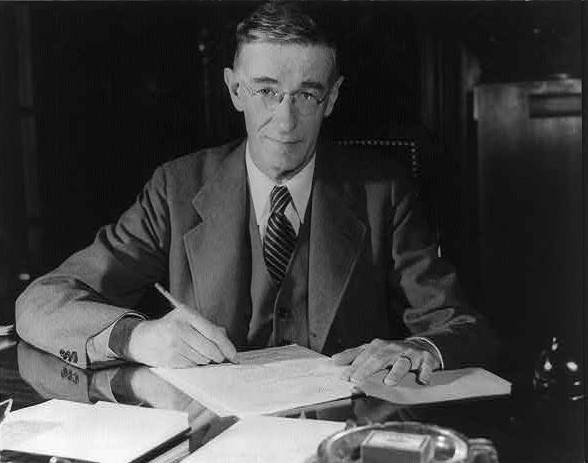
Vannevar Bush
American engineer and inventorWikipedia
56
MENTIONS
30
EPISODES
28
PODCASTS
Search complete. 56 mentions across 30 episodes found for "Vannevar Bush".
Sep 30, 2026

Andrew ScullGUEST
the veterans hospital suffering from psychiatric disorders some of them getting lobotomies huge need for trained professional manpower and this is a period where america transforms itself the war has meant mass mobilization the breakdown of the constraints on the federal government the advent of massive intervention into the economy and into everything else, the birth of the modern research university.
Andrew ScullGUEST
Vannevar Bush, who's the science advisor, writes a very famous book on the need for big science, the need for the government to invest in science.
Andrew ScullGUEST
Science has contributed to winning the war, most obviously in the atom bomb.
Andrew ScullGUEST
But in radar in all kinds of ways.

Jesse MichelsHOST
More on exactly how they got there later.
Jesse MichelsHOST
But every name on their list traces back to the same wartime science network run by one man, Vannevar Bush, which means whoever was making these calls wasn't improvising, and they probably came from the deepest part of America's nuclear program.
Jesse MichelsHOST
So I mean 100 feet.
Jesse MichelsHOST
Have you guys measured out how big 100 feet would've been? Like, what's the si- I'm bad with, like, scale.
33 MINS LATER
Scott RamseyGUEST
Health problems can be solved.
Scott RamseyGUEST
He's going down this wish list that any scientist would love to be able to say, and he says, "We have this technology now."
Jesse MichelsHOST
And he worked closely with Vannevar Bush.
Jesse MichelsHOST
He-

speaker_0HOST
The site itself appears altered, with symmetrical clearing that doesn't match the surrounding landscape.
speaker_0HOST
And Michels connects Aztec to a larger secrecy network, wartime science circles around Vannevar Bush, radar development, and the government's intense interest in anything linked to atomic research.
speaker_2HOST
So the crash wasn't just an accident, but a problem the state moved quickly to control?
speaker_0HOST
Precisely.

Casey DreierGUEST
this"?Yeah, I mean, I think that really goes back to the whole World War II experience, right, where technology basically helped won- win the war.
Casey DreierGUEST
And the Vannevar Bush, who wrote Science, The Endless Frontier, one of my favorite, you know, found- founding documents of fundamental science policy, saying that fundamental science, exploratory science, uncertain outcome science, not applied science, uh, is actually critical to the long-term health and survival of a nation, security of a nation, not just for public health, but also for, you know, they just come out of, you know, if the Nazis had gotten the atom bomb, World War II would've gone very differently, right? Inventions of radar, uh, other fundamental technologies, even things like penicillin in terms of treating troops.
Casey DreierGUEST
All of these types of fundamental investments fundamentally changed the US relationship and, and this idea of this kind of growing and active federal government.
Casey DreierGUEST
Uh, he wrote this report to Roosevelt.

Barry WerthGUEST
Absolutely.
Barry WerthGUEST
Though he was not a chemist or a biologist, he was an electrical engineer, built one of the first room-sized analog computers.
Barry WerthGUEST
Vannevar Bush and a number of other scientific administrators began meeting in 1940 and surveyed the American scientific infrastructure and found that that it was not well-organized, it was not competitive, certainly with the Germans who had the best science in the world, certainly the best chemistry in the world.
Barry WerthGUEST
And Bush and these other administrators decided to approach Franklin Roosevelt.

Harper ReedGUEST
I don't say this, it's just some irrational thing that just popped up.
Harper ReedGUEST
A lot of the United States' prowess post-World War II came directly from innovations around Silicon Valley, from Vannevar Bush on.
Harper ReedGUEST
And I think that's important, right? Like it's important to acknowledge that that's a real thing.
Harper ReedGUEST
The world's most, you know, some of the world's most our biggest and best companies came from that area.

Harper ReedGUEST
I don't say this, it's just some irrational thing that just popped up.
Harper ReedGUEST
A lot of the United States' prowess post-World War II came directly from innovations around Silicon Valley, from Vannevar Bush on.
Harper ReedGUEST
And I think that's important, right? Like it's important to acknowledge that that's a real thing.
Harper ReedGUEST
The world's most, you know, some of the world's most our biggest and best companies came from that area.

MarkHOST
So on a wartime supply chain where every pound of cargo space is contested, that's the difference between, you know, you getting mail and no mail.
ReneeHOST
And in 1945, Vannevar Bush writes the often quoted article, As We May Think in the Atlantic that July.
ReneeHOST
The memex is in there and the people remember it as a prophecy of the internet.
ReneeHOST
What it actually is mechanically is a desk full of microfilm with a screen on top and a way of linking one frame to another.

Daniel SheehanGUEST
You know, after it was created by the National Security Act of 1947.
Daniel SheehanGUEST
But you had Vannevar Bush was on it.
Daniel SheehanGUEST
Hoyt Vandenberg, that they've named Vandenberg Air Force Base after, was on it.
Daniel SheehanGUEST
James Forrestal was on it, was the Secretary of Defense.

Stefanie HutkaGUEST
And then we can expand that out.
Stefanie HutkaGUEST
We were talking about earlier, and I was talking to my students about this classic human-computer interaction paper, as we may think, by Vannevar Bush from 1945, his memex, this portmanteau of memory expansion, sort of the precursor to, it literally looks like a desktop being a precursor to the internet and so on and so forth, this idea that we're expanding human cognition.
Stefanie HutkaGUEST
So there's this kind of through line, and I think being a practitioner in the UX world as generative AI was coming online, it started to feel like we kind of lost the plot in some ways, or there's certainly a big risk of losing the plot.
Stefanie HutkaGUEST
And I talk about that in the book and particularly get into the deeper philosophy behind that in the final chapter.
20 more episodes mention Vannevar Bush.
Create an account to see the whole feed, search across every transcript, and follow the entities you care about.