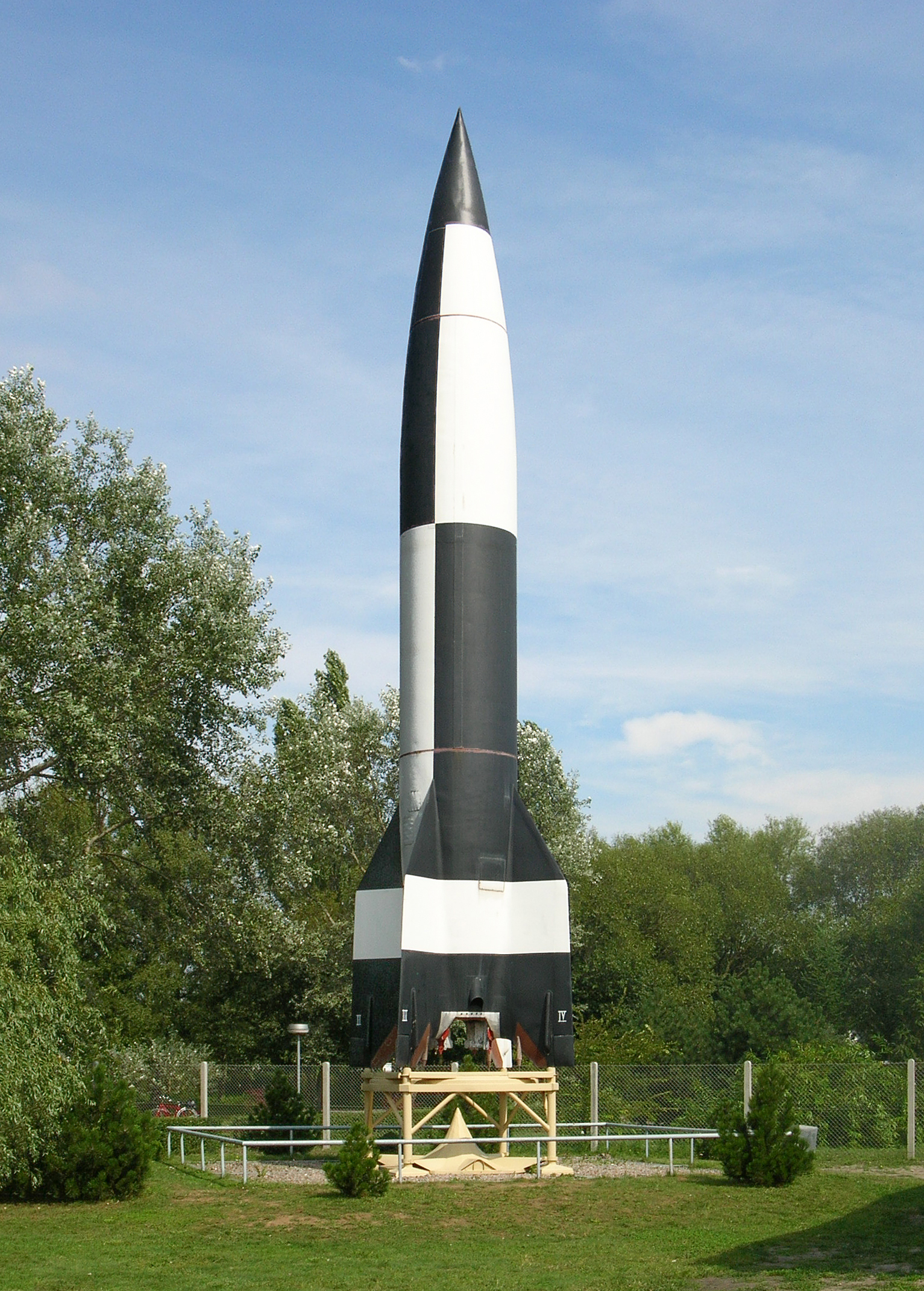
V-2 rocket
33
MENTIONS
10
EPISODES
9
PODCASTS
Search complete. 33 mentions across 10 episodes found for "V-2 rocket".
Sep 18, 2026

Stuart GaryHOST
Once operational, Spectrum will carry payloads of up to 1,000 kilograms into low Earth orbit with an expected cadence of around 30 launches a year.
Stuart GaryHOST
Now, for the record, the first European rocket to reach space was a Nazi V-2 rocket, which was launched from Peenemünde back on June the 20th, 1944.
Stuart GaryHOST
This was the first successful German V-2 launch to exceed the Kármán line, the internationally recognised 100-kilometre boundary where space begins.
Stuart GaryHOST
It reached an apogee of approximately 176 kilometres, making it the first man-made object to enter outer space and the first suborbital spaceflight.
Stuart GaryHOST
It was part of a series of vertical test launches that June to study the rocket's behaviour in the near vacuum of space.
Stuart GaryHOST
Another launch also in June 1944 reached an even higher altitude of around 179 kilometres.
Stuart GaryHOST
The first successful V-2 flight overall was back on October 3, 1942, also from Peenemünde.
Stuart GaryHOST
It reached somewhere between 85 and 90 kilometres in altitude, which the Nazis celebrated as reaching the edge of space, but in reality didn't cross the Kármán line.

Matt BrackenGUEST
The Army wouldn't buy it 'cause they said, "That's not as good as artillery." You know, Goddard gave the plans to the world.
Matt BrackenGUEST
The Germans picked up the plans at the, uh, Library of Congress and made the V-2 rocket that hit London using Goddard's liquid-fueled plan.
Matt BrackenGUEST
This is not new technology.
Matt BrackenGUEST
It's century-old technology.

QuinnHOST
When Mittelwerk was captured, it was in full production mode, and US troops seized enough parts and hardware to build over 100 missiles.
QuinnHOST
Over in the States, the military started a campaign of test launches using the V2s as what we call sounding rockets.
QuinnHOST
Now, if you don't know what a sounding rocket is, a sounding rocket is designed to be small, cheap-
Other ChrisHOST
It doesn't go where you think it goes.
QuinnHOST
Listener, I apologize.
Other ChrisHOST
Either way, took resources away from the reactor because he jacked up his staging.
QuinnHOST
And we, well, I mean Americans, you, took resources away from Nazi Germany and shipped those first V2s over to the US, reassembled them in Mexico, and flew them for all kinds of purposes, some of them military, some of them scientific.
QuinnHOST
One of them landed in Mexico.

Tail DraggerHOST
They were looking at the V-weapons program.
Tail DraggerHOST
The V-1 flying bombs and the V-2 ballistic rockets that would later devastate London.
Tail DraggerHOST
The intelligence extracted from those Mosquito photographs, flown through some of the most heavily defended airspace in Germany, led directly to Operation Hydra in August of 1943, the Bomber Command raid that set the V-2 program back by months and may have prevented a much earlier and more intensive bombardment of southern England.
Tail DraggerHOST
Two Merlin engines and a camera in a wooden airframe.
Tail DraggerHOST
That is what bought those months.

Alice RobertsHOST
We now move from British planes to German military hardware.
Alice RobertsHOST
One of the most destructive weapons developed by Nazi Germany was the V2 rocket, the forerunner to later ballistic missiles.
Alice RobertsHOST
Each rocket bore a warhead containing 900 kilograms of explosives, and it's thought that around 3,000 rockets were launched at Allied targets during the Second World War.
Alice RobertsHOST
We now join two brothers who are on the search for a V2 rocket, which fortunately never hit its target and ended up in a farmer's field.
Alice RobertsHOST
The hunt is focused near the village of Marden in Kent.
Alice RobertsHOST
Amateur military archaeologists Colin and Sean Welsh are on the trail of a V2 that struck here at 2.15 a.m. on the 9th of March, 1945.
Alice RobertsHOST
Aerial imagery taken after the war shows it came down in this field.
Sean WelshGUEST
We've excavated several V2 rockets and V1 flying bombs, so I'm afraid to say we've become experts.
speaker_0NARRATOR
The Heverswerksstelle Pinamunde, abbreviated as HVP, became one of five military proving grounds and the site for the development of several World War II guided missiles.
speaker_0NARRATOR
The most notorious was the world's first operational liquid fuel rocket, the V-2, known to its designers as the A-4.
speaker_0NARRATOR
The V-2 rocket was the progenitor of all modern rockets and a direct forerunner of the Saturn V moon rocket.
speaker_0NARRATOR
It was the first ballistic missile and the first man-made object launched into space.
speaker_0NARRATOR
It also took an extraordinary amount of testing to get right.
speaker_0NARRATOR
When finally used against the Allies in World War II, V-2 rockets were responsible for the deaths of around 7,000 people, but 20,000 had died during construction of them.
speaker_0NARRATOR
Most of those were slave labour workers from the Mittelbau-Dora concentration camp As Roy Irons pointed out in his book, Hitler's Terror Weapons, however, by 1943 the Germans were doing so badly in the war that Hitler was determined to press on with testing the weapon in order to build German morale and show his troops the war was still winnable.
speaker_0NARRATOR
But still the testing gave rise to embarrassments and mistakes.

Gregory FoleyHOST
Cheap, lightweight, radio-controlled target drones for use, again, in training.
Gregory FoleyHOST
If you listened to the Lions Led by Donkeys episode on Operations Aphrodite and Anvil, You'll recall that the US Air Force and Navy, respectively, had both experimented with converting retired aircraft into remote-controlled bombs loaded with explosives to be flown into high-value targets like German U-boat pens and factories producing the Nazis' deadly V-1 and V-2 rocket systems.
Gregory FoleyHOST
You can listen to Lions to learn how that endeavour went.
Gregory FoleyHOST
Not well.
Gregory FoleyHOST
And supposedly, they did build a small number of them which had been fitted with a downward-facing video camera so they could be used for reconnaissance missions.
Gregory FoleyHOST
And this is an innovation which prefigured the next phase in the drone's evolution.
Gregory FoleyHOST
Moving into the 1950s, the US did continue producing a number of target drones, but when it came to the subject of pilotless aircraft, their energies were mostly dedicated to guided missiles like the V-1 and the V-2.
Gregory FoleyHOST
Because for things like reconnaissance and surveillance, they had the state-of-the-art U-2 spy plane.

speaker_10VOICE_ACTOR
Trojan? Trojan.
speaker_10VOICE_ACTOR
There's been an alert at factories producing parts for V-1 and V-2 rockets to prepare for retooling.
speaker_10VOICE_ACTOR
They're going to
speaker_13VOICE_ACTOR
make the projector? It would seem so, sir.

Rebecca SiegelHOST
I'll take 2,000 a month, but I don't like the name.
Rebecca SiegelHOST
Let's call it a Vengeance Weapon 2." And that reflects his creativity because he'd already had a Vengeance Weapon 1, so now it's the Vengeance Weapon 2, which they nicknamed the V-2.
Rebecca SiegelHOST
And Wernher was like, "Okay, love the name.
Rebecca SiegelHOST
That's so amazing, but it's definitely not ready yet.
Rebecca SiegelHOST
Okay.
Rebecca SiegelHOST
Well, let's rebuild our rocket facility, but this time around let's do it in an underground hellscape staffed by starving slave laborers." And that's what they did.
Rebecca SiegelHOST
Production of the A-4/V-2 moved to an underground facility called Mittelwerk, which was part of the Dora concentration camp.
Rebecca SiegelHOST
And Wernher was not part of the decision-making process there.

speaker_0NARRATOR
His name sat in the story like an anchor, lending it a weight that Anetti's credentials alone could never have provided.
speaker_0NARRATOR
And there was another name, Werner von Braun, the German-born rocket engineer who had designed the V-2 rocket during the Second World War and then, after his controversial recruitment by the United States through Operation Paperclip, had led the development of the Saturn V rocket that carried astronauts to the Moon.
speaker_0NARRATOR
Von Braun had died in 1977, a few years after the claim was first published.
speaker_0NARRATOR
Like Fermi, he was beyond reach.