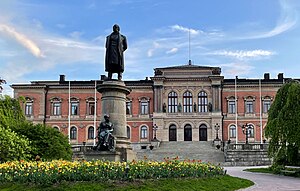
Uppsala University
Public university in Uppsala, SwedenWikipedia
21
MENTIONS
19
EPISODES
19
PODCASTS
Search complete. 21 mentions across 19 episodes found for "Uppsala University".
Sep 15, 2026

Chris McKennellGUEST
... theory is going in the same dir- They're all coming from different perspectives, but they're all pointing at the same thing.
Chris McKennellGUEST
There was a, a wonderful paper by a woman, uh, uh, re- an extremely respected, uh, mater- uh, scientist in Uppsala University.
Chris McKennellGUEST
Her name is, uh, Professor Maria Strom.
Chris McKennellGUEST
And she put out a paper on universal consciousness in November that points to exactly the same ideas that my academic paper points to.

Jean GomesHOST
She's published over 160 articles in peer-reviewed journals and books on healthcare.
Jean GomesHOST
She holds various roles at universities across the world, including Harvard Medical School, University of Melbourne, Australia, and Uppsala University in Sweden.
Jean GomesHOST
So let's get into it.
Scott AllenderHOST
Welcome to the mindset economy.

Charlotte BungeGUEST
Always with that, it's not so easy if we just like generalize that around the world.
Chhavi SachdevHOST
Charlotte Bunge is a researcher at Uppsala University in Sweden, and she studies how plant-based alternatives might help with the global transition to more healthy and sustainable diets.
Charlotte BungeGUEST
There are very, very different ways of producing livestock, so I think it's also important when we talk about that, that we are talking primarily about this very industrial livestock production that we're having in the world.
Chhavi SachdevHOST
As she points out, we have to be careful about generalizing when talking about meat production.

Andrew Hunter MurrayHOST
[laughs]
James HarkinHOST
Any fans of, um, Uppsala University in?
Dan SchreiberHOST
Whoo.
James HarkinHOST
Oh, really? Oh, yes, that's what I was expecting.

Hank GreenHOST
the linden trees that grew on his family's homestead.
Hank GreenHOST
Linnaeus got a medical degree and became a professor at Uppsala University, where he devoted himself to the study of nomenclature.
Hank GreenHOST
He had his students go to places and bring back specimens for him to study and categorize.
Hank GreenHOST
The method he eventually adopted was based on morphology, or physical form and structure.

David FergusonHOST
He received the Nobel Prize on December 10, 1903, in recognition of his theory of electrolytic dissociation.
David FergusonHOST
His father, Svante Gustaf Arrhenius, held a position at the University of Uppsala.
David FergusonHOST
His uncle, Johan Arrhenius, was a botanist writer and a long-time secretary of the Swedish Agricultural Academy in Stockholm.
David FergusonHOST
Svante Arrhenius was an outstanding student in school.
David FergusonHOST
His physics teacher was M. Friedrichs.
David FergusonHOST
author of the most popular contemporary Swedish secondary school physics textbook.
David FergusonHOST
His university degrees were all from the University of Uppsala.
David FergusonHOST
Definitely a chemist that worked hard.

Shawn RoskeGUEST
And always I did have this question in my, my design background I was influencing on how to, how to make a challenging game that, uh, has people in a safe container where they can explore challenging subject matter.
Shawn RoskeGUEST
So I've, I've been doing that for years and I, I've followed along the work of many really, um, cutting edge designers and thinkers in this sphere, such as Dr. Sarah Lynne Bowman who operates out of Uppsala University, and she's part of the Transformative Play Initiative there.
Shawn RoskeGUEST
And they produced a, I think a landmark textbook on transformative play.
Shawn RoskeGUEST
Uh, we drew upon that, that book actually heavily when we were doing our presentation to explain to our audience the design background for this, for this therapeutic tool we designed.

speaker_2NARRATOR
Our guest, Carl-Oskar Bohlin, has served as Sweden's Minister for Civil Defense since 2022.
speaker_2NARRATOR
Bohlin has been a member of Sweden's parliament, the Riksdag, since 2010 and completed law courses at Uppsala University.
speaker_2NARRATOR
As Minister for Civil Defense, he plays a central role in strengthening Sweden's resilience against both natural and man-made threats, and holds the distinction of being Sweden's first Minister for Civil Defense since 1947, reflecting the country's renewed and urgent emphasis on comprehensive national security.
speaker_2NARRATOR
Sweden's total defense concept integrates military and civil defense to build national resilience to a variety of threats, including but not limited to extreme weather, pandemics, cyberattacks, terrorism, nuclear attacks, and full-scale war.

David BorysHOST
I'm a military historian, and this is Hostile History, a podcast where we go inside some of the most defining conflicts and rebellions.
David BorysHOST
In this episode, I'm joined by Margaret Hunt, emeritus from Uppsala University in Sweden, as we travel Europe between the 15th and 17th centuries to tear down misconceptions.
David BorysHOST
Camp followers and conscripts, women in Europe's early modern armies.
David BorysHOST
When you think of war in the past, it's easy to assume that conflicts were fought by men.
Margaret HuntGUEST
Now, those impoverished populations are also the groups from which soldiers tend to come.
Margaret HuntGUEST
So what this means for the study of, well, war, women, men, is that there's, I would say, a lot more focus today on what war means for a lot of different people other than those particular guys who end up on the battlefield.
David BorysHOST
Margaret Hunt, a professor emeritus from Uppsala University in Sweden, says the key to understanding women's roles in modern warfare is to first look and understand how war is funded, because war isn't just all about what happens on the battlefield.
David BorysHOST
And as soon as you broaden your view and include how conflicts impact society at large, you begin to find a lot of people who in past history might have been sidelined as non-combatants.

Terje GansumSOUNDBITE_SPEAKER
And we should be very grateful that it was the Swedish Gustafson who actually did the excavation, and he was a lot more advanced than the Norwegian archeologist used to be.
Eric MeyersNARRATOR
Gustafson had trained at Uppsala University, and he'd gained a wealth of experience excavating many Viking age sites in Sweden, where he'd learned new techniques.
Eric MeyersNARRATOR
The data collected by Gustafson was so comprehensive that in conjunction with the new work done on the bones, Terje was able to interpret the funeral in which the nameless women were laid to rest.
Terje GansumSOUNDBITE_SPEAKER
We saw that we could divide the stages of the building process into several phases.
9 more episodes mention Uppsala University.
Create an account to see the whole feed, search across every transcript, and follow the entities you care about.