Upper Paleolithic
PeriodWikipedia
44
MENTIONS
10
EPISODES
8
PODCASTS
Search complete. 44 mentions across 10 episodes found for "Upper Paleolithic".
Oct 26, 2026

speaker_0NARRATOR
This ability gave them a distinct survival advantage over their Neanderthal counterparts, who relied more on individual strength and instinct.
speaker_0NARRATOR
Furthermore, language allowed for the refinement of toolmaking techniques, The Acheulean hand axes used by Homo erectus gave way to the more sophisticated blade tools of the Upper Paleolithic, which required precise instruction and replication.
speaker_0NARRATOR
Teaching these skills verbally meant that each generation could improve upon the last, accelerating technological advancements.
speaker_0NARRATOR
Language gave us speech, but symbols gave us memory.

Gary MannersHOST
Eastern European sites also show what else a mammoth could provide.
Gary MannersHOST
A 2020 study in Antiquity led by Alexander Pryor on Kostan-Key 11 in Russia noted that circular features made from mammoth bone are known from across Upper Paleolithic Eastern Europe, and are widely identified as dwellings.
Gary MannersHOST
That feature yielded charcoal and burnt bone, though the Missouri paper notes suggestions that the cost and key 11 rings were too large to roof.
Gary MannersHOST
Bone also served as fuel, and here the Boreas team wrote about Breitenbach itself.

Freddie SayersHOST
so
Charles FosterGUEST
Let's scroll back a little bit further in history than we've gone back so far, back to the Upper Paleolithic.
Charles FosterGUEST
So we are basically Upper Paleolithic hunter-gatherers.
Charles FosterGUEST
Strip the Armani suit off a Wall Street broker and you have a caribou hunter beneath.
Charles FosterGUEST
And depending on how you do the calculation, about 90% of our time as behaviourally modern humans has been spent as hunter-gatherers.
Charles FosterGUEST
We can acknowledge that communitarianism is the best type of policy.
Charles FosterGUEST
We can acknowledge that being locked up in our own carapace is a miserable and politically and sociologically deadly way to try to exist.
Charles FosterGUEST
So yeah, we've got to become Upper Paleolithic hunter-gatherers, even if we live in Dollars Hill.

speaker_6GUEST
So in those northern regions, there is identical artifacts and identical skull types.
speaker_6GUEST
And what's really strange about that is that many of them, not only were they large, but had protruding brow ridge, sloped skulls, very upper Paleolithic, very archaic type skulls.
speaker_6GUEST
Now, some of them would eventually become, you know, northern Europeans, but then there was a sect that came out of that.
speaker_6GUEST
And then they ended up over here.
6 MINS LATER
speaker_6GUEST
And many of the Cro-Magnon skeletons were 6'7", 6'8", 7 foot.
speaker_6GUEST
And that also is that Cro-Magnon had protruding brow ridge, more of an archaic-type skull, large jaws, protruding brow ridge.
speaker_6GUEST
I mean, not as pronounced as a Neanderthal, but Upper Paleolithic.
speaker_6GUEST
And that's exactly what we find in England, and it's exactly what we find in Ohio Valley.

JimmyHOST
To him, that was the job description of a shaman in a hunting society, the specialist who travels to the other world to win game from whoever controls the animals and comes back with it.
JimmyHOST
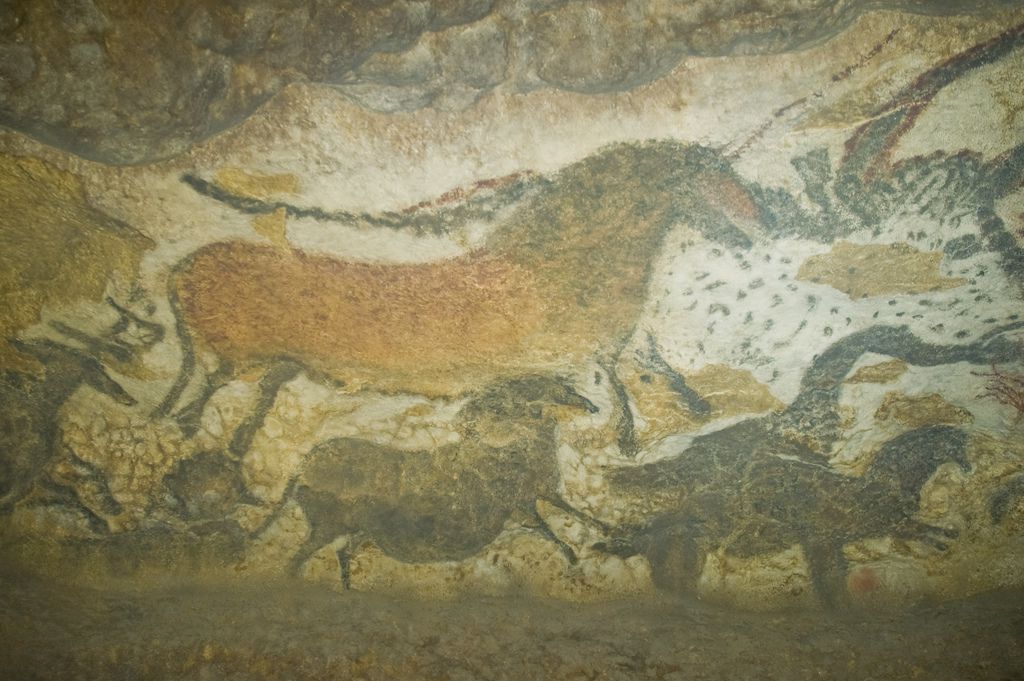
He pointed to the painted caves of the Upper Paleolithic as the horizon where that kind of thinking shows up, which would make the skeleton of the story well over 10,000 years old.
JimmyHOST
Interestingly, none of these theories necessarily cancels the others out.
JimmyHOST
A hunter's tale could pick up a cattle raid on the steppe, borrow a few monsters from Mesopotamia, settle at Tyrens under a Mycenaean king, and get counted off into twelve by a Greek poet.
Graham HancockGUEST
If you check back in the old literature, you can actually find reference to it.
Graham HancockGUEST
F.S. Mariel, the director of the Maltese Museums back in the 60s, didn't like that bison bull figure because it raised the horrible possibility that the hypogeum might date to the Upper Paleolithic rather than to the Daleks.
Graham HancockGUEST
So he solved for Copland by scrubbing it off for water.
Nikki GlaserSOUNDBITE_SPEAKER
Nikki Glaser, the stunning tour.

NickHOST
And Gough's Cave may not have been some isolated community doing something bizarre.
NickHOST
A 2023 study by William Marsh and Sylvia Bello surveyed the late Upper Paleolithic European sites and found a broader pattern among populations associated with the Magdalenian culture tradition.
NickHOST
Of the sites where researchers could determine mortuary behavior, 13 contained evidence interpreted as cannibalism, 10 contained primary burial, and 2 combined both.
NickHOST
Skull cups and other post-mortem modifications appeared repeatedly, and when those practices were compared with ancient genetic ancestry, the authors proposed that funerary cannibalism may have belonged to a wider Magdalenian mortuary tradition that eventually declined as populations carrying different ancestry and different burial customs expanded across Europe.
7 MINS LATER
NickHOST
Yet even Fontbréguat cannot tell us whether the dead were relatives, enemies, captives, or victims of some emergency.
NickHOST
Archaeology can sometimes recover the meal without recovering the reason for it, including carefully modified skull cups that are known from Upper Paleolithic, Neolithic, and Bronze Age contexts, including Gough's Cave, Herxheim, and several Iberian sites.
NickHOST
What emerges is not evidence for one enormous European cannibal culture, but something much stranger.
NickHOST
Different populations, separated by thousands of years, repeatedly discovering that the human corpse could become food, ritual material, an object of transformation, or several of those things simultaneously.