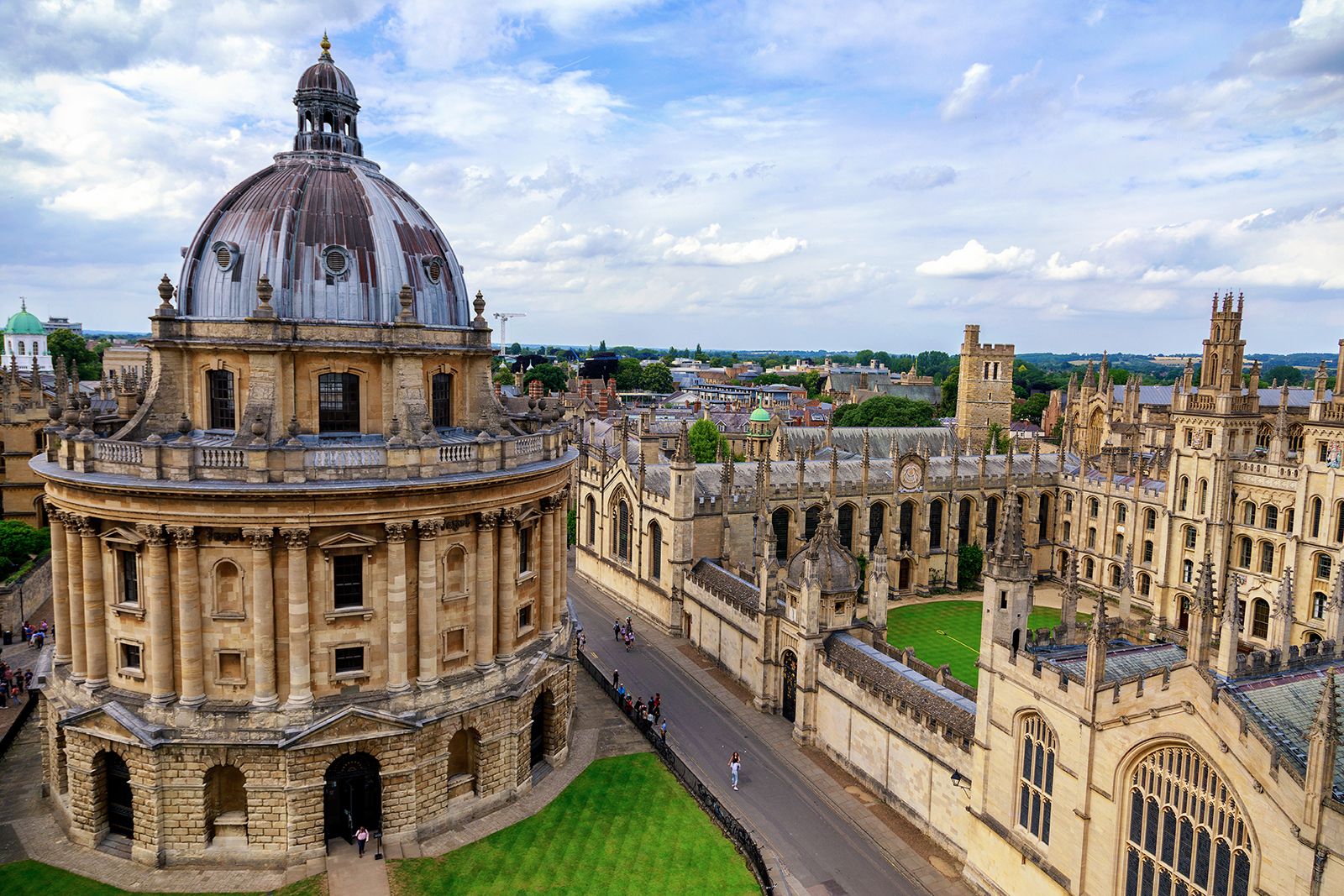
University of Oxford
Research university in Oxford, EnglandWikipedia
1.3k
MENTIONS
811
EPISODES
696
PODCASTS
Search complete. 1290 mentions across 811 episodes found for "University of Oxford".
Sep 22, 2026

Nicola LudinGUEST
There are lots that is sort of missing and we'd really like to address that with sleep solutions and that's what the project's all about.
Jesse MulliganHOST
I understand you're collaborating, University of Auckland, along with National University of Samoa and University of Oxford.
Jesse MulliganHOST
Is that correct?
Nicola LudinGUEST
Yeah, that's absolutely right.

Sebastian HassingerHOST
I'm your host, Sebastian Hassiar.
Sebastian HassingerHOST
[heartbeat] My guest today is Tim Palmer, Royal Society Research Professor Emeritus in Climate Physics at the University of Oxford, senior fellow at the Oxford Martin Institute, and a member of the Oxford Quantum Institute.
Sebastian HassingerHOST
He is a fellow of the Royal Society, a CBE, a recipient of the Institute of Physics Dirac Gold Medal, and a lead author of the IPCC.
Sebastian HassingerHOST
He did his PhD in general relativity at Oxford, partly under Roger Penrose.
Sebastian HassingerHOST
He then spent most of his career at the UK Met Office and the European Centre for Medium-Range Weather Forecasts, where he pioneered the probabilistic ensemble forecasting methods that are now standard in operational weather prediction worldwide.
Sebastian HassingerHOST
That is a lot of biography, and I mention it very much on purpose because I think it's particularly relevant here.
5 MINS LATER
Tim PalmerGUEST
Um, you know, maybe I should just take a few seconds to just talk a little bit about my background.
Tim PalmerGUEST
Um, I, you know, you can probably tell from my accent I'm from the UK.

speaker_0HOST
Right.
speaker_1HOST
And he was the Regis Professor of Modern History at Oxford University.
speaker_0HOST
Which is a huge deal.
speaker_1HOST
Oh, to hold that chair is to be at the absolute pinnacle of the historical profession.

Hector MintoGUEST
So does whoever we want to put a curb cut in.
Hector MintoGUEST
So does the Oxford University.
Hector MintoGUEST
Essentially, they get their data about what conversations are happening around disability and technology.
Hector MintoGUEST
which means that we can have guided, targeted responses to what we're learning about what works and what doesn't work.

Carl Hayden SmithGUEST
And so my sort of inclination was to get people together in groups.
Carl Hayden SmithGUEST
And at Oxford University, we got people to come and shut their eyes for five, six hours and just dive into sound and see how much sound could really transform consciousness.
Carl Hayden SmithGUEST
And that's been an amazing journey with 40 shows so far across the world in very weird and wonderful contexts, including Antarctica and the Amazon, and getting briefs like, can you do a museum of consciousness, just playing sound transmissions to the trees and the plants and the animals and no human audience.
Carl Hayden SmithGUEST
And just getting these sort of weird and wonderful briefs So it's been, yeah, a real pleasure to get to know artists.

Stuart BruceGUEST
But we didn't really do anything externally because I wasn't 100% convinced I was onto something.
Stuart BruceGUEST
And then in April that year, Rupert Younger, who's head of the Center for Corporate Reputation at Oxford SAID, University of Oxford, he published a paper on AI as a stakeholder.
Stuart BruceGUEST
And I'm thinking, ah, I might
Tony GarnerHOST
be onto something here.

Mary IrwinGUEST
A British author, an award-winning author named Catherine Bruton, she writes children's books for ages 8 to 12.
Mary IrwinGUEST
And she went to Oxford University and a professor there suggested that She was looking for a disease to focus on in a book of hers for children that supported children who'd lost siblings to a terrible disease.
Mary IrwinGUEST
And she was pointed in the direction of SMA-PME.
Mary IrwinGUEST
And she found our website, smapme.org. And she came to me and also to Dr. Jeffrey Medin, who is one of our two front-running researchers, along with Dr. Michelle Allen Sharpley in the U.S. We worked together on her book, Tadpole Summer is the name of it.

Type Three AudioNARRATOR
Joe et al.
Type Three AudioNARRATOR
University of Oxford plus geodesic, constitutional mid-training.
Type Three AudioNARRATOR
End quote.
Type Three AudioNARRATOR
We therefore design a controlled synthetic setting to test whether mid-trained motivations hold under these failures of downstream supervision.

Charles FosterGUEST
So edges are where it all happens, and we're better off acknowledging that we're edge people in an edge world.
Dan KieranHOST
And I can't help but draw a comparison with you because you're like a lawyer, veterinary surgeon, you're an academic at Oxford University, and yet, Charles, your stuff is pretty edgy, right? You're quite out there, but you must be pretty out there in the context you're hanging out.
Charles FosterGUEST
I don't think I'm any edgier than almost all the people here at this apparently centrist place, the University of Oxford.
Charles FosterGUEST
Okay,

Brandon JulianHOST
Women who have this body type are at greater risk of having a heart attack than men.
Brandon JulianHOST
The researchers from Oxford University found that having bigger waist and higher waist-to-hip and waist-to-height ratios left women 10-20% more at risk of a heart attack.
Brandon JulianHOST
Having more fat around the waist has also been linked to a raised risk of cancer and diabetes.
Brandon JulianHOST
Jacqui Fenner, a body form expert working with DiLeo, added, "...apple-shaped people are often overweight in the center and above the waist.
801 more episodes mention University of Oxford.
Create an account to see the whole feed, search across every transcript, and follow the entities you care about.