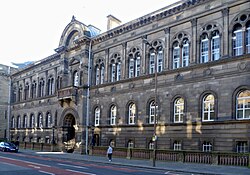
University of Edinburgh Medical School
Medical school in Edinburgh, ScotlandWikipedia
8
MENTIONS
6
EPISODES
6
PODCASTS
Search complete. 8 mentions across 6 episodes found for "University of Edinburgh Medical School".
Nov 23, 2026

Paul LahaneGUEST
Conan Doyle, he was born in Edinburgh in the late 1850s.
Paul LahaneGUEST
into a fairly poor background, where he, through his brightness and diligent studies, got a place at Edinburgh Medical School, where he met his professor, Dr Joseph Bell, who was said by Doyle to be the real inspiration for the character Sherlock Holmes.
Paul LahaneGUEST
You said that People
AdamCORRESPONDENT
used to write letters, still do write letters, asking for the help of Sherlock Holmes.

Paul LahaneGUEST
Conan Doyle, he was born in Edinburgh in the late 1850s.
Paul LahaneGUEST
into a fairly poor background, where he, through his brightness and diligent studies, got a place at Edinburgh Medical School, where he met his professor, Dr Joseph Bell, who was said by Doyle to be the real inspiration for the character Sherlock Holmes.
Paul LahaneGUEST
You said that People
AdamCORRESPONDENT
used to write letters, still do write letters, asking for the help of Sherlock Holmes.

Tony HoskinsHOST
I want to touch upon the family background a little bit, as there is quite a bit of military and civil service within the family history.
Tony HoskinsHOST
So starting with the great-grandfather, Robert Dixon, who was from Dumfries in the Scottish Borders, he studied medicine at Edinburgh University, which has been a world-leading centre for medicine since 1726, when the Edinburgh School of Medicine was first established.
Tony HoskinsHOST
Robert Dixon was a contemporary of Charles Darwin at the Edinburgh School of Medicine.
Tony HoskinsHOST
So as you can see, it was the elite in the medical world at the time.
Tony HoskinsHOST
And so Robert Dixon would have been among the leading physicians of his time.

Sam LeinsterGUEST
One of the students who came to Leiden to study was a Scotsman called John Munro.
Sam LeinsterGUEST
And John Munro went back to Edinburgh, where he hailed from, and he founded Edinburgh Medical School in 1726.
Sam LeinsterGUEST
I'm a graduate of Edinburgh Medical School and we have been very proudly celebrating our 300th anniversary this year.
Sam LeinsterGUEST
When you put it against Bologna and Padua and Salerno, it's not really terribly impressive, but we think it is.
Sam LeinsterGUEST
Things then moved much more widely.

Kojo KoramGUEST
At the age of empire, so much of European imperial wealth was driven by the commercialization of psychotropic substances and not just the ones that then became prohibited in the 20th century, the ones that became integrated in the European diet, the tobaccos, the coffees, the sugar, were traded by shipping companies alongside the opiums and the cannabises.
Kojo KoramGUEST
And I think the real high points of that was the emergence of two Scotsmen, one William Jardine, who studied just down the road at Edinburgh Medical School, from Dunfreesia, who, in my estimation, is the most successful narcotrafficante in human history.
Kojo KoramGUEST
El Chapo Guzman and Pablo Escobar could only wish for the wealth and influence that occurred originally working for the East India Company, pivoting once the East India Company decided to use the trade of opium to rebalance its trade deficit with China.
Kojo KoramGUEST
became an opium smuggler and when the Qing Dynasty of China tried to prohibit the opium smuggling from the British smugglers was able to lobby Lord Palmerston and even design the entirety of the of the war plan in order to facilitate the British Opium Wars.

Alex RichardsHOST
Where did this all start? What's your journey into this world?
Mike O'ReillyGUEST
Well, I trained at Edinburgh Medical School, started in about 1983, and I was always a bit interested in business, I suppose, and working and how that all worked.
Mike O'ReillyGUEST
I remember my mother taking me to parties sometimes, and I would talk to, I think she worked as a secretary for the army, and she would take me along when I was 12 to meet some brigadier general or something, and I And I was quite happy to chat to him about his job.
Mike O'ReillyGUEST
I loved hearing about people's jobs and what they did.